

Wade Davis
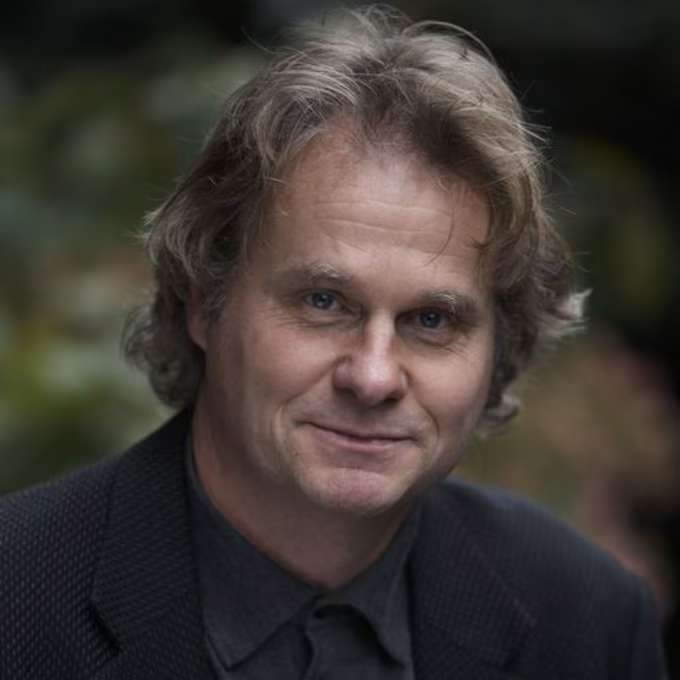
Wade Davis is an ethnographer, writer, photographer, filmmaker, anthropologist and ethnobotanist whose work has taken him from the Amazon and Andes to Haiti, Borneo, Tibet, East Africa, Polynesia, Australia, Colombia and the Arctic.
A Life Shaped by Culture, Plants, and Place
A Harvard-trained scholar, Davis holds degrees in anthropology and biology and earned his Ph.D. in ethnobotany from Harvard University. Through the Harvard Botanical Museum, he spent more than three years in the Amazon and Andes as a plant explorer, living among Indigenous communities and making thousands of botanical collections. His work has long explored the relationship between culture, ecology, traditional knowledge, language, memory and place.
Books, Exploration, and Global Recognition
Davis became widely known for his research in Haiti into folk preparations associated with the creation of zombies, work that led to his books The Serpent and the Rainbow and Passage of Darkness. The Serpent and the Rainbow became an international bestseller and was later adapted into a motion picture.
His many books include One River, The Wayfinders, Light at the Edge of the World, The Lost Amazon, The Clouded Leopard, Shadows in the Sun, Grand Canyon and Into the Silence: The Great War, Mallory, and the Conquest of Everest, which won the 2012 Samuel Johnson Prize for nonfiction. His writing and photography have helped bring global attention to Indigenous knowledge systems, cultural survival, biodiversity and the fragile beauty of the world’s remaining cultural landscapes.
Davis served as Explorer-in-Residence at the National Geographic Society from 2000 to 2013 and is Professor Emeritus of Anthropology at the University of British Columbia, where he held the BC Leadership Chair in Cultures and Ecosystems at Risk. His honors include the Explorers Medal, the Lowell Thomas Medal from The Explorers Club, the Lannan Foundation Prize for literary nonfiction, the Royal Canadian Geographical Society’s Gold Medal and multiple honorary degrees.
Listen to Wade Davis on World Footprints
On World Footprints, Wade Davis joins Tonya and Ian Fitzpatrick in a legacy broadcast that reflects the heart of our mission: travel as a pathway to deeper understanding, cultural respect and global citizenship. In the episode, Davis discusses his travels through Peru, Borneo, Tibet and northern Kenya, offering insight into the people, places and traditions that have shaped his life’s work.
Legacy Show: Descending the Dragon, Travel Adventures, Women’s Voices in Iran
Wade Davis appears in

This broadcast is a favorite legacy show that we produced under our old name Travel'n On and before rebranding as WORLD FOOTPRINTS. National Geographic author Jon Bowermaster talks about his journey down the coast of Vietnam. Then- Canadian anthropologist Wade Davis joins Tonya and Ian to talk about his recent travels to Peru, Borneo, Tibet and northern Kenya. Finally, learn about the Shams Ensemble, one of the first groups to pursue musical independence and freedom of women's voices in Iran, and their current US tour. The Shams Ensemble is a musical ensemble that uses the Tanbur, Daf (frame drum), Ney, and several other percussion instruments to play Sufi, Kurdish folk, and Persian traditional music. In 1977 Keikhosro Pournazeri worked to form the Shams Ensemble in Kermnshh, Iran. He invited a few of his students who were familiar with playing Tenbur, and over time, as they learned the instrument and gained [...]

