
North America

Totem Poles of the First Nations in Vancouver Canada. Photo: Tonya Fitzpatrick
“Through travel I first became aware of the outside world; it was through travel that I found my own introspective way into becoming a part of it.”
– Eudora Welty
Explore the history, diverse cultures and traditions of the North American countries of Canada, Mexico and the United States. North American culture reflects both the cultures of its indigenous people- the Native Americans as well as the culture that is influenced by European Colonization.
The United States is the third largest country in the world and one of the most culturally diverse countries of the world. Described as the ‘melting pot‘ of North America , amalgamation of different cultures has given shape to the unique U.S. culture.
Mexico is the most populous state of North America and one of the largest city in the world.
Canada is the largest country of North American region and covering more than half of the continent’s area.

On this day in the year 1800, President John Adams became the first United States President to move into and take up residence in the Executive Mansion, later to be called "The White House." Adams penned a prayer the next day that read: "I pray Heaven to bestow the best of blessings on this House, and all that shall hereafter inhabit it.

On this date in 1938, alien creatures from Mars invaded the earth, wreaking widespread havoc. At least, that is what some believed after listening to an Orson Wells radio broadcast "War of the Worlds" on the popular Mercury Theatre series on the CBS radio network.

The Centennial Anniversary of the United States was approaching. The French public wanted to present a suitable gift to it's sister democratic republic. The result of much deliberation produced the prototype for the Statue of Liberty. The statue, crated in 214 separate boxes arrived in New York Harbor on June 17, 1885. On October 28, 1886, President Grover Cleveland dedicated the statue that has since stood as a symbol of the best qualities of the American vision. The Statue of Liberty is a copper statue designed by French sculptor Frederic Auguste Bartholdi and built by Gustave Eiffel. The Statue of Liberty design is inspired by Libertas, a robed Roman goddess of liberty from slavery, oppression and tyranny. She holds a torch above her head with her right hand and carries a tablet with Roman numerals spelling out July 4, 1776 inscribed on it and walks forward as a broken chain [...]

It was October 27, 1904 when the first underground line of the New York City subway opened. The construction methods at the time involved digging up the earth, digging the tunnel, building the subway and then re-covering the construction. 150,000 people rode the subway when it opened to the public for the first time, regarding the new form of public transit more as a circus act than as part of the drudgery of daily life.

The Chicago Fire of 1871, also called the Great Chicago Fire, started on October 8 and lasted until October 10, 1871. The flaming blaze destroyed thousands of buildings and home dwellings and claimed hundreds of lives. Legend has it that a cow kicked over a lantern in a barn owned by Catherine O'Leary.

Walt Disney World Resort opened on this date near Orlando, Florida in 1971. As the largest recreational resort in the world, Disney World Resort now consists of four theme parks, two waterparks and 23 hotels. Walt Disney began looking for an appropriate location as early as 1959. Unhappy with the many businesses that had cropped up around the Anaheim Disneyland, Walt Disney wanted a much larger parcel of land to control the development in the immediate vicinity of his project.

Construction on the Washington National Cathedral was begun on this date in 1907. Located at Wisconsin and Massachusetts Avenues in Washington, DC, the National Cathedral is a Gothic edifice belonging to the Episcopal Church USA. President Theodore Roosevelt presided over the laying of the foundation stone and construction continued for 83 years. The Catheral is listed on the National Register of Historic Places.

The 1859 Yellowstone Expedition first reported the find of an amazing rock formation, know by local Native Americans as the "Bear's Lodge". It was during this expedition that the name "Devils Tower" originated.

Setting off on August 31, 1803, Meriwether Lewis and William Clark explored the lands west of St. Louis acquired by the United States in the Louisiana Purchase from France. Commissioned by President Thomas Jefferson, the expedition sought to explore the Missouri River and the Indian tribes, flora and fauna of the region.

On September 20, 1967, Queen Elizabeth II launched the RMS Queen Elizabeth 2, fondly known as the "QE2". The gold scissors she used to cut the ceremonial ribbon was the same pair used by her mother and grandmother to launch the Queen Elizabeth and Queen Mary. The QE2 was built and operated by the Cunard Line from 1969 to 2008. Queen Elizabeth was retired after her final crossing to New York, on 8 December 1968.

Settled 100 year earlier by Spain, the territory known as Alta California was rich in natural resources and ocean harbors. In 1846, settled by Europeans moving west,

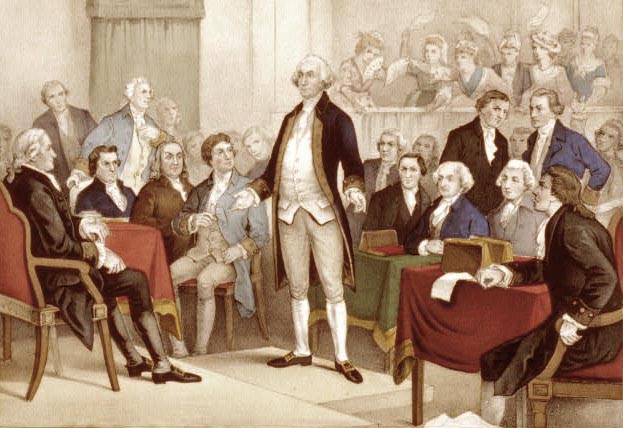
The long-distance relationship between King George III of England and his American colonies was not going well. On September 5, 1774 a convention was held in Philadelphia, attended by 55 members appointed by the twelve of the thirteen British colonies.