

This Sprawling Tokyo Museum Rethinks What We Consider “Art”
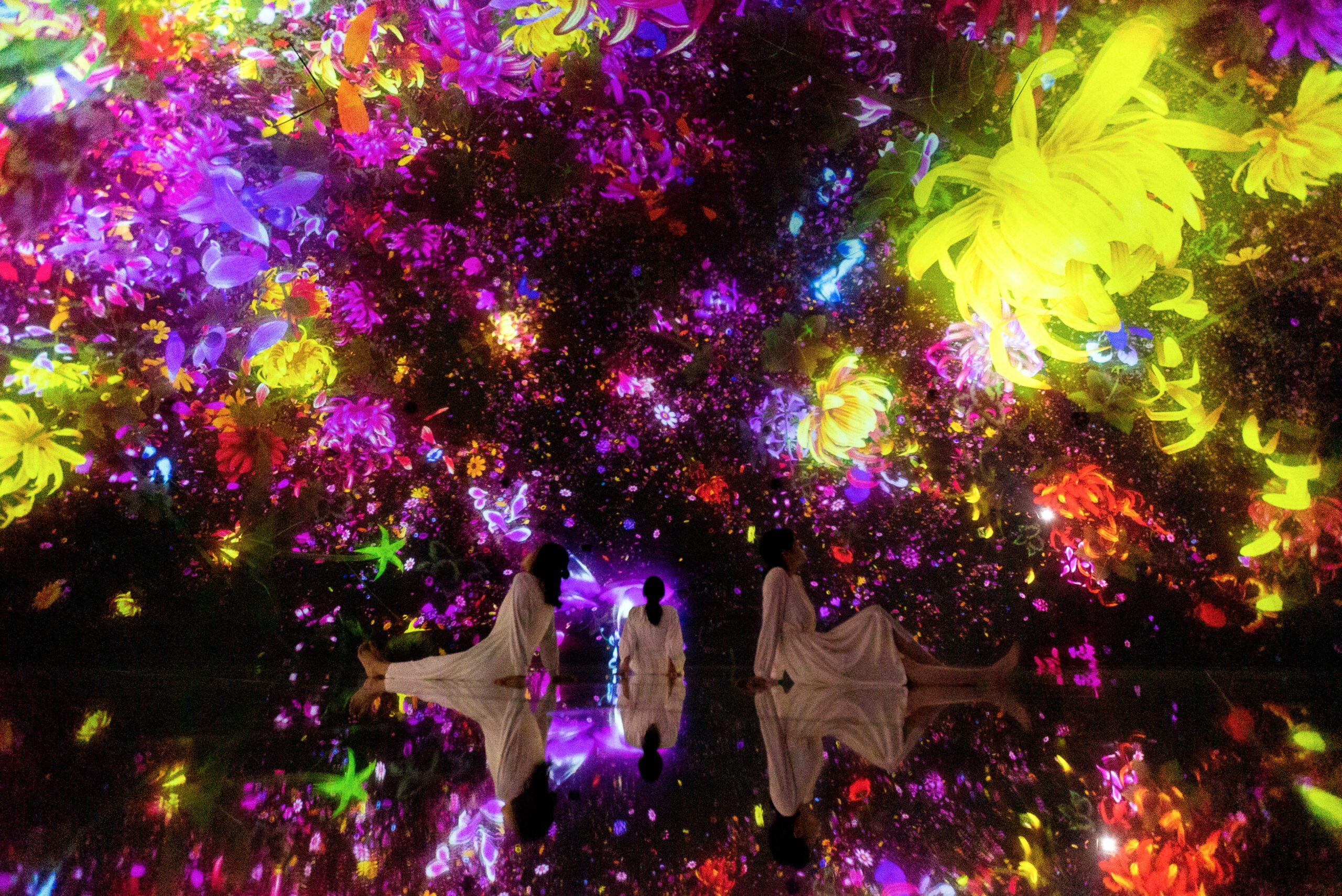
Floating in the Falling Universe of Flowers Photo: ©teamLab
Posted November 19, 2025
teamLab Planets Transports Art Lovers to a New Universe
In the past few years, the term “immersive art experience” has been applied a bit too liberally, to abandoned convention centers and malls with famous artists’ work projected onto blank walls. Van Gogh, Picasso, and Monet all got this special treatment, where visitors could walk amongst the moving images, popularized after appearing in a 2020 Netflix series. You couldn’t open Instagram without seeing people you knew posing in front of one of the works around the United States. But art isn’t just meant to be seen. It is also meant to be experienced, felt, and participated in. One gallery in particular has inspired a wave of others.

teamLab, One Stroke Bench © teamLab
Redefining the Art Gallery
Several art experiences reestablish the connection between art and the artist as interest grows around the United States. Meow Wolf made a name for itself nationwide, starting in 2008 in Santa Fe, New Mexico, as a collective looking to break out of the traditional gallery system. It has since expanded to Denver, Dallas, and the wildly popular Omega Mart in Las Vegas, which resembles a supermarket.
Hopscotch, located in San Antonio and Portland, launched in 2018 with rotating exhibits and collaborations with the Human Rights Campaign. Visitors can jump into a pit filled with changing-colored balls or leave an anonymous message on a vintage telephone.
Columbus, Ohio-based artist and designer Jordan Renda founded Otherworld in 2019 with a storyline connecting the rooms with sculptures and digital projections. A second location opened in Philadelphia in 2024. Superblue in Miami pulls from different artists, each working on a different, temporary installation space. Both are ADA accessible.

teamLab, Drawing on the Water Surface Created by the Dance of Koi and People – Infinity © teamLab
The Original “Interactive Art”
They all trace inspiration to teamLab, created by a Tokyo-based collective of artists, engineers, and animators in 2001. The first operation, Borderless, gets its name from “art without borders,” with over 50 pieces that move between spaces. teamLab Planets, which debuted in 2018, takes art a step further into the sensory. Both rank among the top attractions for travelers to the city.
Named by Guinness World Records as the most visited art museum by a single art group in the world, teamLab Planets just completed an expansion nearly doubling in size. The expansion includes the gallery “Catching and Collecting Extinct Forest.” In this gallery visitors capture and study extinct animals using a smartphone app, chasing species of dinosaur and mammals along the walls.
In the Athletic Forest, the visitor engages spatially with the art. This includes sliding down a slope and bouncing on round stepstones that make a sound and change color with every move. Another area features swinging steps that require precise movement to reach the other side. This gallery resembles a playground where even grown-ups can feel like kids again.
The Floating Flower Garden features mirrored floors that reflect the orchids that are raised and lowered around visitors based on their movements. In terms of sensory play, nothing matches “Drawing on the Water Surface Created by the Dance of Koi and People – Infinity, which allows visitors to wade into ankle-deep water with lights projected onto it. The humans become the iconic koi fish, moving barefoot through the space. But don’t worry, teamLab provides lockers for your shoes and other items you don’t want to get wet.

teamLab, Multi Jumping Universe, Courtesy teamLab Borderless, Jeddah (c) teamLab
The Visitor as The Artist
What makes teamLab Planets so different from other interactive art spaces is the ability for visitors to become a part of the expanding work. It’s especially interesting in the growing world of AI art and NFTs.
In the “Sketch Factory” gallery, visitors create drawings, which are scanned and become part of the moving imagery on the walls. In a sense, they become part of the teamLab collective. At the end of your visit, you can even get your drawing created into a physical product for purchase, like a t-shirt or tote bag, returning the art to a physical medium. It’s also one of the more unique souvenirs you can find.
teamLab also has installations elsewhere in Japan, along with in Saudi Arabia, Macao, and Singapore. The works also join permanent collections of museums around the globe, plus touring and temporary exhibits. Reservations for teamLab Planets are required, with timed entry, and tickets start at 4,000 yen. It’s easily accessible from the Shin-Toyosu train station and a short distance from the hotels of Ginza. Give yourself at least three hours to explore. There’s also a vegan ramen shop on-site if you need a snack break. Also, Glass House, a tea and sake cafe includes its own teamLab work to admire.