

American Democracy: Voting Rights & Election Reform
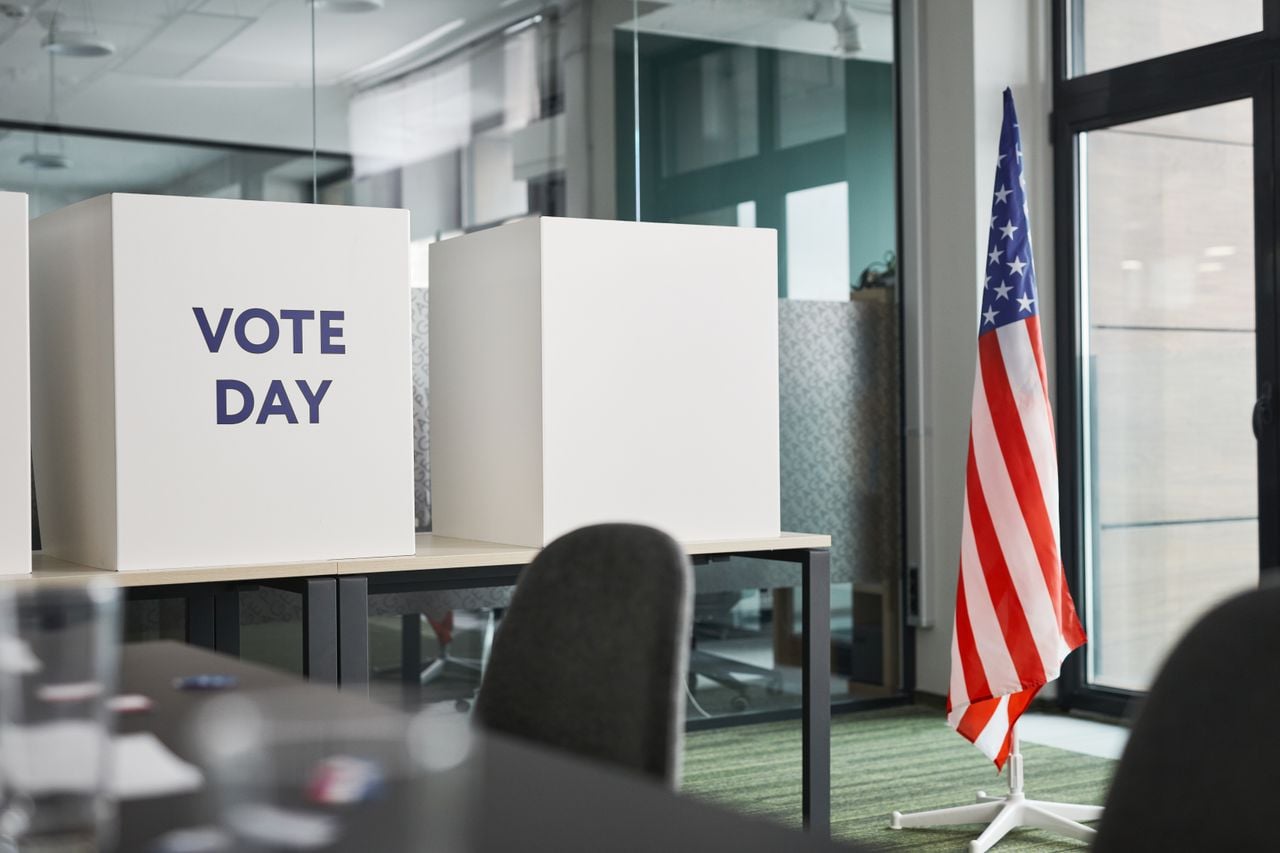
Voting rights, fair representation and election reform are central to the ongoing debate over American democracy. Photo: Edmond Dantès/Pexels.
Aired on October 16, 2026
What other countries can teach us about democracy—and how home exchange travel changes the way we see the world.
What does it mean to live in a democracy if political power isn’t equally shared among the people? What would it take to create a more representative American democracy? And what happens when travel helps us see our own society from a different perspective?
Americans grow up learning about the United States as a model of democracy. Yet questions about voting rights, political representation and election reform have followed the country throughout its history. Who gets to vote? How are electoral districts drawn? Why can a presidential candidate win the Electoral College without winning the national popular vote? And how much influence do ordinary citizens really have over their government?
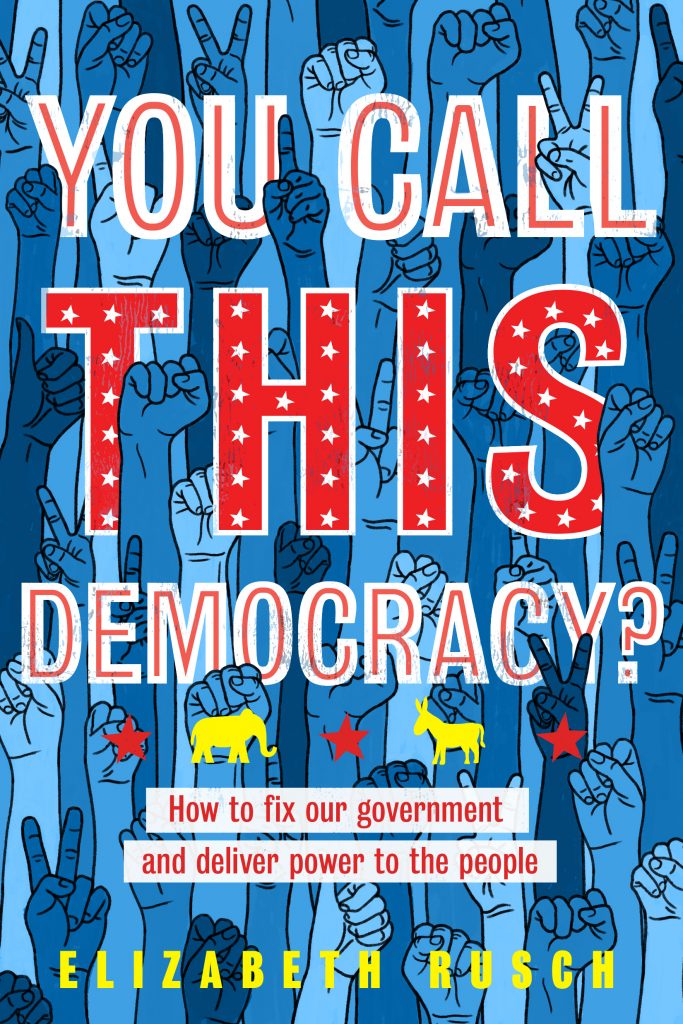
Award-winning author Elizabeth Rusch explores these questions in her book, You Call THIS Democracy? How to Fix Our Government and Deliver Power to the People. She joins World Footprints hosts Tonya and Ian Fitzpatrick for a revealing conversation about the structural flaws in American democracy, what other countries are doing differently and how meaningful political reform might be possible.
Our discussion also ventures beyond politics into Elizabeth’s passion for international travel. She shares how home exchange travel and the experience of living within different cultures have influenced her worldview and inspired her writing.
At first glance, democracy and home swapping may seem like unrelated subjects. But both invite us to step outside familiar surroundings and question the assumptions we’ve inherited about how the world works.
American Democracy and the Struggle for Equal Representation
America’s founders proclaimed revolutionary ideals of liberty and self-government, yet early voting laws denied large portions of the population a voice in government.
The Constitution did not establish universal voting rights. In the nation’s early years, voting was largely restricted by state laws that frequently favored white men who owned property. Women, enslaved people, many free Black Americans and Native Americans were excluded from meaningful political participation.
That began to change through generations of protest, advocacy and constitutional reform.

The U.S. Capitol in Washington, D.C., where Congress meets and debates issues central to American democracy, voting rights and election reform.
Ratified in 1870, the 15th Amendment prohibited denying voting rights on the basis of race, color or previous condition of servitude. In 1920, the 19th Amendment prohibited denying voting rights on the basis of sex. Congress followed with the Voting Rights Act of 1965, a landmark law aimed at dismantling racial discrimination at the ballot box.
These achievements fundamentally transformed the American electorate. Yet the history of voting rights also demonstrates that democratic progress has rarely occurred without sustained public pressure.
In You Call THIS Democracy?, Elizabeth Rusch asks readers to examine the distance between America’s democratic ideals and the realities of its electoral system.
Her central argument challenges a deeply rooted assumption: holding elections does not automatically guarantee equal political representation.
Gerrymandering Explained: When Politicians Choose Their Voters
One of the most enduring controversies in American politics is gerrymandering, the practice of manipulating electoral district boundaries to give a political party or group an advantage.
The term dates to 1812, when Massachusetts Governor Elbridge Gerry signed legislation establishing a strangely shaped electoral district. Political opponents compared its outline to a salamander, inspiring the name “Gerry-mander.”
More than two centuries later, the technology used to draw political maps has changed dramatically, but the underlying problem remains.
When lawmakers draw district boundaries to protect political interests rather than reflect communities fairly, they can make elections less competitive and weaken some voters’ political influence.
Gerrymandering also illustrates one of Rusch’s central concerns: the rules that determine political representation are often established by the very institutions and political interests that benefit from them.
What would American elections look like if those rules were designed differently?
The history of gerrymandering is documented in the Smithsonian National Museum of American History’s collection on American democracy.
Voting Rights, the Electoral College and Money in Politics
Gerrymandering is only one part of the conversation.
Rusch also examines voter suppression, the Electoral College and the influence of money in American elections.
The Electoral College, established through the Constitution, determines the outcome of presidential elections through votes allocated to the states and the District of Columbia. Because most states award their electoral votes on a winner-take-all basis, a candidate can become president without receiving the most popular votes nationwide.
For some Americans, the Electoral College represents an important feature of the country’s federal system. Critics argue that it gives voters in different states unequal influence over presidential outcomes.
Voter access presents another complicated challenge. Registration requirements, identification rules, polling-place availability and other election procedures can affect how easily eligible citizens exercise their voting rights. Debates about these policies often involve competing concerns about accessibility, election administration and public confidence.
Campaign financing raises further questions about whose voices carry the greatest influence in politics.
Rather than treating these issues as disconnected political disputes, Rusch encourages readers to consider how they interact—and whether the overall system delivers meaningful representation to the people it is supposed to serve.
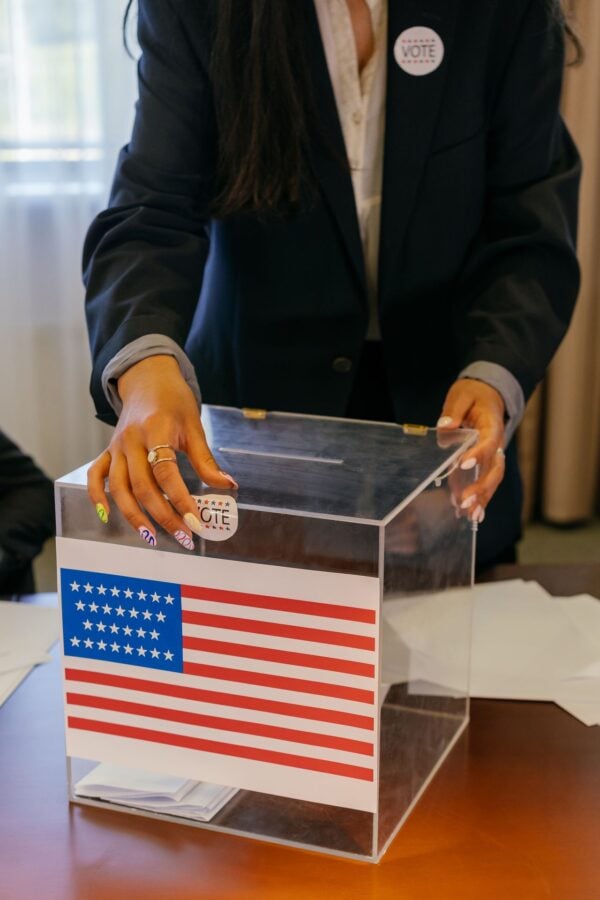
The right to vote is fundamental to democratic participation, but debates about fair representation extend beyond the ballot box. Illustrative photo: Mikhail Nilov/Pexels.
What Can Other Democracies Teach the United States?
Americans often look inward when debating the future of their political system. Elizabeth Rusch encourages a broader view.
Countries around the world have developed different approaches to voter registration, electoral representation, campaign financing and election administration.
Some democracies use proportional representation, which allocates legislative seats according to parties’ shares of the vote. Others employ independent commissions to draw electoral boundaries or have made voter registration more automatic.
These alternatives are not perfect, and political systems reflect different histories, legal structures and cultural priorities. Nevertheless, international comparisons can challenge the idea that America’s existing arrangements are the only workable options.
Rusch’s examination of other democracies invites a deeper question: If other countries have found different ways to address problems of political representation, what can Americans learn from those experiences?
It’s a question that extends beyond political parties or individual elections and speaks to the continuing responsibility of citizens to understand how their government functions.
Home Exchange Travel: Seeing the World Through Someone Else’s Eyes
Elizabeth’s interest in how other societies function isn’t limited to political research.
An avid traveler and prolific author, she has discovered that some of her most meaningful international experiences come from home exchanges—staying in other people’s homes rather than traditional hotels.
Through the home-swapping network HomeExchange, her family has experienced destinations in ways that can be difficult to replicate through conventional tourism.
A home exchange offers something that a standard hotel stay often cannot: an introduction to the ordinary rhythms of another community.
Instead of spending every day within the familiar routines of a tourist district, travelers may find themselves shopping at neighborhood markets, discovering local gathering places and adjusting to customs very different from their own.

Home exchange travel allows visitors to stay in residential settings and experience destinations from a different perspective. Illustrative photo: Jonathan Borba/Pexels.
There are practical benefits, too. For families and travelers planning longer stays, home swapping can reduce accommodation expenses while providing kitchens, living spaces and other comforts of home.
But for Elizabeth, the experience goes beyond affordability.
Her travels have helped shape her perspective as a writer, exposing her to unfamiliar places, people and ways of life. She has spoken about how these experiences have inspired many of her books.
For World Footprints, that’s an important connection. Travel is not simply about visiting unfamiliar destinations. At its best, it encourages us to examine our assumptions, appreciate different perspectives and recognize the humanity we share.
What You’ll Hear in This Episode
- Why many Americans misunderstand how their democracy compares globally
- Where the U.S. falls short in representation, voting access and participation
- Simple democratic reforms already working in other countries
- How political dysfunction becomes normalized over time
- Why reimagining democracy requires looking beyond U.S. borders
- How travel and home exchange experiences shape perspective and storytelling
Why This Episode Matters
This isn’t a conversation about politics as usual. It’s about stepping outside of what we think we know.
At a time when trust in institutions is low and frustration is high, this episode offers something different: perspective grounded in how the rest of the world actually functions. It challenges the idea that meaningful change is unrealistic—and replaces it with examples that already exist.
And it reminds us of something travel has always taught:
There is more than one way to live.
More than one way to govern.
More than one way to imagine what’s possible.
Listen to Elizabeth Rusch on the World Footprints Podcast
Join Tonya and Ian Fitzpatrick for a conversation with Elizabeth Rusch about voting rights, election reform, international perspectives and the cultural lessons of home exchange travel.
Listen to the podcast episode and discover why understanding other societies may be one of the most valuable ways to reconsider our own.
You can also watch our uncut video interview with Elizabeth Rusch, Reviving U.S. Democracy: Innovative Solutions.


Book Your Travel to ANY Destination
Use the interactive map below to search, compare and book hotels & rentals at the best prices that are sourced from a variety of platforms including Booking.com, Hotels.com, Expedia, and more. Search for ANY destination by clicking in the upper left corner of this map.
Join the community!

Join our community to receive special updates (we keep your private info locked.)
