

Christmas at Jekyll Island Club Resort: History & Holiday Magic
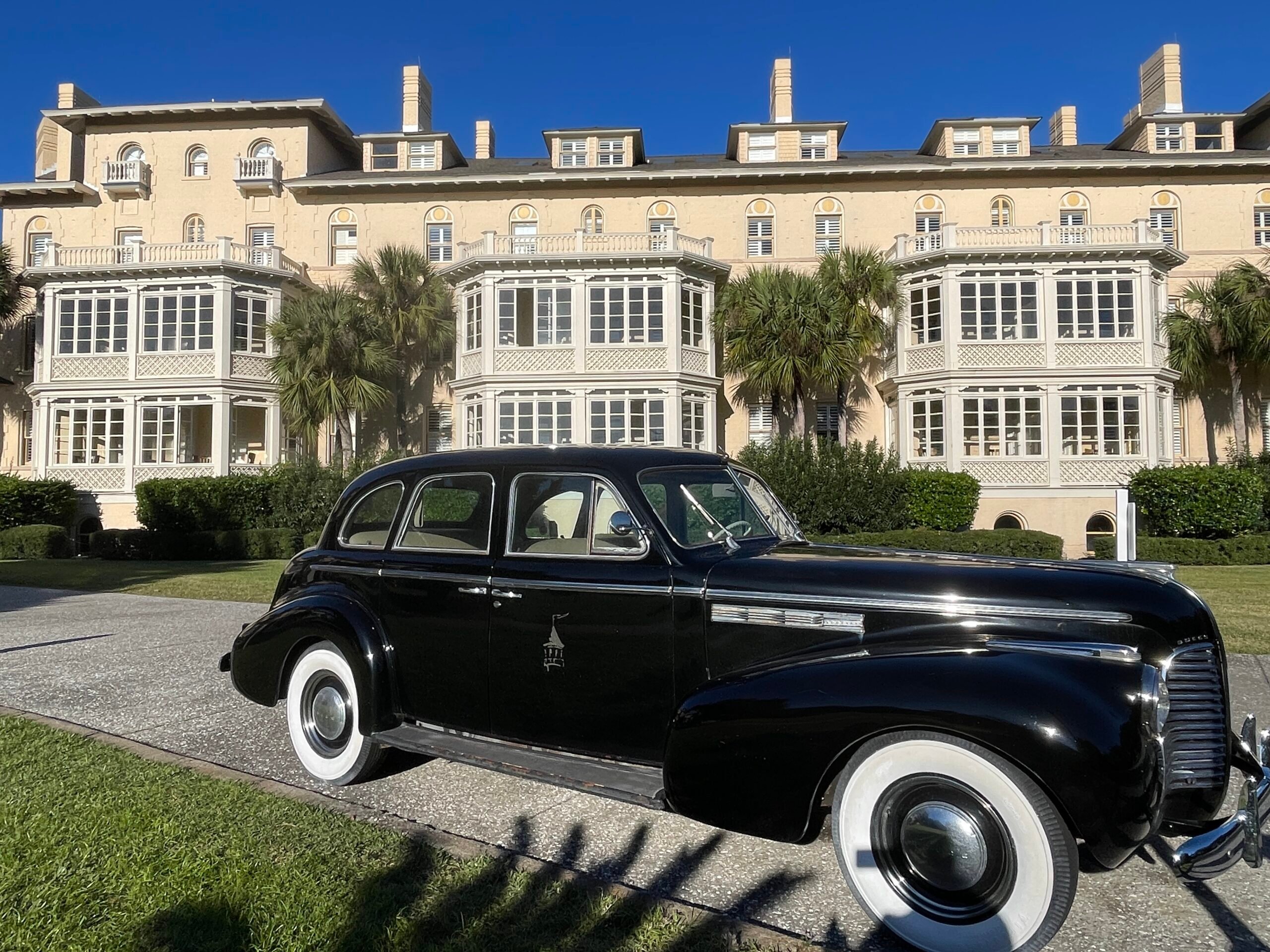
Jekyll Island Resort and antique car. Photo: Tonya Fitzpatrick
Posted December 7, 2025
An Unexpected Holiday Destination
Jekyll Island doesn’t top most lists of holiday destinations, but maybe it should. Every December, the former Gilded Age retreat along Georgia’s coast settles into a different rhythm. Live oaks are strung with lights, historic cottages glow behind garlands, and the old clubhouse lawn holds a towering Christmas tree. On the surface, it’s festive and charming. But what sets Jekyll Island apart isn’t just the decorations. It’s the history beneath your feet.
This is a place shaped by power, wealth, labor, and displacement. During the holidays—when everything is softened by lights and tradition—that contrast becomes even more visible.
From Millionaire’s Club to National Landmark
The Jekyll Island Club opened in 1888 as a private winter retreat for America’s wealthiest industrialists and financiers. This was not a resort built for the public. It was designed as a closed sanctuary for families like the Morgans, Rockefellers, Vanderbilts, and Pulitzers. At one point, the club’s members reportedly controlled nearly one-sixth of the world’s wealth.
They came to Jekyll to escape northern winters and public scrutiny. The island was private and deliberately difficult to reach. But leisure wasn’t the only thing happening here. In the late 1890s, the Club built the Sans Souci Apartments, a shared-ownership residence for members that is widely considered one of the earliest examples of a condominium in the United States.
Later, in 1910, a secret meeting took place on the island that helped shape what would become the Federal Reserve system. And in 1915, a phone inside the clubhouse was used to place what’s widely recognized as the first transcontinental telephone call.
-

- Federal Reserve room. This is the room where it happened. Photo: Tonya Fitzpatrick

-
- Preserving history on camera. Image of the first Transcontinental phone call. Photo: Tonya Fitzpatrick


First condo. Photo: Tonya Fitzpatrick
Today, those same buildings anchor the modern resort. The Queen Anne–style clubhouse now serves as the main hotel at the Jekyll Island Club Resort. Former private cottages operate as museums, accommodations, and event spaces. You can trace the hierarchy of the old club simply by walking the grounds.
By December, the tone shifts. Columns and porch railings are wrapped in lights. Trolley tours circle the historic district. Visitors carry hot chocolate instead of cigars. Santa stands where financiers once gathered.

Seasons Greeting sign on Jekyll. Photo: Tonya Fitzpatrick
A Gilded Age Christmas Tradition
In the Club’s early years, families arrived around Thanksgiving and stayed through winter. Christmas was a centerpiece of the season. Historical records describe decorated trees, formal dinners in the Grand Dining Room, and gatherings inside private cottages. Staff and workers were sometimes included in the celebrations. Children from nearby communities were treated to holiday parties.
For a place rooted in extreme exclusivity, these moments reveal how tradition softened the edges—at least occasionally.
That rhythm still carries forward today, just in a more open way. Holiday trolleys move past decorated cottages. Guided history tours revisit how families once spent their winters here. A massive tree rises in the center of the Historic District with tens of thousands of lights. Nearly every structure—clubhouse, cottages, storefronts—is wrapped in garlands and bows.
It’s festive without being excessive. The architecture still leads. The island still feels like itself.

Jekyll Island porch decoration. Photo: Tonya Fitzpatrick
Holly Jolly Jekyll and Family-Friendly Festivities
“Holly Jolly Jekyll” now reaches well beyond the historic core. Light displays extend into the Beach Village area, along parts of the golf course, and through the island’s recreation spaces. The mini-golf course transforms into Peppermint Land, with candy-themed décor and oversized ornaments that instantly draw families in.
Programming leans into tradition without feeling manufactured: Breakfast with Santa, outdoor movie nights, ornament-making workshops, and community parades that bring out both visitors and locals. It feels less like a theme park overlay and more like a coastal town leaning into the season.
-
- Jekyll Club Garden. Photo: Tonya Fitzpatrick

-
- Bagpipe seranade. Photo: Tonya Fitzpatrick

-
- Champagne from the bottle I sabered with Bagpipe player. Photo: Tonya Fitzpatrick

Adults have their own version of the holiday experience. There are Victorian-style afternoon teas, cocktails around outdoor fire pits, and evening walking tours that pair décor with real history. One evening included something I never expected to do on a Georgia barrier island in December—I took part in a champagne sabrage, cleanly slicing the top off a bottle in old-world fashion. It was celebratory without being gimmicky, and somehow on brand for a place that has always blended tradition with spectacle.
You’re not just looking at lights—you’re walking through 150 years of American economic, social, and labor history.
-
- Big tree on Jekyll front lawn. Photo: Tonya Fitzpatrick

-
- Tree of lights on Jekyll Island. Photo: Tonya Fitzpatrick

-

- Lawn of lighted ornaments on lawn at Jekyll Resort. Photo: Tonya Fitzpatrick

-
- Jekyll christmas decore inside. Photo: Tonya Fitzpatrick

-
- Moss tree on Jekyll Island with lights. Photo: Tonya Fitzpatrick

-
- Decorated moss tree on Jekyll Island. Photo: Tonya Fitzpatrick

Inside the clubhouse, the season feels quieter but intentional. The lobby centers on a massive Christmas tree. Dining rooms roll out seasonal menus. Carols play softly in the background, and on select evenings, a local bagpiper performs at dusk along the riverfront lawn. It never feels stiff. It feels lived in.
One of my favorite details was the elf scavenger hunt tucked into the first floor of the clubhouse. More than 20 small elves were worked into garlands, lanterns, and architectural nooks. Kids compared notes. Adults joined in without much fanfare. The prizes were simple—but mine ended up being a holiday cocktail at the historic bar. Low-key and very Jekyll.
-
- Elf in a lantern. This was a crafty way to hide this elf. Photo: Tonya Fitzpatrick

-
- Don’t look now. There’s an elf on a shelf. He was one of over 20 elfs in the scavenger hunt. Photo: Tonya Fitzpatrick

-
- This elf was hiding in plain sight but the scavenger hunt required that you look closely. Photo: Tonya Fitzpatrick

Reconciling the Past
For all its charm, Jekyll Island carries a history that isn’t decorative. Before industrialists arrived, Indigenous communities lived here. Later, the island became part of Britain’s colonial system and was worked by enslaved Africans. After emancipation, Black families built nearby communities—only to be displaced when the island was converted into a private club for America’s elite.
That history isn’t always front-and-center in the holiday narrative. But it’s present.
As a woman of color, I couldn’t ignore it. I felt the weight of it while listening to stories of wealth and winter leisure. Who built this? Who was allowed here? Who labored so that others could rest?
Reconciling with that past doesn’t mean rejecting what the island is today. For me, it meant holding both realities at the same time—standing in spaces that once excluded people like me, while recognizing that today those same spaces are open. That shift matters. It gives the holiday traditions more meaning, not less.
-
- Horse and buggy at sunset on Jekyll

-
- Sunset on Jekyll Island is a time for reflection. Photo: Tonya Fitzpatrick

A Holiday Destination With Layers
Jekyll Island is undeniably beautiful during the holidays. The live oaks wrapped in lights. The steady pace of the trolleys. The mix of Victorian architecture and coastal quiet. It works.
But what makes it stay with you is that the island doesn’t hide its layers. You can enjoy the decorations and still feel the weight of what came before them. You can build new traditions while moving through old ground.
On my final evening, I took a horse-drawn carriage around the property to see the Christmas lights and the last of the sunset over the resort grounds. It was a straightforward way to take in the scale of the place and notice details I hadn’t caught earlier in the trip.
-
- Horse buggy candy cane land on Jekyll. Photo: Tonya Fitzpatrick

-
- One of the many decorated house on Jekyll Resort property. Photo: Tonya Fitzpatrick

After the ride, I had a holiday dinner that stood out for one reason: Chef Nickel Bundy (@Nickel) and his shrimp and grits. I’ve had my fair share of shrimp and grits throughout my travels, and this one was different. The base was creamy in a way I hadn’t seen before—rich without being heavy. Anyone visiting should absolutely request his shrimp and grits.
As the evening wrapped up, the lights didn’t soften the island’s history or its contradictions. They just sat alongside them. And that felt honest.
Jekyll Island isn’t just a festive backdrop. It’s a historic place that shows its full shape—even during the holidays. And that’s what made spending time here meaningful.

Ornaments hanging on Moss tree on Jekyll. Photo: Tonya Fitzpatrick
CLICK for discounts at Jekyll Island Resort and other nearby hotels
Use the interactive map to search for travel discounts around the world.
Join the community!
Join our community to receive special updates (we keep your private info locked.)