

Chilean Tourism and the Indigenous Mapuche

A traditional Mapuche ruka, or dwelling, reflects Indigenous building practices in southern Chile, where land and cultural heritage remain deeply connected.
Posted October 11, 2026
Editor’s Note: This article examines Mapuche tourism in Chile in the context of Indigenous land rights and the Mapuche people’s struggle for self-determination. We have updated historical references and added current context while preserving the author’s original reporting and perspective. As of September 2026, Chile has extended emergency security measures in the Araucanía Region and the provinces of Arauco and Biobío. Some Mapuche organizations have challenged those measures and called for solutions addressing longstanding disputes over land, Indigenous rights and political recognition.
The regions of Biobío and Araucanía, which lie somewhere in the middle of the 2,653 miles that stretch from Chile’s top to bottom, are nevertheless known as “the south.” A tourism hot spot for culture, handicrafts, and its pastoral landscape, this area is also a center of conflict— the indigenous Mapuche in the area, as throughout Chile and Argentina, constantly struggle for access to their ancestral lands and basic human rights. Visitors shouldn’t stay away, but rather, be intentional with their time, money, and presence.
A Brief History
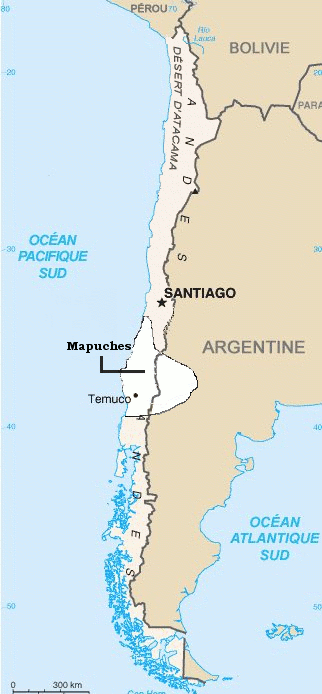
Map highlighting areas historically associated with the Mapuche in Chile and Argentina. Source: CIA World Factbook; adaptation credited to Wart Dark/Wikimedia Commons.
Conflict between the state and the Mapuche dates back to the arrival of Spanish colonists in 1541. Throughout the nearly five centuries that have followed, tension has been ongoing, with a particular escalation, corresponding to a resurgence in public visibility, since the end of Augusto Pinochet’s dictatorship in 1990.
The administrations of Michelle Bachelet and Sebastián Piñera both touted policy reforms and community development funding to ease this tension and ostensibly benefit the Mapuche, but neither resolved the longstanding disputes over ancestral lands and the influence of private development interests.
State appropriation of Mapuche lands for private sale and development for things like logging and other forestry projects is an ongoing problem and frequently leads to unprovoked, violent raids on indigenous communities, and the arrests and occasionally death of community members at the hands of military police. Even when raids are not actively occurring, heavy police and military presence is a constant issue in Mapuche territory. The highway is lined with checkpoints, and arbitrary detentions are common. Another issue has been the poor treatment of Mapuche prisoners in state detention, which has resulted in numerous long-term hunger strikes.
Note: Human rights organizations continue to document concerns affecting Mapuche communities in Chile, including allegations of arbitrary detention, treatment of Indigenous land defenders and the consequences of prolonged emergency powers in southern Chile. See Amnesty International’s Chile human rights report and the Chilean National Human Rights Institute for further documentation.
Indigenous Cultures as Tourist Attraction
Travelers to Concepción, Chillán, Temuco, Ercilla—cities in the Biobío, Ñuble, and Araucanía regions—and the surrounding area would be remiss not to consider these circumstances. The tourism industry here relies on a tranquil, presentable image of the area, in which the indigenous population is another idyllic and lucrative attraction. Many upscale commercial tours will highlight the indigenous culture in the region without providing any support to these communities in actuality, financially or otherwise. Plenty of non-indigenous vendors in the cities make decent money selling knockoff Mapuche crafts. This is not a warning to extranjeros to stay away, but rather, to be conscientious, and to make the most of a visit while keeping these issues in mind.
It is immensely dangerous, as well as naive, to regard the Mapuche struggle for self-determination as a cultural experience to be consumed by foreign travelers. Stay up-to-date on the evolving situation by keeping track of Mapuche news via sites Mapuexpress, among others.
If and when booking a cultural tour, do extra research to be certain that the tour is run by organizations that provide real material benefit to Mapuche communities in the area. Other ways to support indigenous communities in southern Chile directly can include small gestures, such as buying authentic handicrafts, for instance at the Teatro Municipal or near the Plaza de Armas in Chillán, or at stalls scattered widely in and around Ercilla. Ideally, however, one’s solidarity extends beyond a small financial transaction.

Demonstrators display banners and Mapuche flags in support of Indigenous rights. The Mapuche struggle for land and self-determination has generated protests both within Chile and internationally.
Supporting the Mapuche
There are often demonstrations in support of the Mapuche community in cities such as Concepción and Ercilla. Such demonstrations reflect the continuing struggle for land rights, recognition, and justice.
Editor’s Travel Safety Note (October 2026): Visitors should be aware that demonstrations in Chile can become unpredictable, even when they begin peacefully. Police may use tear gas or water cannons, and participation in demonstrations may carry legal consequences for foreign nationals. The U.S. Department of State currently advises travelers to avoid demonstrations and exercise increased caution in Chile. Before traveling to Araucanía or Biobío, consult current local conditions and official travel advisories. U.S. Department of State — Chile Travel Advisory
Another method of support is through educational venues. Just outside Cañete, south of Concepción, is the Museo Mapuche de Cañete, formally known as Ruka Kimvn Taiñ Volil–Juan Cayupi Huechicura. Editor’s update: The museum is temporarily closed for building repairs and exhibition renewal as of October 2026, although some special activities continue.
Outside the regions of Araucanía and Biobío, there are other sites of tribute and education. Should you be spending any time in the capital of Santiago, for example, there is a Monumento al Pueblo Indigena, or Monument to Indigenous Peoples, in the central Plaza de Armas. The National Museum of Natural History or the Violeta Parra Museum will sometimes feature exhibits on Mapuche history and artwork.

A stone vessel and hand stone illustrate traditional food preparation tools associated with Indigenous material culture.
A fundamental element of any visit to a conflict zone as a foreigner is a deliberate, intentional understanding of the situation at hand, and how foreign presence in the region can and does impact such a situation. Travelers from the United States should especially keep in mind the role that the U.S. government has historically played in manipulating politics in Chile, from the military coup of 1973 onward, and be aware that the after-effects of the brutal regime which ensued are still very much a part of Chilean life and culture.
Rather than adopting a stance of guilt or resigning oneself to not understanding, tourists should do their utmost to be educated and, to the extent possible, to support communities locked in a historic battle for their freedom.

A market in Temuco, Chile, displays woven garments, textiles and other handicrafts. Purchasing directly from Indigenous artisans and verified community-owned businesses can help travelers ensure that more tourism revenue reaches local communities. Photo: Mujer Chilena.
Related Stories on World Footprints
-
A Zapotec-Led Tour Company in Oaxaca Putting Its People First
-
Hoonah, Alaska: The Cruise Port That Still Belongs to the People Who Live There
Explore Accommodations in Chile
Use the interactive map below to explore and compare accommodations in Chile, including hotels and vacation rentals available through third-party booking platforms. You can adjust the map to search different destinations and locate nearby points of interest.
Join the community!
Join our community to receive special updates (we keep your private info locked.)