

Wales – The United Kingdom’s Underrated Star
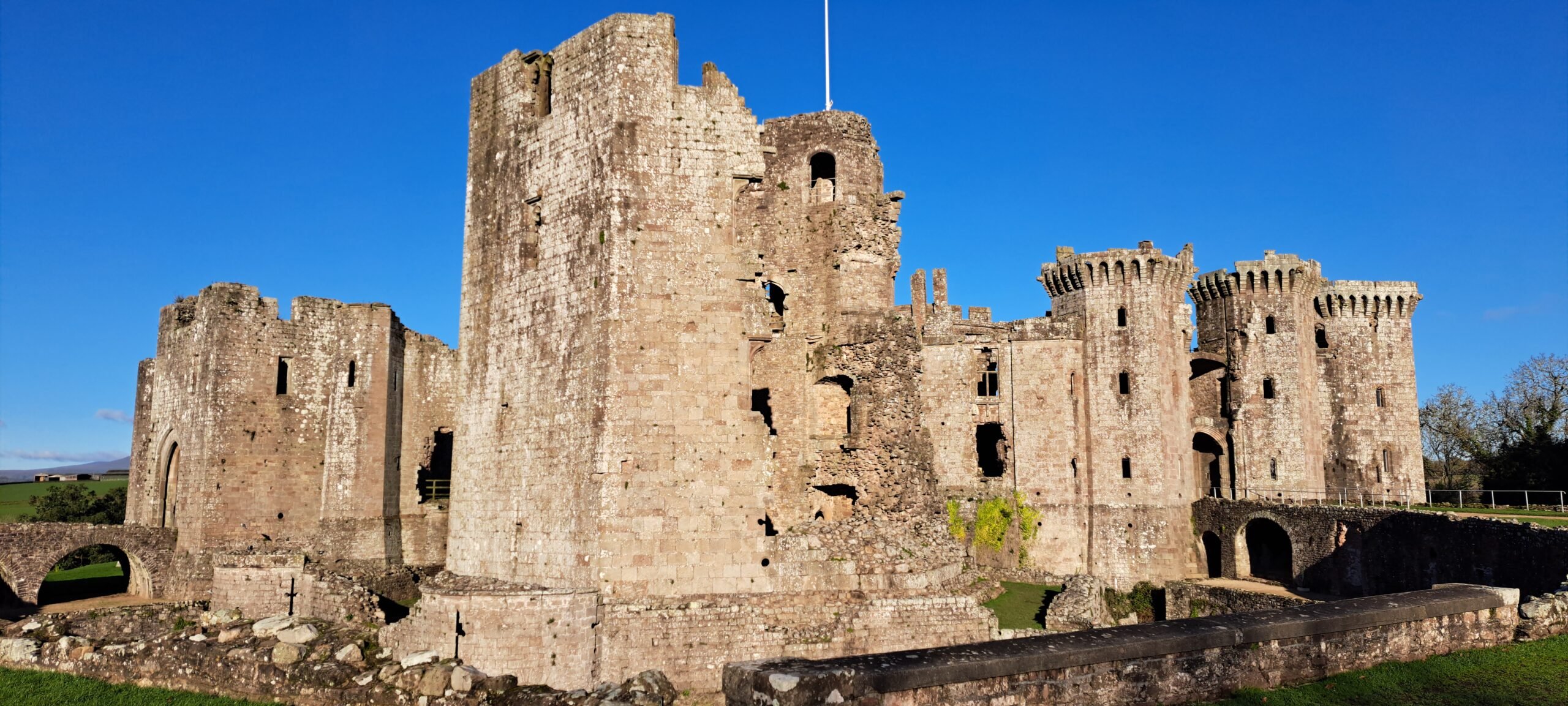
Raglan Castle Photo: Bruce Northam
Posted January 10, 2026
Wales reminds you to unfold your days–and life–like a map, understanding we can’t always refold them the same way. In this corner of the UK, the ever-present ancient structures and modern culinary delights are a vacation in themselves. Bilingual Wales (Welsh and English) has the most castles per square mile in the world, excluding the ubiquitous castle-like churches. Its population of three million people thrives in a vastly diverse landscape the size of New Jersey. Nearly everything fun you can do here is accessible by public footpaths that explore spectacular stretches of coastline, forests, intimate villages, and the world-class city of Cardiff. This place isn’t just a feast for the eyes; it’s a land of feasts.

Cardiff Castle was originally a Roman fort Photo: Bruce Northam
Cardiff – Wales Capital City
Originally a Roman fort, the 2,000-year-old Cardiff Castle serves as Cardiff’s looming centerpiece. When I was there, it was decked out as a winter wonderland. The Welsh take their pop-up holiday shops and festivals seriously.
A converted post office built in 1897 now serves as the Parkgate Hotel, Cardiff’s finest four-star luxury offering. Its stately lobby features a 25-foot ceiling and an appropriately named restaurant, The Sorting Room. Also appropriate, the ground-floor restrooms are labeled “The Mailroom.” The hotel exists a stone’s throw from the slightly curving main drag, St Mary’s Street. Here, the pubs, restaurants, indie shops, and artisan studios serve every whim, with music always being in the air. It doesn’t take long to notice the Welsh love their music. Many global hit-making musicians (Tom Jones, Bonnie Tyler, Badfinger, the list goes on) call this home.

Wales Coast Path Photo: Bruce Northam
The Great Outdoors
The Welsh are, by birth, outdoorsy. This mountainous, coast-hugging country reminded me that the roaming gene of the Welsh continues for generations. Wales’s fantastical country-wide footpath network, where walkers always take precedence over cars, takes a bow along the 870-mile Wales Coast Path. I hiked a section of it within Pembrokeshire National Park, where every few steps offers another epic photo opportunity, whether you click or not.

St Brynach Church in Nevern Photo: Bruce Northam
A Woodsy Wonder
Some people—and places—really know how to redo things. Enter fforest, a woodsy 200-acre experiment in things born from disused and neglected everything, including land, furniture, and buildings. That double-f is not a typo. It represents this trendy meld of a Welsh farm and Japanese forest retreat, where you can get up close and personal with nature while sampling fresh Irish Sea seafood delights. This prime example of glamping-style sustainability, without the brag, showcases indoor-outdoor hospitality at its best.
Here, farm buildings have been transformed into lodges, dining rooms, and saunas. It exudes a communal-dining camp vibe, with excellent soundtracks, as curated tunes ring out clearly in the public spaces. Fforest’s 200 acres provide accommodations for up to 140 guests. It’s the brainchild of Renaissance-architect and designer James Lynch and wife, Sian Tucker, a fellow artist and designer. James was inspired in his youth by an extended homestay in Japan followed by jaunts in California and Scandinavia. Sian dreamed up equally innovative contributions inspired by her homeland that please the eye and soul.

Fforest’s sauna—cleverly constructed from spare parts Photo: Bruce Northam
An Organic and Artistic Campus
This organic and artistic campus offers a range of accommodations, from cabins to tents to geodesic domes. There are also plenty of communal areas including a stone pub and an outdoor fire pit surrounded by Adirondack chairs. An alfresco dinner beckoned nearby as crab-infused pizzas were cooked in a brick oven while sea scallops sizzled in their shells on a grill.
I was there for its annual Winter Feast, where the warm-up featured canapes paired with a Boyashore gin, beetroot sherbert, and tonic. The main event is a hearty nine-course meal for 100 people including sea bass and roasted lamb shoulder. This multi-course dining experience showcases the best of local seasonal produce, much of it foraged by fforest staff or grown in onsite gardens. This gem of a place only accepts direct bookings and the guests are mostly repeat visitors.

Albion Hotel’s two-foot slate walls also make up the exterior Photo: Bruce Northam
Another Treasure – Albion Hotel Pub
Nearby, the couple has also made a positive impact in riverside Cardigan, where they own opposing and nicely paired structures. The Albion Hotel & Pub is a 12-room-collage wonder of salvaged wood inside a building with two-foot slate walls that also make up the exterior. Built in a former warehouse, the hotel is steeped in maritime history. The ship-cabin themes include repurposed pews from now redundant churches. (Looking back, repurposed church pews also sat many folks at fforest.) The hotel’s pub actually ranks as a swank cocktail bar. Across the street from the Albion, also owned by the couple is The Castle, a snug multi-room joint where locals gather to chat and watch rugby. This “historic boozer” features live music and pub-quiz Wednesdays. Another highlight was walking back to fforest from Cardigan along the river on a delightful rail-to-trail.

A megalith near a quarry for Stonehenge Photo: Bruce Northam
A Wales-Style Safari
Motion creates emotion. Sometimes it is tough to beat a curvy mountain road getaway. Cambrian Safaris offers guided mid-Wales tours in a Land Rover by owner and mega-enthusiast Richard Smith. Stops include a quarry for Stonehenge, a burial chamber, a megalithic wonder, and Devil’s Bridge, a waterfall coursing through a narrow channel under a succession of historic bridges that cross over it.

One of the Elan Valley reservoir dams constructed in the late 1800s Photo: Bruce Northam
Besides being a backroads botanical odyssey (Richard is also an ardent naturalist), you’ll behold 4,000 years of mining history and hidden gems including several mind-boggling Elan Valley reservoir dams and The Silver Mountain Experience, a mining museum with theatrical folklore tours.

The view of Hay-on-Wye from atop Hay Castle Photo: Bruce Northam
Don’t Miss Hay-on-Wye
Hay-on-Wye is the world’s first book town (well, since 1977, but in a big way since then). The “Wye” refers to the Wye River that straddles this artistic-retail-heaven village. Every other store, in between the tempting craft shops, is an inviting, overstuffed bookstore. The annual Hay Festival, a literary Woodstock, attracts 175,000 literary types every May. Hay Castle doubles as a museum, bookstore, cafe, and arts center. There, I bought a book entitled Yoga for Stiff Birds (birds is slang for females). The Welsh certainly inherited the famous British sense of humor.

Dad and I tackling Offa’s Dyke in 1998 Photo: Courtesy of Bruce Northam
A Nostalgic Walk on Offa’s Dyke
After a romp through Hay-on-Wye, I broke from the crowd, crossed the river, and walked a section of Offa’s Dyke with a heavy-but-happy heart. I waxed nostalgic while recreating some late-90s moments when I was here with my dad. We undertook a 200-mile trek across Wales, coast-to-coast along Offa’s Dyke—the great dirt wall conceived in the eighth century by King Offa of Mercia to separate England from Wales. The immense earthen barrier, intended to keep the Welsh out of England, eventually became the border between England and Wales. Old grudges die hard; some English and Welsh folks still eye each other warily.
One of many highlights along this trail is atop the long, curving ridge of Brecon Beacons National Park. The valleys below, pardoned by the Industrial Revolution, are where heaven and earth appear to have been reversed.

The Felin Fach Griffin, an epic gastropub Photo: Bruce Northam
Gastro-pubbing
Wales is no stranger to epic gastropubs with classy accommodations above, typically featuring deep soaking tubs. Two recommended countryside retreats are The Felin Fach Griffin (1600s), near Hay-on-Wye, where its dining pub appetizers include a mushroom and filo tart (mushroom ketchup, crisp parsley). The other is the Angel Hotel, which, unlike the country’s many snug structures, is spacious throughout. Its from-scratch international menu includes superfood salads, local mussels, and chicken tikka. Although both in the sticks, these places felt hip, hence the menus ranging from vegan to cider-braised ham hock. These elevated pubs truly pull you in, then fill you up.
It doesn’t take long to realize that Wales is an emerging fresh-seafood destination. Big time. An apt motto for the entire food scene here is grown, not flown. Another revelation was that Wales is number two in the world, behind only Austria, in recycling. In terms of them being recycling champions, a gent in the business whom I chatted up one morning at breakfast told me, “The only thing not recycled in a car is the air in the tires.”
Leaf Peeping Heaven
The term “leaf peeping” doesn’t roll off the tongue here, but every autumn, Wales provides a world-class place to do it. And although I’ve never been much of a Christmas market shopping type, Wales’ offering of such is splendid. I spent the day at the equivalent of an American county fair called the Royal Welsh Winter Fair, where fine livestock (cuddly sheep, lovely cows, and well-groomed horses) and impressive farm machinery melded with artisan gifts and foodie shopping ideas. The fairgrounds setting made switching channels between the down-to-earth seasonal attractions easy.
Wales’s multihued castles, countryside stone walls, masonry architecture, and human will remain as ambassadors from another time–and reveal the eternal grace of this western-UK outlier. Wales won’t disappoint. It’s a whimsical celebration of right now. Get your own Welsh celebration started via Visit Wales.
Click Here for Discounted Accommodations in Wales
Join the community!
Join our community to receive special updates (we keep your private info locked.)

