

The Gordon House: The Frank Lloyd Wright Home Hiding in Plain Sight
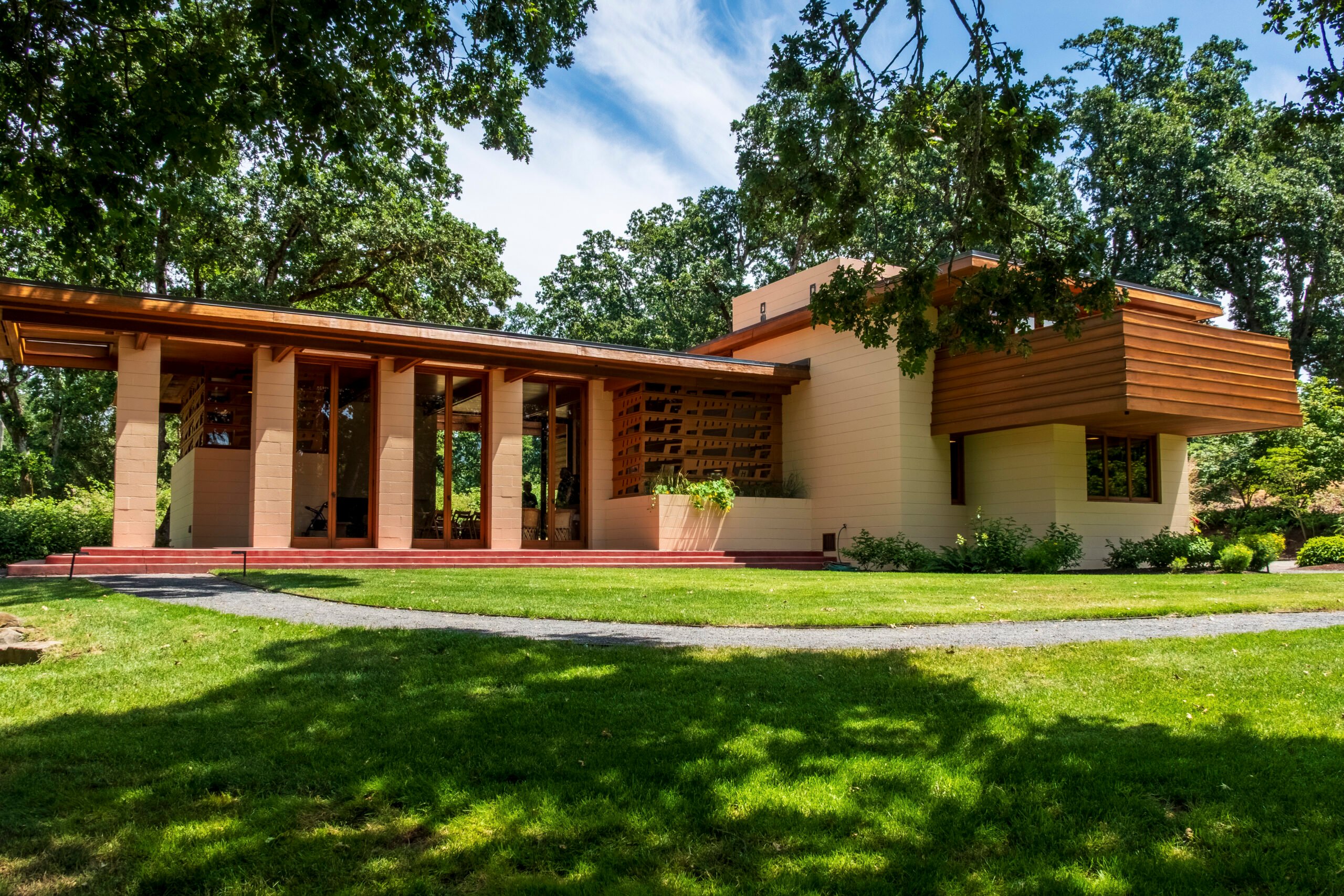
The Gordon House, the only home built from Frank Lloyd Wright's designs in Oregon. Photo by June Russell Chamberlin
Posted August 25, 2025
Like all fretwork by Frank Lloyd Wright, the stylized cedar cutouts over the upper windows of the Gordon House are unique. Some people think the pattern looks like upside-down saw blades in a nod to Oregon’s lumber industry. Others believe it resembles fallen trees or branches, tour guide and assistant manager Mairee MacInnes remarked.
“One of my favorite guesses, though, came from a class of third graders, who were all convinced it was an upside-down cow,” she said. “Once one of them saw it, they all saw it.”
As soon as she said it, many in my tour group — 14 of us — murmured agreement. We saw the cow too, lying like roadkill with its feet in the air. I’m fairly certain Wright would have been appalled.
The famous architect designed homes that embraced beauty, function, and access to nature, even in modest Usonian structures like the Gordon House in Silverton, Oregon. Designed by Wright in 1957 and constructed in 1964, the 2,133-square-foot home illustrates many of Wright’s ideas about organic architecture.
Tours at the Gordon House examine design details and provide a brief history of the Gordon family, Wright’s career and the daring effort that saved the house from certain destruction.

Frank Lloyd Wright designed furniture, such as this table and chairs, unique to each home. Photo by June Russell Chamberlin
The Great Room
Even before you enter the multipurpose great room, Wright’s use of space to influence behavior is obvious. The foyer feels uncomfortable, as Wright intended. He used a lowered ceiling to make the space feel “compressed,” an effect that encourages people to move quickly through to the great room. It also makes the great room, a space with 12-foot-high ceilings, seem airy and spacious. As my tour group soon learned, nothing in a Frank Lloyd Wright home is accidental.
The tour began in the great room, in front of the fireplace. Wright loved fireplaces and put them in most of his homes and even in a gas station in Minnesota. Most of us sat in folding chairs, but a few lucky souls found seats on the built-in banquette.
As MacInnes pointed out, the back of the banquette slopes at 15 degrees, as do most edges in the house. The reason? Wright designed the house for Ed and Evelyn Gordon, a farming couple from Charbonneau, Oregon. Ed Gordon reportedly informed Wright that he found the architect’s furniture designs uncomfortable. He preferred the bench seat in his truck, which sloped at 15 degrees.
Wright responded by using that angle everywhere in the home he designed for the Gordons. Fretwork. Countertop edges. Furniture. Even the exterior siding and fascia boards sit at 15 degrees.

Like other details in the house, the built in banquette in the great room slopes at 15 degrees. Photo by June Russell Chamberlin
Usonian details
Other details in the great room illustrate many of the characteristics of the Usonian homes. Cinderblock walls, white oak beams and woodwork, and cedar plywood are among the local, inexpensive materials used to build the home. The floor, poured concrete stained red and embedded with pipes for radiant heat, is both beautiful and functional.
Built-in storage is everywhere, from shelves and cabinets to a dining table near the kitchen and the banquette beside the fireplace. As MacInnes explained, Wright believed built-in storage kept clutter out of sight — and made the space seem larger. He also liked built-ins for another reason.
“He did like to tell people where to put their furniture and was known to kick out his clients, even the really wealthy ones, years later, and totally rearrange their homes how he thought they should be,” MacInnes explained. “If it’s built in, it is where he wants it to be, and you can’t do anything about it.”
Wright believed beauty and nature were essential. In the great room, which translates to a row of 12-foot-tall custom glass doors along two sides of the room. In addition to flooding the space with natural light, the doors open wide on piano hinges, blurring the line between indoors and outdoors.

Frank Lloyd Wright sought to make nature accessible throughout the home, with tall glass doors in the great room and balconies upstairs. Photo by June Russell Chamberlin
Saving the Gordon House
In its original setting, the bank of glass doors in the great room framed views of the Willamette River and Mt. Hood from a small rise on the Gordon’s farm. The Gordons lived in their Frank Lloyd Wright home — the only one in Oregon — for the rest of their lives. Ed Gordon died in 1978. By the time Evelyn Gordon passed away in 1997, a leaky roof and deferred maintenance had taken their toll on the house. The new owners planned to demolish the Gordon House, but the Frank Lloyd Wright Building Conservancy in Chicago, Illinois, stepped in to save it.
To move it to this site, engineers cut off the top half and dismantled everything but the lower cinder block walls and concrete floor. The second story was propped up, and a new foundation, floor, and cinder block walls were built up to meet it. Piece by piece, the house was reassembled. “They saved as much of the original wood as they could, which is most of it,” MacInnes said. “All of the doors, including the glass and fittings, are original.”
Preserved as a museum, the Gordon House opened to the public in 2001.
The Workspace and Office
Wright referred to the kitchen as the workspace, tucked into one corner of the house near the laundry facilities and Ed Gordon’s office. Red countertops (not original), built-in appliances (original, except for the dishwasher) and cabinets dominate the space. Ceiling lights, under cabinet lighting, and a skylight provide illumination.
The windowless kitchen is too cramped for everyone to fit, so some in the tour group stand in the short hall by the built-in wine rack and edge into Ed Gordon’s office. Our guide points out the door that leads to the carport, making it easy to bring in groceries or access the farm office without tracking mud through the house. The office also has a bathroom with a shower.
Small as it is, the kitchen is one of the larger workspaces that Wright designed. “He’s known for really tight, uncomfortable, almost boat-like spaces with few, if any, external windows,” MacInnes said.

The work space, or kitchen, in the Gordon House has no windows but it does have a skylight. Photo by June Russell Chamberlin
The Bedrooms
The Gordons requested a master bedroom that felt like a safe, dark, cave. They certainly got it. With a lowered ceiling and single window, the room feels uncomfortably compressed, like the foyer. Custom beds, a pink-tiled bathroom, built-in dressers, closets, and shelves complete the space.
Ed Gordon apparently slept in the cave-like bedroom, but Evelyn Gordon preferred to sleep upstairs. Floor-to-ceiling glass windows and doors flood the two bedrooms with light. In each room a corner door, made to look the same as the windows, opens onto a balcony. These bedrooms also feature built-in shelves, desk space, and closets. MacInnes said that Wright designed the space so that if you were lying in bed, you’d see the sky and treetops, not the flat roof.
The only way to get that view for yourself is to spend the night. For a contribution of $599 (at time of publication) to the Gordon House Conservancy, up to four adults can stay overnight in the house.
The wood-paneled second floor also includes a pink-tiled bathroom and a nook for Evelyn Gordon’s loom. Weaving was one of her hobbies. Fretwork — the poor man’s stained glass — decorated some of the windows here, too.

Evelyn Gordon preferred the light filled upstairs bedrooms. Photo by June Russell Chamberlin
The Gordon House Exterior
Back outside after the tour, my friend and I followed the path that circles the house, taking photos and noticing the architectural lines. Obsessed with horizontal lines, Wright placed them everywhere in the Gordon House: in the roofline, windows, balconies and steps. Even the cinderblocks create horizontal lines. Wright insisted vertical lines be filled in, effectively erasing them.
Walking beneath the towering white oaks that shelter the Gordon House, I thought about Wright’s vision for affordable, beautiful homes that connected with nature. Steps flow from the great room to the lawn, embodying his ideals yet again.
As we headed back to the cars, I turned to take a last look at the Gordon House, Wright’s Usonian treasure. The layers of horizontal lines from the roof to the outer steps somehow give the home an understated presence. The tall windows of the great room glinted in the bright summer sun.
Beside them, rows of fretwork filled the corner of the house. I realized that no matter how remarkable Wright’s designs, I’ll never be able to look at that intricate pattern without seeing what the third graders saw: upside-down cows, their feet in the air, like roadkill.
Click Here for Discounted Accommodations in Silverton, Oregon
Join the community!

Join our community to receive special updates (we keep your private info locked.)

