

Lady Bird Johnson — The Woman Who Shaped Austin’s Green Soul

Lady Bird Johnson in a field at the family ranch in Stonewall. Photo Gilliespie Counry Historical Society
By Sharon Kurtz
Posted March 2, 2026
I’m honored to write about Lady Bird Johnson, a woman whose vision still shapes the city I call home — Austin, Texas. I live just a few miles from the Lady Bird Johnson Wildflower Center, and I go often. In every season, something is blooming. It feels less like a formal garden, and more like an ongoing conversation she began decades ago, one that Austin is still answering.
Born Claudia Alta Taylor on December 22, 1912, in Karnack, Texas, she grew up surrounded by pine woods and open fields stitched with wildflowers. Nature wasn’t ornamental in her childhood. It was simply there, part of daily life.
She came to Austin for college, made a life here, and married Lyndon B. Johnson in 1934. From then on, Austin wasn’t just where she lived, It became the place where her love for family, beauty, and the environment could grow and thrive.

Lady Bird Johnson Wildflower Center Pollinator Garden. Photo Sharon Kurtz
First Lady of the United States: Beautifying America
When she became First Lady in 1963, the country was grieving and unsettled. Her role could easily have remained ceremonial. It didn’t.
Lady Bird believed beauty was not a luxury; it was a public responsibility. If highways, parks, and neighborhoods looked cared for, people might care more about where they lived. She traveled the country advocating for cleaner streets, restored waterfronts, and tree planting campaigns. Not everyone welcomed billboard restrictions, and the Highway Beautification Act of 1965 faced pushback from advertising and business groups. She kept pressing anyway.
The legislation limited billboards and encouraged the planting of native flowers along American roadways. But her influence reached further. She pushed for the restoration of urban parks and the reclamation of neglected public land.
Here in Austin, that philosophy reshaped Town Lake. Years later, it was renamed Lady Bird Lake in her honor. Fitting for a place where runners, kayakers, families, and visitors all move through a landscape that feels intentionally preserved.
She understood something simple: environment shapes experience.
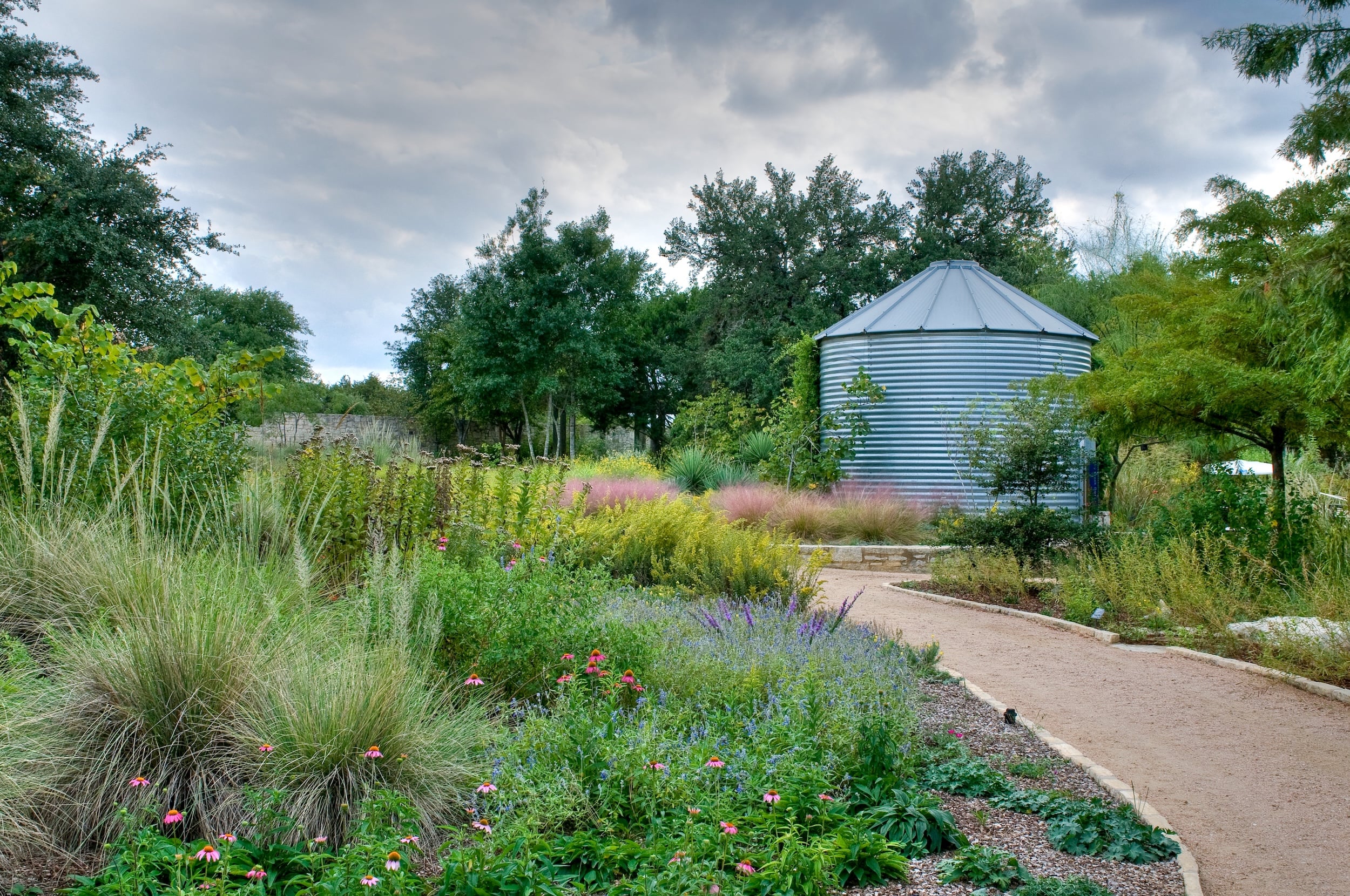
Wildflowers line the path to the Silo at Lady Bird Johnson Wildflower Center. Photo Lady Bird Johnson Wildflower Center
The Lady Bird Johnson Wildflower Center: A Living Legacy
I’ve watched my granddaughter’s eyes light up at the Lady Bird Johnson Wildflower Center since she was small enough to ride in a stroller.
The center is more than a garden. It’s a place where children wander limestone paths, where parents pause longer than they meant to, and where even hurried adults slow down without quite planning to.
In spring, bluebonnets, black-eyed Susans, and Indian paintbrush spill across the meadows in wide bands of color that feel unmistakably Texan. In early summer, native grasses sway in the heat, and shaded courtyards offer relief beneath a big sky. Fall brings softer light and late bloomers. Winter strips things back to structure — seed heads, bare branches, the quiet geometry of the land.
Founded in 1982 by Lady Bird and actress Helen Hayes, the center began as the National Wildflower Research Center. Its mission was straightforward: protect and reintroduce native plants. Today, it partners with the University of Texas and continues that work through research, seed banking, and sustainable landscape design.
But when you’re there, what you notice first isn’t the mission statement. It’s the stillness. The crunch of gravel underfoot. The way native plants thrive without constant tending.
You leave looking at your own yard, and maybe even your own city, a little differently.

Pink clouds reflected in the pond at the Lady Bird Johnson Wildflower Center’s display garden. Photo Lady Bird Johnson Wildflower Center
Austin’s Green Soul
Lady Bird Johnson didn’t just plant flowers. She planted expectations.
Drive through Austin in spring and you’ll see wildflowers edging highways and medians. Walk the Ann and Roy Butler Trail around Lady Bird Lake at sunrise and you’ll pass runners, cyclists, and families with strollers — all moving through a space that feels cared for.
That layering of nature into daily life didn’t happen by accident.
Austin’s identity, its greenbelts, trails, and accessible waterfront, reflects her steady insistence that nature and community belong in the same frame.
Visitors sense it too. Come in spring for the wildflowers. Wander Zilker Botanical Garden. Take a Hill Country drive just outside the city limits. The landscape isn’t the background here. It’s part of what makes the city feel like itself.

Kayaking on Lady Bird Lake. Photo Visit Austin
Lessons from Lady Bird Johnson
Lady Bird Johnson’s life reminds me that influence doesn’t have to be loud to last.
She didn’t simply speak about change; she worked for it — meeting resistance, persuading lawmakers, and returning to the same arguments until they gained traction. She understood patience and persistence.
Living in Austin, I see her impact in small, daily ways: in roadside blooms, shaded benches, and preserved shoreline. It makes me more attentive. A little more protective.
Taking care of our surroundings isn’t decorative work. It’s civic responsibility and, at its best, an act of love.
Plan Your Visit
Where: Lady Bird Johnson Wildflower Center, Austin, Texas
Hours & Info: www.wildflower.org
Best Time to Visit: Spring for peak wildflowers; early fall for comfortable walking weather
Nearby: Lady Bird Lake trails, Zilker Botanical Garden, Texas Hill Country scenic drives

Praire Coneflower in Bloom at Lady Bird Johnson Wildflower Center. Photo Sharon Kurtz
Lady Bird Johnson made conservation feel practical and personal. She didn’t just shape Austin’s landscape; she changed how we move through it.
You see her imprint everywhere—in wildflower-lined roads to parks and trails, and it makes me grateful to live somewhere that carries her vision forward. For those of us who live here, her legacy isn’t abstract.
It’s blooming — sometimes quietly — all around us.
Click here for discounted accommodations in Austin, TX
Join the community!
Join our community to receive special updates (we keep your private info locked.)

