

The Passages of Buenos Aires – Where the Soul of the City Lives
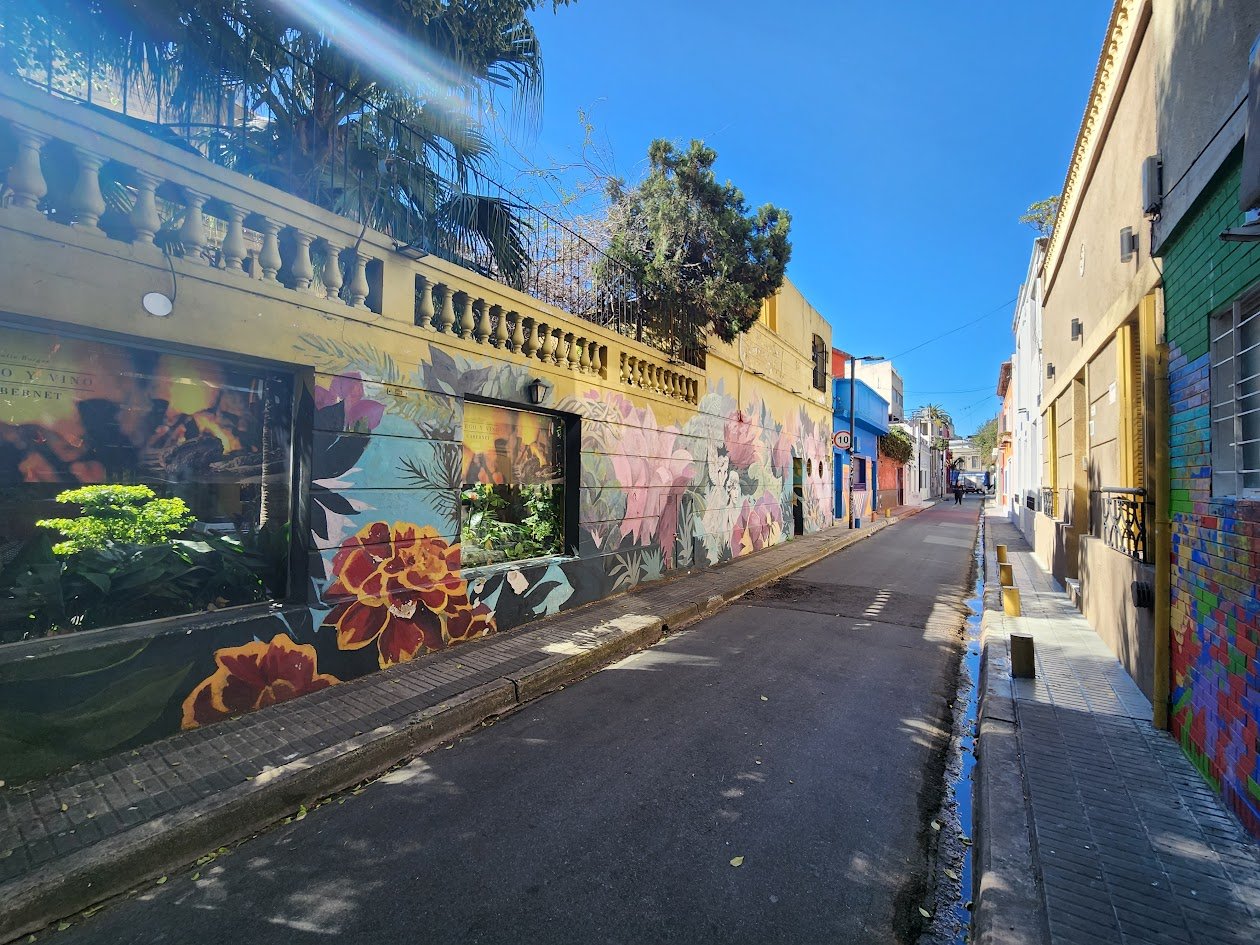
Pasaje Russel Photo: Ana Astri-O"Reilly
Posted November 16, 2025
Acclaimed Argentine author and poet Jorge Luis Borges once wrote, “Hard to believe Buenos Aires had any beginning. I feel it to be as eternal as air and water.” Buenos Aires has a rich history and architectural heritage for a relatively young capital with an ancient soul. And the best way to discover the soul of the city is to take long, leisurely walks.
As you stroll around, you will find oases of quiet in busy areas. These are the pasajes, or passageways, which serve as time capsules, preserving the memory of a city in constant flux. They also show us how generations of Porteños went about their daily lives.
But why do the passages of Buenos Aires exist? There are many different reasons. Most passages were built in the late 19th and early 20th centuries when the city experienced rapid and significant economic and population expansion.
Some passages were created when large, wealthy families divided their street block among their children and needed access to their homes. Others were designed as covered shopping arcades, while others emerged as a solution to overpopulation. These newly created inner streets increased the buildable area and provided desperately needed space for new homes.
Passages come in different shapes and sizes, like cul-de-sacs, through streets, U-shaped, or L-shaped. They can be public, like the through streets, or built on private land, like the covered commercial galleries of the late 19th century. Other passages are repositories of street art, where Porteño artists bare their souls.

Pasaje 5 de Julio Photo: Ana Astri-O’Reilly
Pasaje 5 de Julio, a Historic Battle Site
It’s July 1807. The menacing presence of British warships off the coast of Buenos Aires announces an impending invasion. The United Kingdom needs a foothold in the Spanish Americas because Napoleon’s Continental Blockade has stopped trade with Europe. The colony of Buenos Aires, distant from the metropolis and vulnerable to attacks, is there for the taking.
The Royal Navy’s attempt to invade and conquer Buenos Aires failed. Local militiamen, with the spontaneous help of ordinary citizens, fought them back. It’s hard to picture the cannon shots and war cries now, but there was a hard-fought battle in the area around the Santo Domingo convent. That decisive battle took place on July 5th and marked the beginning of the Spanish colony’s road to independence. It is said that many English soldiers were buried at the site of the old Dominican monks’ cemetery, which is where the Pasaje 5 de Julio is located.
Nowadays, Pasaje 5 de Julio is a quiet, cobbled pedestrian street. The architectural styles range from Beaux-Arts to rationalism to colonial. The presence of the Dominican Order is still noticeable today: the 18th-century buildings belong to the Divinity School of the Universidad Santo Tomás de Aquino, and the convent and basilica are located just a few yards from the pasaje.
The Timeless Elegance of Pasaje Roverano
Next to the historic Cabildo, the seat of colonial power in Buenos Aires, stands Pasaje Roverano. Built in 1878 by Angel and Pascual Roverano, the original two-story building had shops on the ground floor and apartments on the first.
In 1888, the owners gave up a section of the building to make way for the new Avenida de Mayo. Soon after, they added extra floors to compensate for the loss of space. In 1912, the building underwent further renovations, and the passage connecting Avenida de Mayo with Hipólito Yrigoyen Street was added.
Although this century-old passage is open to the public, Pasaje Roverano is located on private property. The shopping arcade on the ground floor exudes the elegance and sophistication of early 20th-century design. Curved windows with brass frames grace the storefronts, and stained-glass windows add a note of color. The magnificent onyx staircase takes you up to the upper floors or down to the basement and more commercial space.
The COVID-19 pandemic forced many businesses to shut down, including the barber shop where the late Pope Francis had his hair cut. However, Pasaje Roverano is experiencing a renaissance with the traditional hat shop Lagormasino leading the way. For evening drinks and live music with wonderful city and river views, the rooftop bar Mirador Plaza de Mayo is unparalleled. Reservations are required.
The rich materials and graceful lines of Pasaje Roverano transport you to a bygone era of Buenos Aires.

Pasaje Rivarola Photo: Ana Astri-O’Reilly
Parisian flair at Pasaje Rivarola
Hidden away from the hustle and bustle of the Tribunales area, Pasaje Rivarola is an oasis of calm and elegance designed in 1924 by the acclaimed architectural firm Petersen, Thiele, and Cruz.
What makes Pasaje Rivarola unique is its symmetrical design. The four Beaux-Arts buildings on one side mirror those opposite, and each of the four corner buildings features a beautiful neoclassical dome. Each dark dome has white accents and is topped with a smaller cupola and a pointed spire. The use of high-end materials, such as marble, Slavonian oak, and intricate wrought iron, in the Juliette balconies contributed to its charm.
Although the area, like the rest of the city, was severely impacted by the COVID-19 pandemic, a few businesses have managed to survive, including an art gallery, the Libreria de Mujeres —a bookstore specializing in feminist literature —and Café Rivarola, a perfect spot for a quiet coffee or a light lunch.
Palermo Soho’s Urban Art
The Palermo Soho neighborhood has long been the epicenter of art, fashion, and design in Buenos Aires. Street art, cobbled streets, independent boutiques, and turn-of-the-century architecture contribute to its bohemian atmosphere.
Not far from Plaza Serrano, along Gurruchaga Street, there is a succession of passages: Russel, Santa Rosa, Soria, and Coronel Cabrer. Although they are situated in a busy commercial area, these original pedestrian streets provide an oasis of calm and color.
In each passage, the facades are masterpieces of art intervention. Colorful murals, graffiti, whimsical tiled designs, and posters with artists’ manifestos adorn every available space and vie for your attention.

Pasges Lanin Photo: Ana Astri-OReilly
Art Intervention at Pasaje Lanín
Barracas, a barrio in the southeast portion of Buenos Aires, had a thriving abattoir and tannery scene until the yellow fever epidemic of 1871. After the wealthy families fled north to avoid the plague, working-class and immigrant families moved in. Factories and warehouses provided jobs, although most had closed down by 1980, and the neighborhood started to decline.
Local artist Marino Santa María, who lives and works on Pasaje Lanín, decided to add a pop of color. In the early 1990s, he decorated the front of his home with mosaic tiles forming abstract designs. This uplifted the street and brought a sense of joy.
His neighbors liked it so much that they asked him to intervene their homes’ facades. Santa María sketched a unique design for each house, and the homeowners chose the colors. Little by little, the result of this collaboration between artist and neighbors was a bright and lively area in a predominantly grey and industrial landscape.
The passages not only alter the city’s grid pattern but also preserve the atmosphere of previous eras, providing a sense of belonging and porteño identity.
Click Here for Discounted Accommodations in Buenos Aires
Join the community!
Join our community to receive special updates (we keep your private info locked.)

