Travel to Armenia for Ancient Monasteries, Wine and Mountain Trails

Travel to Armenia for Ancient Monasteries, Wine and Mountain Trails

Tatev Monastery stands amid the mountains of Armenia’s Syunik Province. The medieval complex became an important religious, cultural and educational center.

Posted February 8, 2026

Getting your Trinity Audio player ready...

Editor’s note: This article was revised and updated by Tonya Fitzpatrick in August 2026. 

Armenia may be small, but it is not a country to rush through.

The landlocked nation sits in the South Caucasus, bordered by Georgia, Azerbaijan, Iran and Turkey. A trip can move from Yerevan’s museums and cafés to medieval monasteries, vineyard country and mountain trails without covering enormous distances.

Yerevan is the natural starting point. Republic Square, the Cascade Complex and the Matenadaran manuscript museum introduce different parts of the capital’s story. On a clear day, Mount Ararat appears beyond the city. The mountain remains one of Armenia’s most important national symbols, although it stands across the border in modern-day Turkey.

Yerevan skyline at dusk with Mount Ararat in the distance

Mount Ararat appears beyond Yerevan at dusk. The mountain remains closely tied to Armenian identity, although it stands across the border in eastern Turkey.

Armenia’s Christian Heritage

Armenia is widely recognized as the first state to adopt Christianity as its official religion. Armenian tradition dates that decision to 301. The Mother See of Holy Etchmiadzin remains the spiritual and administrative center of the Armenian Apostolic Church.

Three intricately carved Armenian khachkars standing outdoors

Khachkars, Armenia’s distinctive carved cross-stones, combine Christian symbolism with detailed patterns and motifs. The tradition remains an important expression of Armenian cultural identity.

The country has three properties on UNESCO’s World Heritage List: the Cathedral and Churches of Echmiatsin with the archaeological site of Zvartnots, the monasteries of Haghpat and Sanahin, and Geghard Monastery with the Upper Azat Valley.

Geghard offers one of Armenia’s most memorable settings. Builders carved parts of the medieval monastery directly into the rock. The complex once included a school, library and manuscript center as well as churches and tombs.

These sites remain places of worship, not simply historic attractions. Visitors should follow posted rules, dress respectfully and avoid interrupting religious services for photographs.

Garni Connects Armenia’s Pagan and Christian Past

Many travelers pair Geghard with the nearby Temple of Garni.

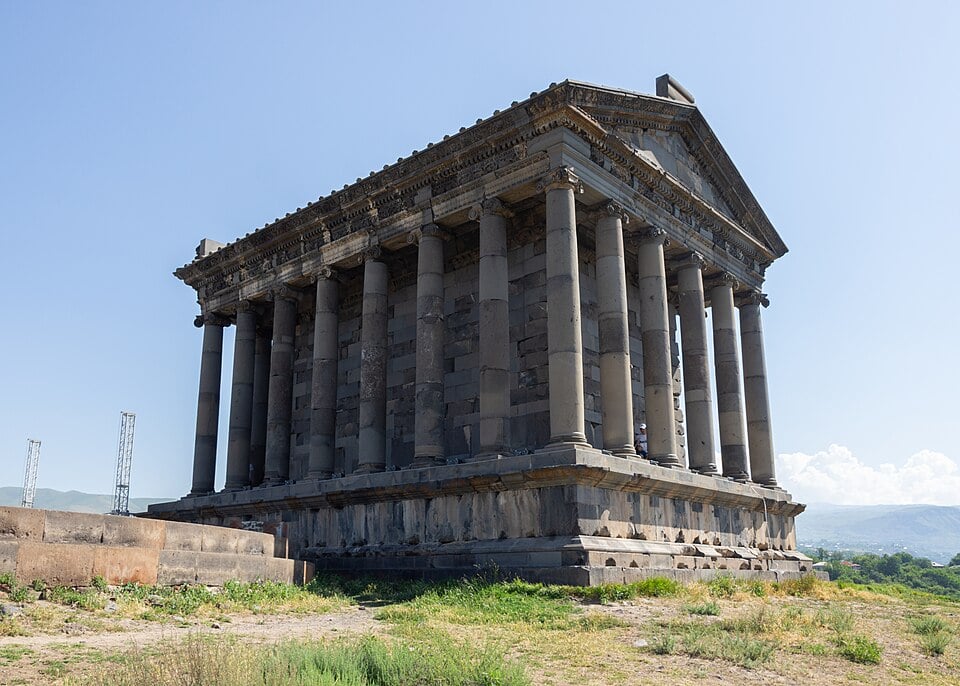
King Tiridates I erected the temple in 77 AD. Its colonnaded design reflects Hellenistic architecture, and historians have long associated it with Mihr, the Armenian sun god.

What visitors see today is not an untouched ancient building. A powerful earthquake caused the temple to collapse in 1679. Architect Alexander Sahinyan led its reconstruction from 1969 to 1975, using surviving stones and new material where necessary.

Temple of Garni overlooking the Armenian highlands

The first-century Temple of Garni reflects Armenia’s pre-Christian past. An earthquake destroyed the structure in 1679, and specialists reconstructed it between 1969 and 1975. Credit: Vyacheslav Argenberg/Wikimedia Commons, CC BY 4.0

Below the archaeological complex, basalt columns line the Azat River Gorge. The formation is often called the Symphony of Stones because the tall columns resemble the pipes of an organ. Garni and the basalt formation were added to Armenia’s UNESCO tentative list in 2025, but they are not yet inscribed World Heritage sites.

Armenia’s Wine Story Goes Back Thousands of Years

Armenia’s wine history reaches far beyond its modern tasting rooms.

Excavations at Areni-1 Cave in Vayots Dzor uncovered the earliest known integrated winemaking installation. Dating to around 4000 BCE, it included a grape-pressing platform, fermentation vessels, storage jars and chemical traces of wine. Armenia placed the cave on its UNESCO tentative list in 2026.

Modern vineyards continue to shape the surrounding region. Visiting smaller wineries and village producers can keep more tourism income within local communities.

Food offers another way into Armenian culture. Lavash, the thin bread traditionally prepared in a clay oven, is part of everyday meals and family celebrations. UNESCO placed Armenia’s lavash-making tradition on its Intangible Cultural Heritage list in 2014.

Mountain Trails Beyond Yerevan

Armenia also has a strong outdoor side.

Dilijan National Park offers forest trails, lakes and access to historic monasteries. Near Yenokavan, the Lastiver area is known for wooded paths, caves and waterfalls. Farther south, Vayots Dzor and Syunik add rocky landscapes, small communities and some of Armenia’s most dramatic religious sites, including Tatev Monastery, which overlooks the Vorotan Gorge.

Travelers should plan remote routes carefully. The current U.S. State Department advisory places Armenia at Level 2 and says not to travel to the border region with Azerbaijan. It also restricts travel by U.S. Embassy personnel in specific parts of Gegharkunik and Syunik. Check current guidance before hiking or driving near border areas.

Armenia works best when travelers leave room for more than the major landmarks. Spend time in Yerevan, but follow the monasteries, vineyards and mountain roads into smaller communities. The distances may look short on a map. The history rarely is.

Flock of sheep grazing across rocky highland terrain in Armenia

Sheep graze across Armenia’s rugged highlands, where pastoral traditions remain part of rural life.

Book Your Stay in Armenia

Use the interactive map below to compare hotels and rentals in Yerevan and other parts of Armenia. Move the map to explore different regions, then use the filters to compare prices, locations and amenities.


Join the community!

Kalinag-TM_sm.jpg

Join our community to receive special updates (we keep your private info locked.)

  • Jackie Jones1

    Jacqueline “Jackie” Jones is a Barbadian author and entrepreneur who spends more time lost in the virtual world than anyone should. Jackie loves meeting new people as much as she loves traveling, and she’s often guilty of “interviewing” unsuspecting strangers whether they want her to or not. When she’s not dealing with the day-to-day of running two businesses (Originz Multimedia and Waterway Media), or spending time with family and friends, Jackie turns to words and is an accomplished speculative fiction writer.