

Six Adventurous Cruises for Intrepid Travelers
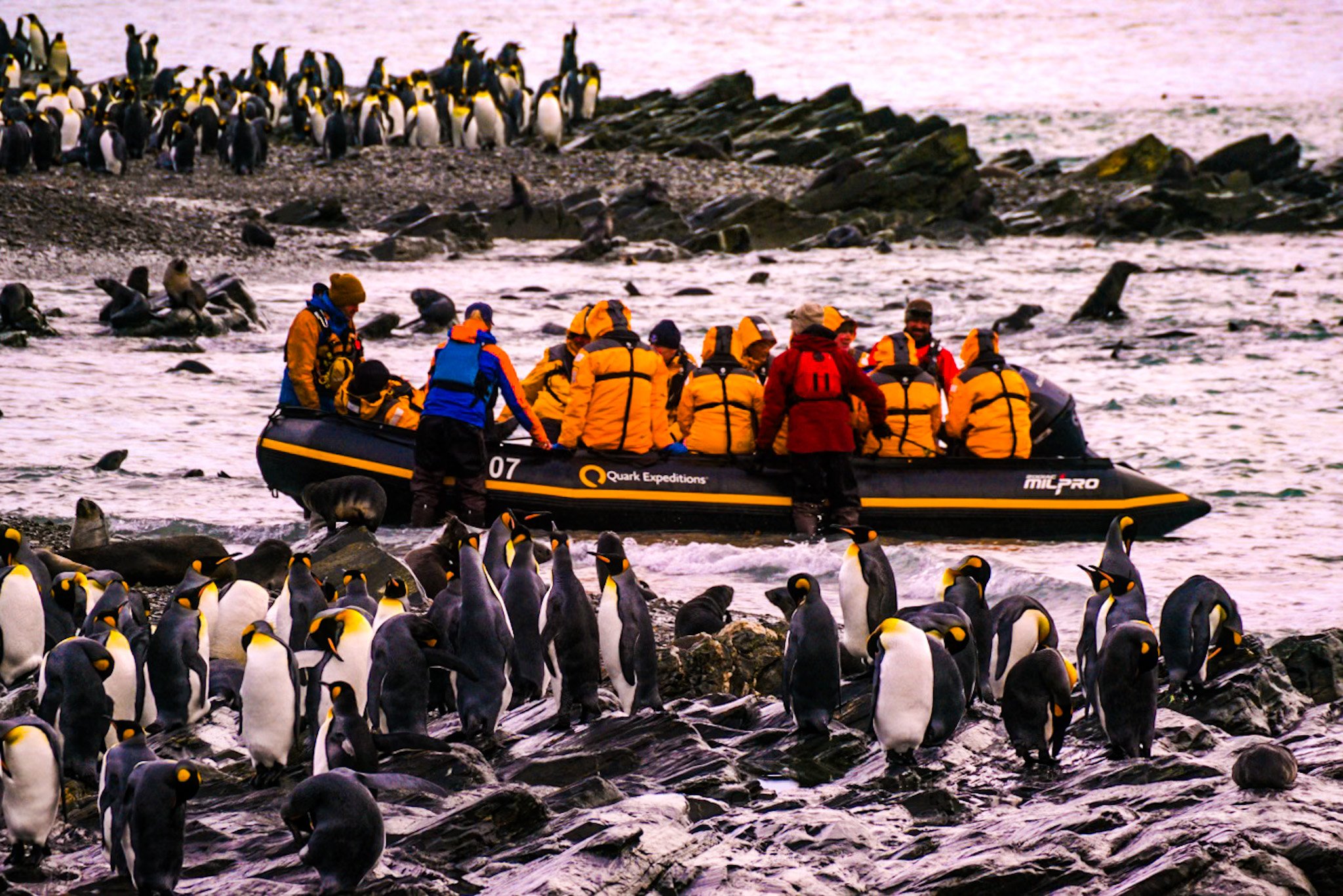
On a zodiac landing in Antarctica with Quark Expeditions
Posted October 9, 2025
Expedition cruises extend to some of Earth’s most fragile and captivating lands with itineraries that focus on nature and culture. Traditional cruises may offer a robust choice of onboard activities and a seemingly endless number of food options, but expedition cruises provide a very different motivation: Scientists, marine biologists, historians, and other experts lead expeditions. And no two cruises are ever the same.
The Expedition Experience
The experience of traveler Gabriela Ramos on a Quark Expeditions cruise is illustrative. “I was awestruck when hundreds of Emperor penguins surrounded me on a stopover at South Georgia Island,” she said. “To keep a responsible distance from these amazing flightless birds, yet to be so up close and personal, was an experience that will be etched in my heart and soul forever.”
That could never have happened on a traditional cruise with thousands of fellow passengers. Expedition cruises mount their intrepid voyages on smaller ships with a capacity of under 200 guests. They utilize Zodiac craft for daily landings on wilderness shores to discover unforgettable landscapes and diverse wildlife in their natural habitat. Often, they will be greeted by Indigenous communities and other local people.
Here are six expedition cruises that offer a range of opportunities. We’ll look at polar routes to Antarctica and Greenland, along with a transit of the Panama Canal to the biodiverse shores of Costa Rica and Panama. Then, we’ll discover Polynesian culture in Tahiti. We’ll also marvel at marine life in the Sea of Cortez, and explore the world’s largest rainforest in the Amazon.

Encountering penguis at Saint Andrew’s Bay South Georgia Island Photo: Nicholas Kontis
Quark Expeditions
Since the early 1990s, Quark Expeditions has been at the forefront of polar expedition cruises, boasting the largest polar-class fleet in the industry. The South Georgia and Antarctic Peninsula Penguin Safari rank among the most popular voyages. Due to climate conditions, it is feasible only between October and March.
My 16-day voyage with 127 other travelers began in Buenos Aires. We flew to Ushuaia, Argentina, to board Quark’s newest vessel, the Ultramarine. Then we crossed the tumultuous Drake Passage to South Georgia Island and icy Antarctica, Earth’s southernmost continent.
The only settlement in South Georgia is the tiny hamlet of Grytviken. Here, visitors may find the landmark grave of Sir Ernest Shackleton, the charismatic Irish polar explorer. But I came to see penguins, which inhabit the island in incredible numbers. There’s a good reason Quark promotes this as its “Penguin Safari”: South Georgia is home to four species of penguins and more than 30 other species of breeding birds.
The Ultramarine accommodates up to 199 guests and 140 staff and crew. Designed for comfortable sailings in rougher waters, the vessel is well prepared to plow the treacherous Drake Passage.
Why go: In a word, penguins. Iconic emperor penguins and a diverse array of birds are on display. The Ultramarine is both functional and cozy, with large staterooms. The southern polar region is a paradise for landscape photographers. Scenes such as clouds floating over snow-capped peaks, towering above the open sea, must have enchanted Shackleton.

A parrot couple in the Amazon Photo: Nicholas Kontis
Aurora Expeditions
The tropical rainforests of Costa Rica and Panama rank among the most biologically diverse on our planet. Aurora Expeditions’ 14-day Costa Rica and the Panama Canal cruise, aboard the high-tech vessel Greg Mortimer, provides a wonderful way to explore the region.
Costa Rica’s Manuel Antonio and Corcovado National Parks are home to sloths, parrots, macaws and four species of monkeys — capuchin, howler, spider, and squirrel. Well-tended hiking trails link white-sand beaches with rugged rainforest. Panama’s Coiba National Marine Park reveals a wealth of oceanic creatures. Cruise passengers enjoy snorkeling in colorful reefs, kayaking through a tranquil bay, and stand-up paddleboarding.
Also in Panama, travelers visit a village of Indigenous Emberá Drua people and take a guided tour of Panama City’s charismatic old town, Casco Viejo. A day crossing of the remarkable Panama Canal, through the locks from the Pacific Ocean to the Caribbean Sea, checks off a bucket-list experience.
Why go: Besides the array of biodiversity, many travelers consider the 50-mile transit of the Panama Canal, through the jungles from the Pacific to the Caribbean, to be the adventure of a lifetime. Aurora guarantees a daylight crossing of the world’s most famous canal. Expert expedition guides explain the history and workings of the channel on the annual sailing, which begins in April.
The Greg Mortimer is a comfortable expedition ship. Observation decks, spread throughout the boat, are ideal for mingling with the crew and other guests, as well as enjoying scenic views, especially sunsets.

The spellbinding stripped rocks of East Greenland. Photo: Nicholas Kontis
Poseidon Expeditions
The Arctic contains some of the last untouched wilderness and the vastest open spaces on Earth. It is defined by colossal glaciers that shimmer in the summer’s midnight sun, lofty icebergs, picturesque fjords, and mountains in polychromatic stripes. In Greenland, polar bears outnumber humans.
In 2022, I realized an Arctic dream that had been delayed two years by the Covid pandemic, as I joined Poseidon’s voyage from the Svalbard archipelago to Greenland and Iceland. I flew to Longyearbyen, Norway, on Spitsbergen Island, home to 2,400 residents from 53 countries—and the port from which many Arctic adventures begin.
Following in the footsteps of Norwegian explorer Roald Amundsen, Poseidon’s expedition extends to the untouched eastern shore of Greenland and remote parts of volcanic Iceland, as well as the colorful city of Reykjavik, the world’s most northerly capital.
Why go: The incomparable Arctic is a unique and remote destination. Seeing the Northern Lights alone might be reason enough to visit this trifecta of some of the northernmost terrains in the world. These pristine landscapes, largely devoid of people, harbor 36 different species of mammals, including the polar bear. This makes any Arctic expedition a grand adventure.

Amazon Nature Tours stopvover to an indigenous village
Amazon Nature Tours
An expedition cruise provides the best way to view the Amazon jungle ecosystem. Better even than a stay at a remote lodge. Amazon Nature Tours’ small ship “Voyage to the Heart of the Amazon” offers a luxurious option.
The Amazon River boasts over 1,100 tributaries, 17 of them more than 1,000 miles long. Comprising 4 million square miles, the Amazon Basin holds two-thirds of all flowing water in the world. In the heart of the rainy season (December to May), the river discharges more than 32 million gallons of water per second. Its gargantuan main channel stretches up to 10 miles wide, sometimes making it impossible to see one side from the other.
The purposely built motor yacht Tucano carries no more than 18 guests on its expeditions from Manaus, Brazil’s paradoxical modern city in the heart of the jungle. The Tucano ventures nearly 200 miles further up the mammoth river than other vessels, making its voyage almost twice as long. Exquisite and spacious decks and deluxe staterooms make this an epic adventure.
Why go: Fish for piranha. Stop for a piranha-free swim. Meet Indigenous tribes at village stopovers. Marvel at the abundance of wildlife, including spider monkeys, sloths, macaws and caimans. The mighty Amazon will always be an explorer’s dream, a natural wonder, an ecosystem unrivaled in diversity and size.

A local Embera women sells souvenirs to visitors Photo: Nicholas Kontis
Variety Cruises
When travelers conjure images of French Polynesia or Tahiti, the first thing that comes to mind is often the idyllic island of Bora Bora, renowned for its luxurious hotels. For example, the iconic Four Seasons Bora Bora features swanky over-the-water bungalows that offer unblemished views of the omnipresent Mount Otemanu.
For travelers wanting to visit multiple islands during a shorter visit, Variety Cruises’ “Tahiti and French Polynesia” itinerary might be more suitable. A small-ship Greek cruise line, Variety offers seven- and 10-night circuits of the Society Islands from the Tahitian capital of Papeete. At 164 feet, the double-masted motor sailor Panorama II has 25 ocean-view cabins with a capacity of 49 guests and 18 crew.
My seven-night cruise brought me to Bora Bora as well as the islands of Moorea, Huahine, Taha’a, and Raiatea. The longer voyage extends to the far-flung and rarely visited Tuamotu island group, which includes Makatea, Rangiroa, and Tikehau.
Why go: A Variety cruise is like sailing with one big, happy family, and island-hopping aboard the Panorama II evokes a sense of South Pacific exploration reminiscent of Captain James Cook’s voyages. Travelers encounter native people showcasing their daily way of life. Incredible snorkeling in clandestine blue lagoons, visits to unpretentious beaches, and excellent onboard cuisine make traveling to Tahiti more than worth the effort.

UnCruise Expeditions a stopover at Isla San Francisco, Sea of Cortez Photo: Nicholas Kontis
UnCruise Adventures
Oceanographic pioneer Jacques Cousteau called the Sea of Cortez “the world’s aquarium.” The UNESCO World Heritage Site lives up to that designation. That’s why the UnCruise Adventures tour, “Baja California’s Whales and Sea Life,” is so popular with travelers who love the nature of a marine environment.
I traveled around the Sea of Cortez for seven days with an intimate group of curious explorers. We swam with sea lions and whale sharks. We also encountered many of the nine species of whales that roam the isolated waters in the winter months.
UnCruise, which began business as a single yacht sailing Alaskan waters, now also offers voyages to Hawaii, Costa Rica, and Ecuador’s Galapagos Islands. Its 10-day Sea of Cortez cruise follows a six-week journey by famed author John Steinbeck aboard a sardine boat in 1940.
Why go: This is a quest for endemic flora, fauna, and secluded beaches on desert islands and other nature preserves in Baja California’s “Galapagos of the North.” Eco-activities include snorkeling, hiking, paddleboarding, kayaking and horseback riding. Stopovers are in Isla San Jose, Bahia Agua Verde, Isla San Francisco, Parque Nacional Bahia de Loreto, Los Islotes, Isla Partida, Isla Carmen, and the area’s crown jewel, Isla Espiritu Santo.
Click Here for Discounted Accommodations in Baja, California
Join the community!

Join our community to receive special updates (we keep your private info locked.)

