

Indonesia’s Mentawai Islands—West Sumatra’s Undiscovered Tropical Paradise
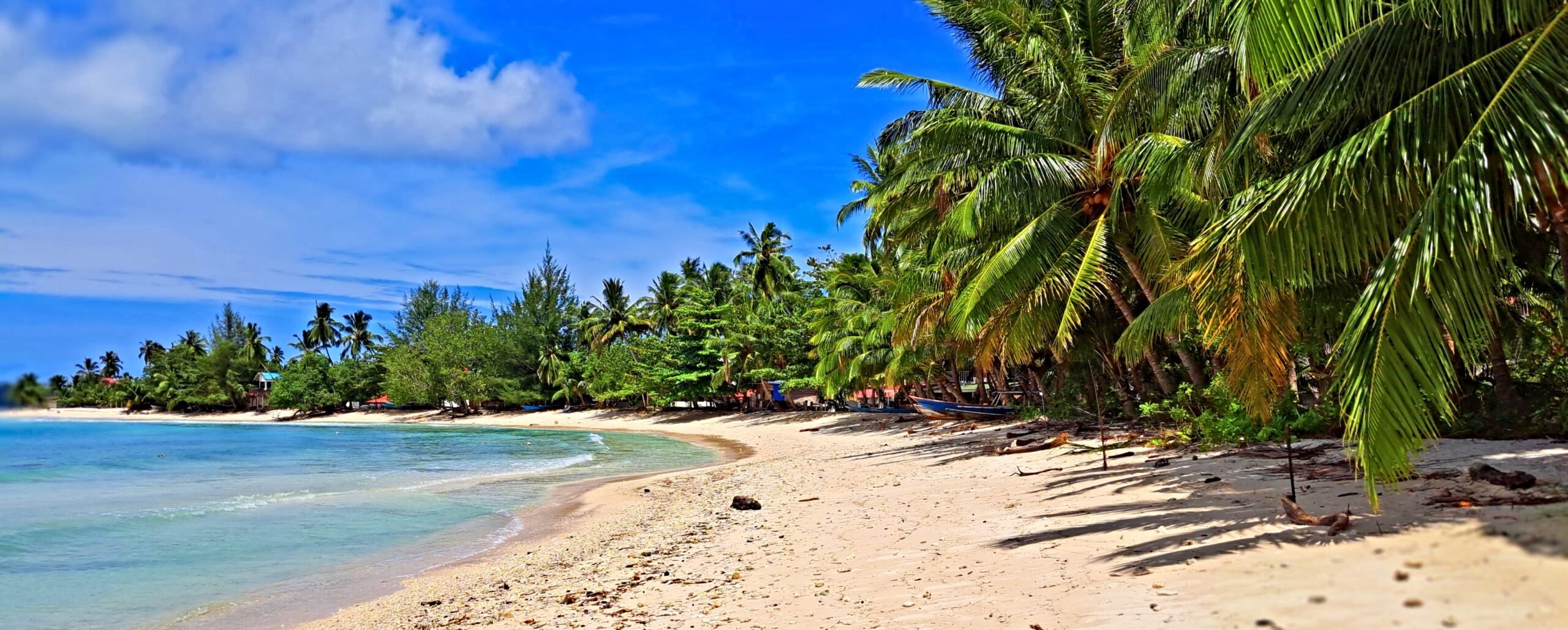
The Mentawai Islands are a jungle-meets-ocean nirvana Photo: Bruce Northam
Posted August 22, 2025
Talk about a getaway. Indonesia’s 17,000 islands include Sumatra, the world’s sixth largest. Making up an incredible slice of its west coast, West Sumatra hugs the Indian Ocean, where 100 miles offshore lie the fabled and exotic Mentawai Islands. Engaging locals include a mix of colorful Indo, tribal, and missionary characters who—mixed with stunning visitor affordability—make these islands a true jungle-meets-ocean nirvana.

The Mentawai Islands–where front-yard boatbuilding and repair sets the late afternoon tone Photo: Bruce Northam
In-the-know international surfers aside, West Sumatra’s Mentawai Islands are not on most tourist’s hitlist. Of course, that makes them even cooler. Surfers charter live-aboard boats to visit the region’s other outlying islands where the Indian Ocean makes for an unforgettable waves playground. World travelers are starting to catch on to these storied islands, which are inhabited primarily by native-tribal animists and the result of successful missionaries. Eighty percent of the population is Christian. A modern airport opened here in 2024. As these islands grow in popularity, mainland Muslims are arriving to look for employment.

Joy on Indonesia’s Sipora Island Photo: Bruce Northam
Sipora Island
Sipora Island is a four-hour boat ride from mainland Padang, where you’ll ride with locals, serious surfers, and volunteer types. Tuapegat is the island chain’s capital where guesthouses mingle with local homes while front-yard boatbuilding and repair sets the late afternoon tone.

They start ‘em young on the Mentawai Island! Photo: Bruce Northam
This is key: American wintertime is low season here. This is not typical for Southeast Asia when tourism typically peaks from December through February. The high-surf season here is June through September. So if you visit to avoid the American winter, you’ll pretty much have the place to yourself.
Sipora’s Crow’s Nest

Sipora’s Crow’s Nest, a splendid waterfront guesthouse Photo: Bruce Northam
Sipora is one of three developed and inhabited amid Mentawai’s 97 islands. I stayed at the 14-guests-max Crow’s Nest waterfront guesthouse, where the multihued, jade-colored waves lull you to sleep and later start your day. Breakfasts here, and pretty much everywhere in this region, include fresh watermelon, pineapple, and papaya. For dinner, we bought grouper from the local fish market and barbecued it on the beach using an actual lemongrass brush to apply fish sauce. This is the perfect tropical beach near a town where a short stroll along the shoreline brings you to places like the Aussie-owned Bakery that not only makes the best bread on these islands but also features a handsome beachside gazebo and an outdoor surfboard-themed shower.

Sipora’s worm ladies don’t mess around with instant protein Photo: Bruce Northam
A drive into the highlands led to a short riverside hike to visit the “worm ladies,” a one-of-a-kind culinary display where two women chop open-river-soaked tree trunks to retrieve the two-foot-long worms living inside channels within the wood. Knee-deep in the river, your hosts gleefully chomp down the worms, which are an excellent source of protein. This is just another one-of-a-kind local experience.
More Charming Lodging Options
I also enjoyed the Oinan Homestay’s stone floors, high ceilings, and views of the coastline. I bonded with the owners and hosts, Desti and Didit, via a lobster barbecue and, the next day, on a fantastic road trip. We drove five hours, back and forth, to the southern tip of Sipora on a new east-coast road. We stopped midway in Sioban, passing wild clove trees and a side-by-side church and mosque. When we reached the end of the road in Katiet, the mood changed as this is a more exclusive area with advance-booked private surf camp villas for international surfers in search of its seasonal 25-foot waves. It’s an idyllic setting but not a stroll up and sample the rooms and pre-meet the staff sort of environment. It was, however, the sleepier offseason, so there was plenty of space to be had. Part frontier, part luxury, the Hollow Tree’s Resort is also open to walk-ins in search of food, beverage, and conversation.
Siberut Island

Boat transport–large and small–is a way of life in the Mentawai Islands Photo: Bruce Northam
A few days later, Desti and Didit became my unofficial chaperones when we took a wild and wavy longboat ride from Sipora Island to Siberut Island that tested my seamanship. Because Desti is a local healthcare executive, we were picked up by a rustic ambulance and transported to the beachfront Manai Koat Guest House in Muara Siberut, the island’s main village. This island features a green landscape and a medley of traditional houses. Here, you’ll find shamans; wild ferns boiled in coconut milk; and jengkol, a delicious stiff circular veggie resembling snow peas. Like in Sipora, accommodations also include exclusive pre-booked surf-camp hotspots.
The more I travel, the more I avoid tourist traps and enjoy simply partaking in the daily life of locals. For instance, Desti manages 1,000 healthcare workers on the Mentawai Islands. I joined her visit to the Puskesmas Public Health Center where she made a speech about local clinics providing yearly physicals. Afterwards, the hospital staff and locals’ moods improved, turning to perpetual smiles and laughter. This is what happens minute by minute in West Sumatra. Our next stop was joining in on a birthday lunch, complete with eye-catching entrees and a tasty cake. Fellow travelers, you will love this part of Indonesia.

Siberut’s Puskesmas Public Health Center Photo: Bruce Northam
Deep into Siberut’s Jungle
Next, it was time to go deep into the island’s interior jungle to meet the true natives. It started with a two-hour drive in a truck on a road that could hold the world record for being the ultimate muddy roller coaster. Then, a village stroll led us to the Buttui River where we loaded into a skinny and tippy canoe that puttered upriver. After stepping onto land again, several stream fjords on foot led us to Buttui village. My guide, Bayu, also brought in supplies for the tribe and initiated a mattutubatta (reunion), as Bayu’s relationship with this tribe goes back many years.
Meeting the Locals
We were greeted like family by Indonesian brothers’ Aman Godai and Aman Lepon, fathers who are also shamans, tattoo artists, and archetypal survivalists. These badass full-time hunters were blown away by my NYC subway map illustrating underground train tunnels, as translated by Bayu, and even more bewildered by the fact that I ride in a tunnel under a river (East River) to visit my wife.
They’ve never worn footwear of any kind. Here, male grooming means plucking beard hairs individually—armpit hairs, too. Chatty and ebullient, they have powerful and piercing eyes. On one of their many necklaces, they hang a bobby-pin, gifted by Bayu long ago, to remove foot thorns and share tattoos. Monkeys, sago, and bananas are central to the cultural Mentawai diet. Godai and Lepon’s children are the first generation mandated to attend uniformed public school. Ps, NYC subway maps (free at all stations) are superb gifts when far and away.
Godai and Lepon’s tattoos have specific meanings. The patterns on their arms represent rattan, acknowledging it’s a necessity for everything they do. Their chests and backs bear bow-and-arrow tattoos including the string, as they hunt and live by the arrow. A ubiquitous sun tattoo represents universal sharing, while their leg tattoos represent the floorboards of their house, and thus stability. Their hands showcase fishing hooks while other parts of their bodies honor pig cages, monkeys, and waterski bugs (those bugs that walk on water). Last but not least, on their backs is always a tattoo of a canoe that corresponds with the balance of life.

Siberut Island brothers Godai and Lepon: shamans, tattoo artists, archetypal survivalists–and NYC subway fans Photo: Bruce Northam
Respect your food’s journey
I enjoyed lunch with the tribe, mostly snacking on their vital sagu, which comes from the inner core of a sagu tree that they refine into a sawdust-like flour that’s then cooked in rolled-up sagu leaves. The final product resembles a stalk of elongated popcorn. We enjoyed the meal seated in a semicircle upon the floor.
It was a family bash, a celebration of real hunters who, until now, had no need for money. None of the residents of this tiny village need to process daily stress. They’re handsome and beautiful at the same time as they’ve retained their pure Mongol origins. By the way, in 2020, animism was declared an official religion by the Indonesian government.

A skull shrine honoring monkeys, pigs, and deer Photo: Bruce Northam
A skull shrine inside Lepon and Godai’s traditional Mentawai Islands homes honor the spirit of their food source: monkeys, pigs, and deer. These hunters and their circle “pray” for these animals and their families, calling to their spirits and for more food. We all embrace higher powers.
On the way back to the coast, while our “mud truck driver” was navigating extremely difficult mud hills and holes, he calmly Facetimed with his wife and young child. The other highlight of the drive home was pausing at Kulukubuk Waterfall.
Pastor Pio

Pastor Pio was stationed here by the Italian Church in 1975 Photo: Bruce Northam
No local or traveler conversation in the Mentawai Islands goes without the eventual mention of Italian Pastor Pio, as after 52 years, he has rightly earned celebrity status there. As a younger man entering the priesthood in Italy, Pastor Pio sought out a more primitive mission and existence. He surely got what he asked for, ending up on the then very primitive Mentawai Islands when he was stationed there by the Italian Church in 1975. He first made a buzz by introducing locals to speargun fishing, and that was the beginning of his legacy helping to transform and improve the lives of these island people through education and goodwill.
Pio noted that the nearby 2004 Tsunami meant rescue workers flowing through the Mentawai Islands, which very much increased its recognition. Now 81, he continues assisting in the most difficult locales by still doing one-week jungle treks into remote areas. To understand these islands, Pio recommends two Cousteau films from 1990 when the cast and crew stayed with him for a week, The Heart of the Sea and The Son of the River. Upon further reflection, Pio warns of the initiation of an anti-local-culture Chinese takeover. When I met Pio, he was in Padang helping to ensure an islander’s university education. Mentawai’s Jesus never lets up for the sake of doing good. The Jungle Pastor’s final musing in his charming Italian accent was, “Doing good pays off, and being funny is everything—no serious!”
For more information about the Mentawai Islands, visit Indonesia.Travel. Consider hiring a local guide to enhance and simplify your experience—Bayu Kumbara is a pro!
Click Here for Discounted Accommodations in West Sumatra, Indonesia
Join the community!
Join our community to receive special updates (we keep your private info locked.)

