

Exploring St. Vincent’s Historical Attractions

St Vincent.Fort Charlotte. Photo: Tonya Fitzpatrick
Posted August 27, 2026
St. Vincent often stands in the shadow of the smaller Grenadine islands, whose beaches, sailing routes and private-island resorts dominate many travel stories about Saint Vincent and the Grenadines. Yet the country’s largest island offers more than a tropical escape.
Across St. Vincent, Indigenous rock carvings, colonial forts, historic churches and plantation-era structures reveal a Caribbean history shaped by conflict, migration, forced labor and cultural survival. Exploring these places also means looking beyond the familiar colonial story. The island’s history did not begin with European arrival, and its heritage cannot be understood only through forts and stone buildings.
St. Vincent’s History Began Long Before Colonization
Indigenous peoples lived on St. Vincent for centuries before Europeans attempted to settle the island. The Kalinago and Garifuna resisted European control well into the colonial period.
The Garifuna emerged on St. Vincent through the blending of Indigenous Caribbean and African peoples. Africans who escaped enslavement on nearby islands joined Indigenous communities; Garifuna oral tradition also recounts survivors of shipwrecked slave ships. Together, they developed a distinct Afro-Indigenous culture.
Joseph Chatoyer, also known as Satuye, became a leading figure in the resistance against British expansion. Older exhibits may refer to the Garifuna as “Black Caribs,” the term used in colonial records. Garifuna is the name used today.
Walk Through Historic Kingstown
Kingstown offers an easy introduction to St. Vincent’s historical attractions. The capital is sometimes called the “City of Arches” because of the stone archways lining several downtown buildings.
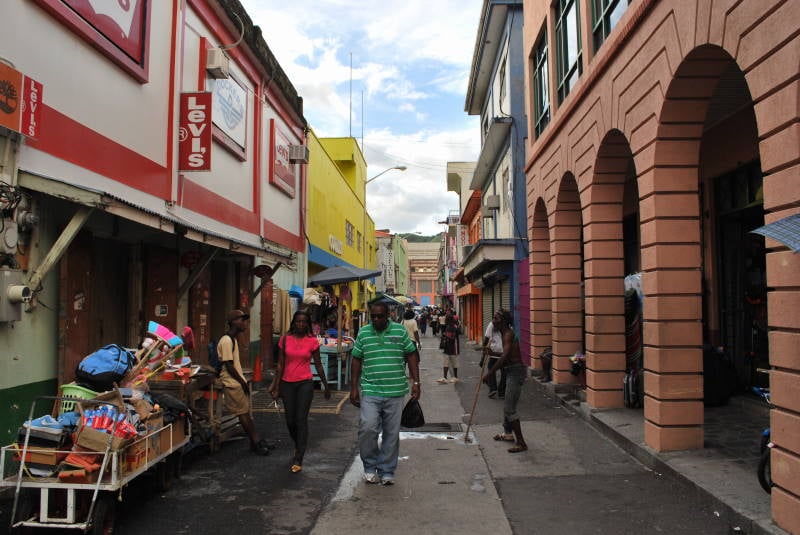
Shops, vendors and historic arches share the streets of central Kingstown, a working Caribbean capital where older architecture remains part of everyday life. Photo by Diego Tirira and CC.20.
The covered walkways provide shade while giving the city a distinctive look. Churches, government buildings, shops, street vendors and the market share the same compact center. Kingstown is not a historic district sealed off from daily life. Its older architecture remains part of a working Caribbean capital.
Look beyond the major buildings to notice the balconies, wooden shutters and relationship between the waterfront and the city center.
See the Island From Fort Charlotte
Fort Charlotte rises about 600 feet above Kingstown on Berkshire Hill. Construction began after Britain gained control of St. Vincent in 1763, and the fort was completed and named in 1806.
At its height, Fort Charlotte had 34 pieces of artillery and barracks for 600 men. Unlike many Caribbean forts built primarily to repel naval attacks, this one was designed largely to defend against threats from inland. Its guns reflected British fear of Garifuna resistance and French-supported attacks.
The fort was named for Queen Charlotte, wife of King George III. Murals in the former officers’ quarters depict parts of Garifuna history. The panoramic view is impressive, but the fort becomes more meaningful when visitors understand whom colonial authorities feared and sought to control.

Fort Charlotte photo by Tonya Fitzpatrick
Visit Kingstown’s Historic Cathedrals
St. George’s Anglican Cathedral and the Catholic Cathedral of the Assumption, commonly called St. Mary’s Cathedral, stand near one another but look strikingly different.
St. George’s occupies the site of an earlier church destroyed by a hurricane in 1780. The present building dates largely to the early 19th century. Its dark woodwork, galleries and chandelier contrast with the bright Caribbean light outside.
St. Mary’s developed over several periods and combines a mix of architectural influences, arches and towers. Both cathedrals remain active places of worship, so visitors should avoid interrupting services and ask permission before photographing people or ceremonies.
Uncover Colonial History at the Botanic Gardens
The St. Vincent Botanic Gardens is more than a nature attraction. Established in 1765, it is recognized as one of the oldest botanic gardens in the Western Hemisphere.
Colonial botanic gardens collected and tested plants for agricultural, medicinal and commercial use. They also supported plantation economies and European expansion.
Captain William Bligh brought breadfruit plants from the Pacific to St. Vincent in 1793, after the mutiny that ended his earlier voyage aboard HMS Bounty. British plantation owners promoted breadfruit as an inexpensive food for enslaved laborers. It later became part of Caribbean food culture and is now central to St. Vincent’s national dish of roasted breadfruit and fried jackfish.
The gardens also contain tropical trees, medicinal plants and conservation areas connected to the St. Vincent parrot, the national bird.
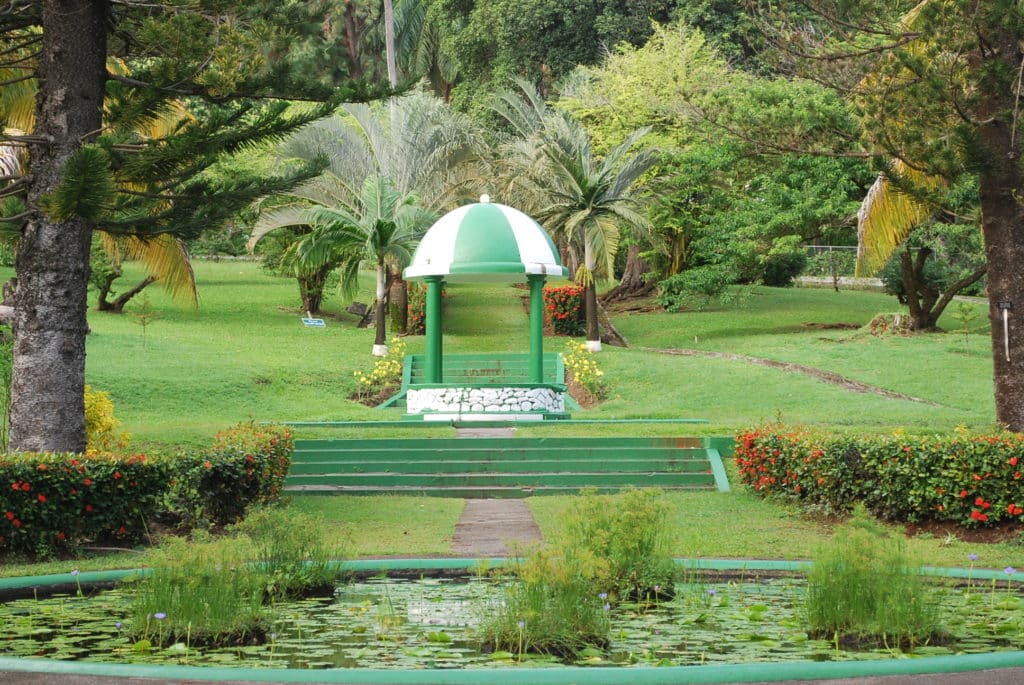
St Vincent Botanical Garden. Photo by Tonya Fitzpatrick
Examine the Carvings at Layou Petroglyph Park
Layou Petroglyph Park preserves one of the island’s most important links to its pre-Columbian past. The main engraving, carved into a large boulder, is considered the largest petroglyph in the Lesser Antilles.
The faces and geometric designs connect St. Vincent with Indigenous artistic traditions found across the Caribbean and parts of South America. Their exact age and meaning remain uncertain, although they may have held spiritual or ceremonial importance.
Visitors should not touch, trace, wet or climb on the carvings. Access conditions can change, so confirm current hours before making the trip.
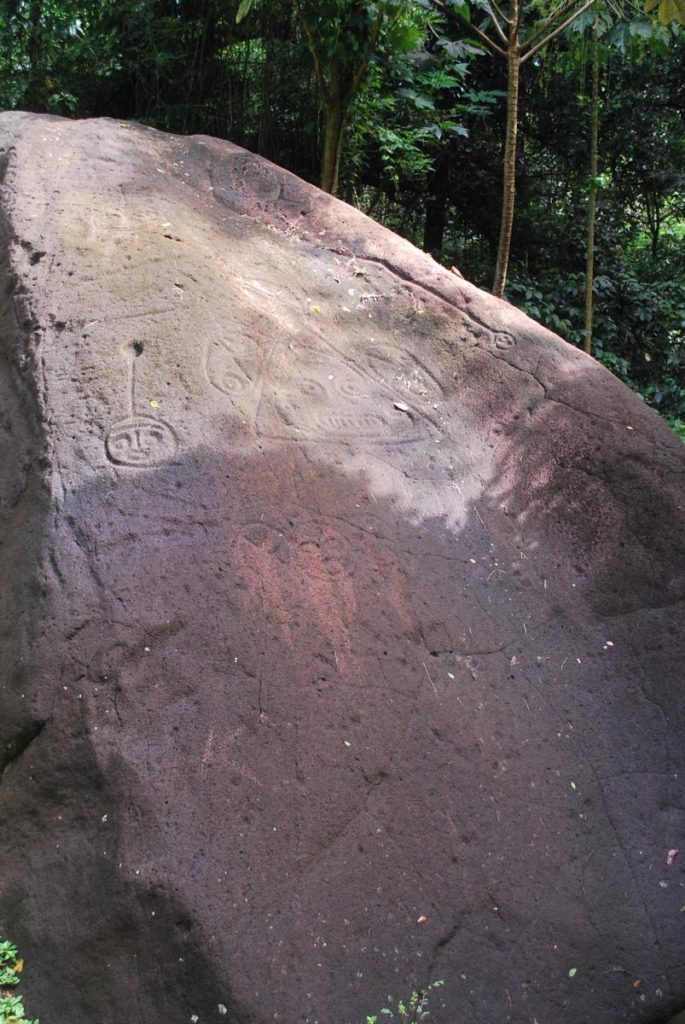
St Vincent at Layou Petroglyph Park. Photo by Tonya Fitzpatrick
Remember Joseph Chatoyer at Dorsetshire Hill
Dorsetshire Hill overlooks Kingstown and is associated with the death of Garifuna leader Joseph Chatoyer during the Second Carib War. He was killed there on March 14, 1795, while leading resistance against British colonization.
After the British defeated the Garifuna, thousands were captured and sent first to Baliceaux. Disease, hunger and harsh conditions killed many. Survivors were deported to Roatán, off the coast of present-day Honduras, in 1797. Their descendants established Garifuna communities across Honduras, Belize, Guatemala and Nicaragua.
Saint Vincent and the Grenadines declared Chatoyer its first National Hero in 2002. Visiting Dorsetshire Hill shifts the focus away from colonial governors and military officers and toward those who fought to defend their land.
Walk Through Black Point Tunnel
Black Point Heritage and Recreational Park contains a tunnel cut through volcanic rock on St. Vincent’s windward coast. The British constructed it around 1815 using enslaved labor.
The passage, which runs more than 300 feet, created an easier route for carrying sugar from the Grand Sable Estate mills to the wharf at Byrea. It may first appear to be an impressive piece of engineering, but its history cannot be separated from the forced labor and plantation economy that produced it.
The tunnel can be dark and uneven, so wear sturdy shoes. Swimming at the nearby black-sand beach is unsafe because of heavy swells and strong currents.
Planning a Historical Tour of St. Vincent
Kingstown, Fort Charlotte, the cathedrals and the Botanic Gardens can be combined in one day. Layou Petroglyph Park lies on the leeward coast, while Black Point Tunnel is on the windward side, making them better suited to separate trips.
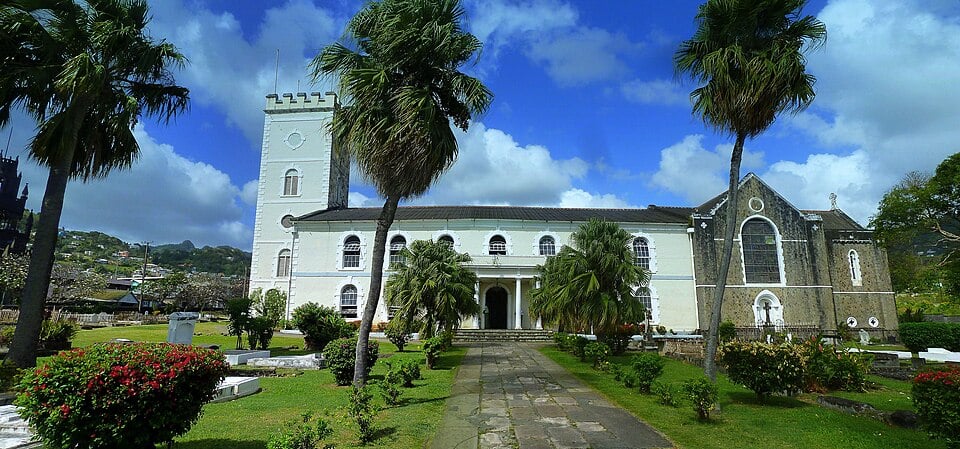
St. George’s Anglican Cathedral stands in central Kingstown, reflecting the influence of the British colonial establishment on St. Vincent’s religious and architectural history. Photo by Edgar El via Wikimedia Commons, licensed under CC BY 3.0.
Opening hours and road conditions can change. A Vincentian guide can provide context often missing from signs and help connect Indigenous presence, Garifuna resistance, enslavement and colonial rule with the island today.
St. Vincent’s forts, churches, gardens, petroglyphs and memorials reveal a destination whose identity reaches far beyond beaches. They tell stories of power and resistance, but also of cultural survival.
Cover image photo by Tonya Fitzpatrick
Book Your Stay on Saint Vincent Island
Find hotel deals on St. Vincent. Search the map to compare hotels, locations and prices, and find the stay that best fits your trip and budget.
Join the community!
Join our community to receive special updates (we keep your private info locked.)