
The Hungarian Man Reconstructing Castles From His Childhood Memories
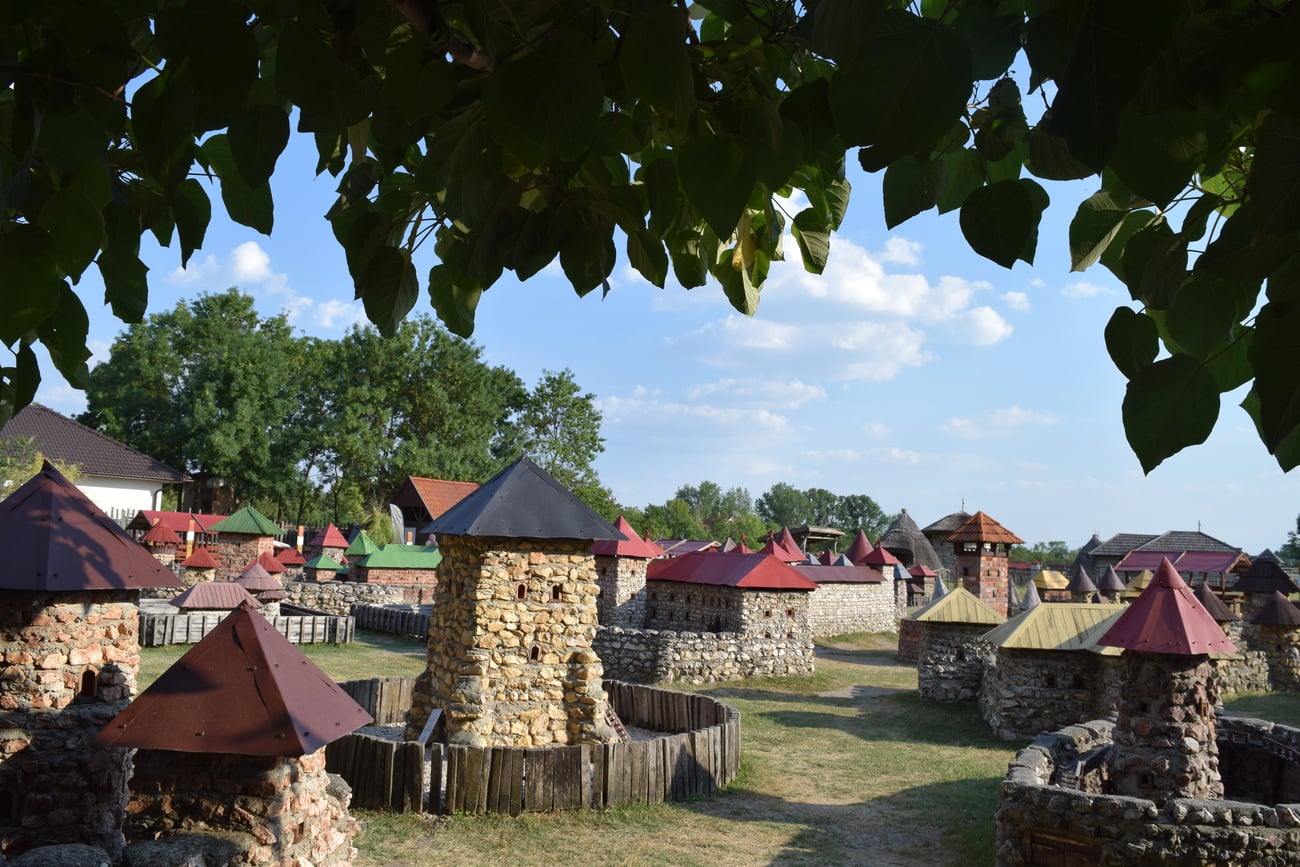
A view across Dinnyés Castle Park, where stone, brick, and timber are used to recreate the appearance of medieval fortifications whose original forms have largely been lost. Photo: Dinnyés Castle Park
By Mate Koczka
Posted October 26, 2026
After a mysterious illness changed his life, Zoltán Alekszi turned a childhood fascination into a Guinness-record heritage mission.
Some of the castles at Dinnyés Castle Park look surprisingly complete: stone walls rise around courtyards, wooden roofs cover towers and tiny stairways connect defensive structures. The strange part is that many of the originals no longer look anything like this. Some are ruins. Others have almost disappeared from the landscape.
That is precisely why Zoltán Alekszi builds them.
In the village of Dinnyés, near Lake Velence in central Hungary, Alekszi has spent more than a decade reconstructing medieval castles that were destroyed, abandoned or reduced to archaeological traces. He aims not to create decorative models of famous landmarks. It is to make forgotten places understandable again.
“I would like to infect everyone with a love of history somehow,” he told me.
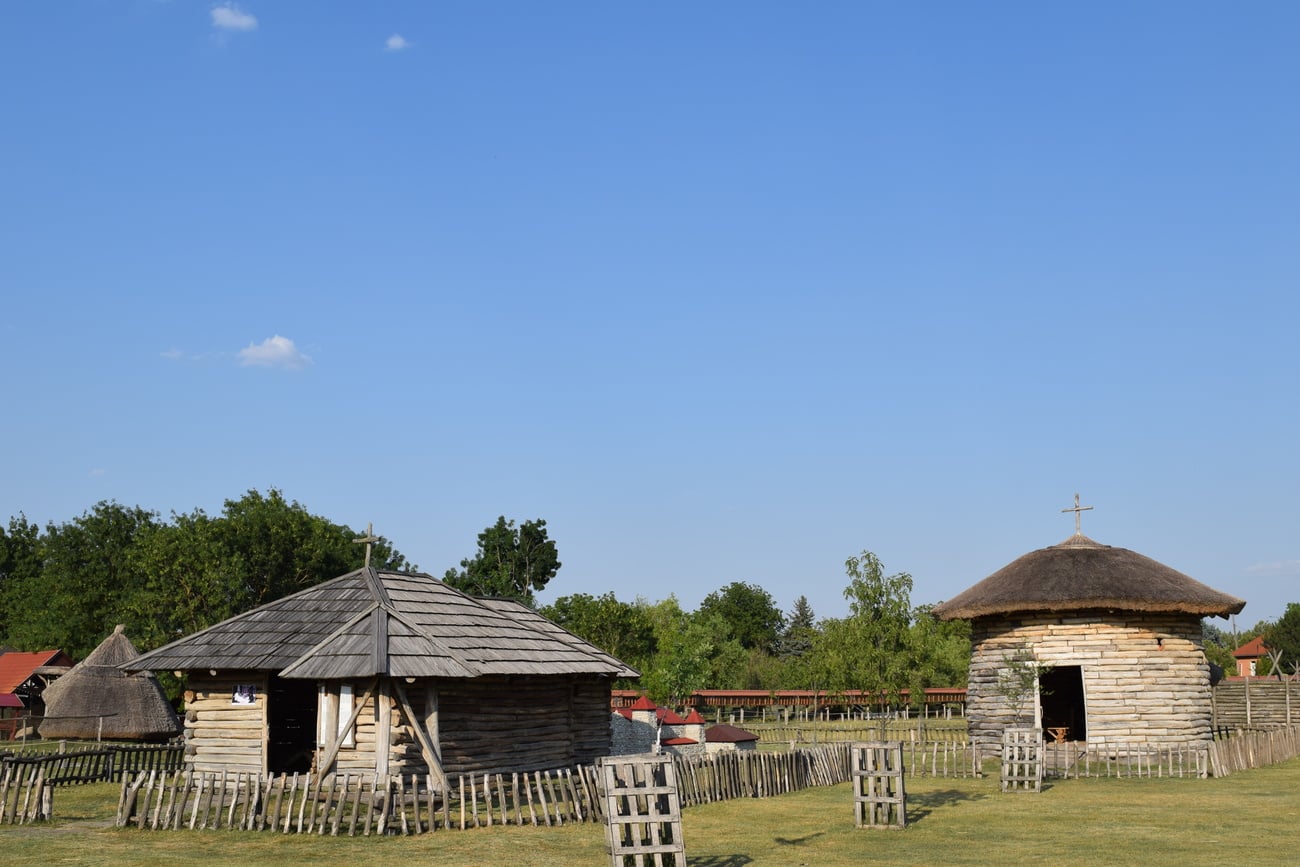
Reconstructed early medieval wooden buildings form part of the Árpád era open-air museum, which expanded the project beyond its original collection of castles. Photo: Dinnyés Castle Park
A Childhood Castle, and a Life Interrupted
The idea reaches back to Alekszi’s childhood. At 12, he read Géza Gárdonyi’s classic historical novel Egri csillagok, set around the Ottoman siege of Eger Castle in 1552. What stayed with him was not only the story, but the castle itself and its ground plan. As a child, he began to imagine that one day he might build a castle of his own.
Adult life took him elsewhere. Alekszi became a successful park and garden builder, creating landscaped properties for wealthy clients. Then, in 2008, his life changed abruptly.
He began suffering recurrent fevers above 40°C. Medical scans repeatedly raised fears of serious disease, and he underwent several operations to remove lymph nodes. The tissue proved not to be malignant, but Alekszi says doctors never established exactly what caused the attacks. The fevers continued, sometimes returning every few months and requiring heavy steroid treatment.
The uncertainty changed the way he thought about time.
“I didn’t want to die,” Alekszi told me. He began to think about a bucket list. If, as he believed, God had allowed him more time, perhaps there was something he was still supposed to do.
The childhood castle dream returned.
Alekszi initially considered building the project near Lake Tisza, where his wife comes from. When plans to acquire a site there fell through, another location entered the story almost by accident.
He and his future wife came to Dinnyés for a concert. He liked the village so much that it eventually became home to the project.
In 2012, he began serious preparations. Construction started the following year. By summer 2014, the park opened with 18 castle reconstructions.
The timing was extraordinary. Alekszi says that shortly before the opening he was again in hospital with severe fever and lost roughly 14 to 15 kilograms in two weeks. There was no neat moment when illness ended and the new life began. He built the park while still living with the condition.
“I wiped out my entire old life so I could do this,” he said in a 2016 interview.
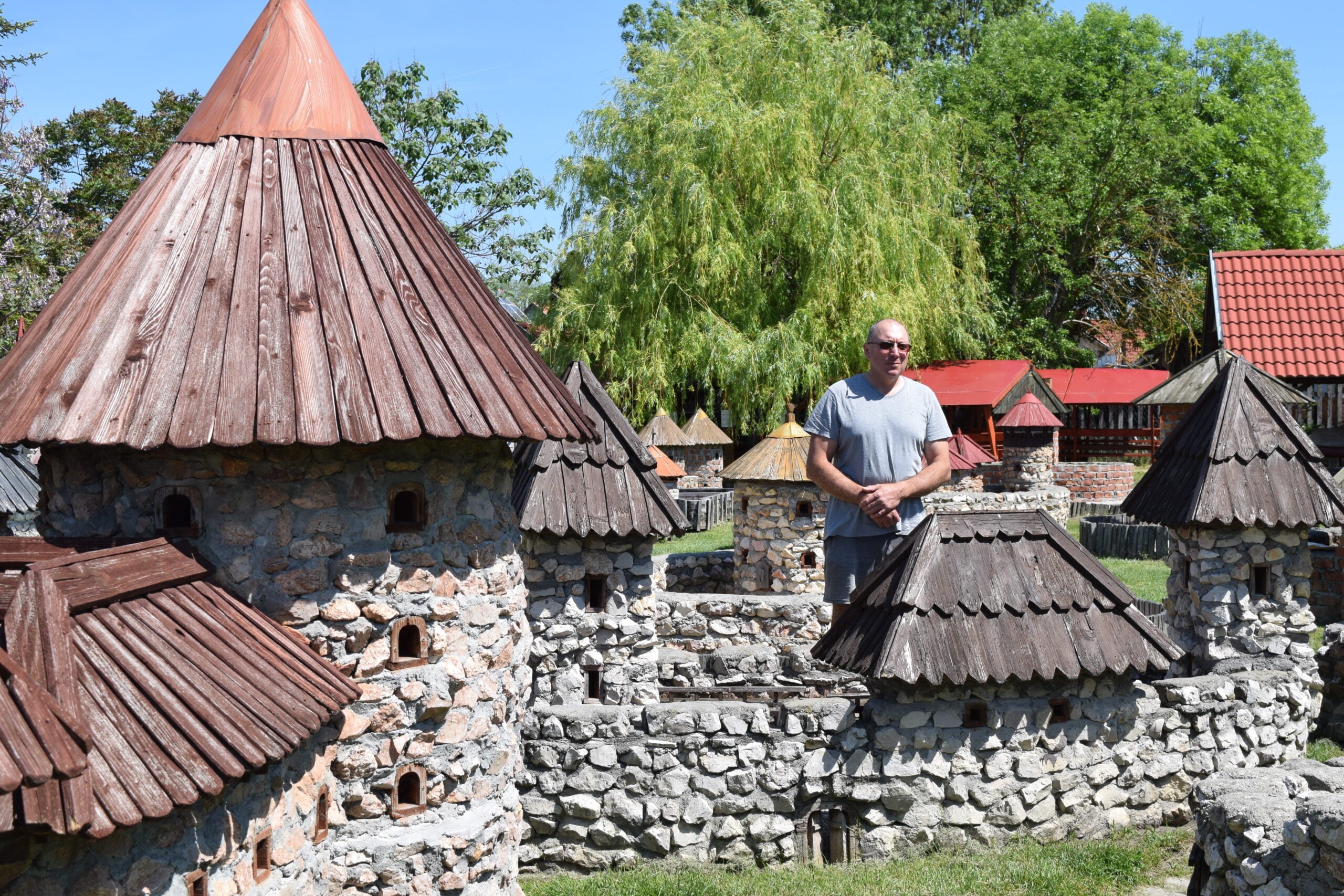
Zoltán Alekszi among the stone and timber reconstructions at Dinnyés Castle Park. Many of the original fortresses represented here survive today only as ruins or archaeological traces. Photo: Dinnyés Castle Park
Reconstructing What Archaeology Remembers
Alekszi is careful with terminology. Guinness World Records officially calls his collection the “largest display of castle replicas,” but he does not consider the structures replicas.
He prefers “reconstruction attempts.”
The difference matters. A replica copies a known original. Many of these castles vanished centuries ago. There are no photographs of them intact, and sometimes even historians disagree about their appearance.
Alekszi starts with archaeological excavation plans, historical descriptions, aerial images and other surviving evidence. He consults specialists, then turns that research into a three-dimensional interpretation. The resulting castle may be the best-supported reconstruction possible, but he does not pretend that every tower or roofline is certain.
It is the reverse of conventional model making. Instead of beginning with a complete building and reducing it in scale, Alekszi often begins with fragments of knowledge and tries to turn them back into architecture.
Material matters too. Stone castles are rebuilt with stone, brick structures with brick and wooden fortifications with timber. Alekszi learned much of the masonry and carpentry himself.
There were failures. Early walls collapsed because he had not yet learned how long the binding material needed to set.
“There is no school for castle builders,” he jokes.
How 46 Castles Became a Record of 47
The project eventually attracted Guinness World Records.
The first application began in 2015 and took about three years to complete. In 2018, a collection of 35 castle reconstructions received Guinness recognition. As Alekszi continued building, the record was renewed repeatedly.
The current official Guinness record is 47 castle structures, achieved on January 8, 2023.
Yet the Castle Park website lists 46 smaller castles. Alekszi explains the apparent contradiction: Guinness also counted a large wooden palisade fort, roughly 30 meters in diameter, bringing the total to 47. A wagon fort that might have become number 48 was not accepted within the Guinness category.
The distinction also shows how much the site has grown beyond its original miniature castles.
Today the 24,000-square-meter park includes an Árpád-era open-air museum, reconstructed wooden religious buildings, a memorial landscape devoted to Hungarian history, a garden railway and a 520-meter Wall of Saints displaying 1,001 figures.
That wall is deeply personal. Alekszi describes it as an act of thanksgiving for surviving the illness that began in 2008.
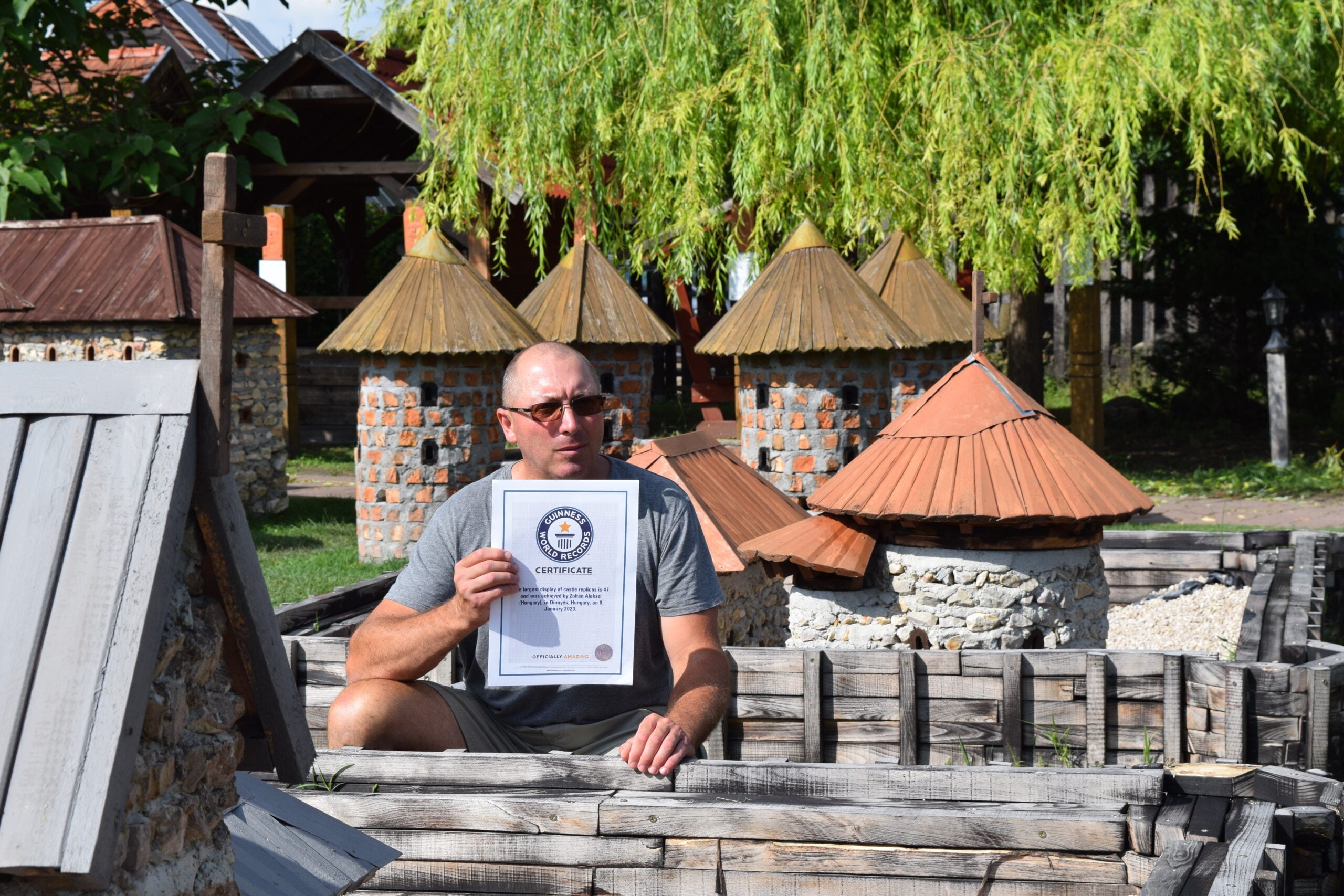
Hungarian Zoltán Alekszi with the Guinness World Records certificate for the largest display of castle replicas. The record reached 47 structures in 2023. Photo: Dinnyés Castle Park,
Saving a Castle Without Saving its Stones
Alekszi’s use of the word “saving” is unusual because he is not restoring the original ruins. He is saving something less tangible: the ability to imagine what those places once were.
An archaeological foundation can tell an expert a great deal. To an ordinary traveler, it may look like stones in grass. A reconstruction can turn that evidence back into walls, gates and towers.
The late archaeologist Gyula Siklósi once gave Alekszi what may be the best description of his work. According to Alekszi, Siklósi told him that he had translated the language of scholars for ordinary people.
That is what Dinnyés does best. It does not claim to replace archaeology. It makes archaeology visible.
And the mission is still unfinished.
Alekszi once spoke of eventually reaching 65 to 70 castles. In August 2026, he told me that the foundations for seven more have already been laid.
His body is making the work harder. He says spinal problems can now make it difficult to stand for more than an hour and a half or two hours at a time. Yet he still goes outside at dawn to work on castle roofs.
For Alekszi, the park has long been more than an attraction.
He said that both his family and the Castle Park have become a kind of therapy for him. “I firmly believe that without them, I might not be alive today.”
Perhaps that explains why Dinnyés feels less like a collection of miniatures than a project about survival.
The castles are structures history almost erased. Alekszi gives them another physical form.
And after once fearing that his own time was running out, he is still building things intended to remain.
Click Here for Discounted Accommodations in Hungary
Join the community!
Join our community to receive special updates (we keep your private info locked.)