

9/11 Survivor Stories: Firsthand Accounts from the World Trade Center and Pentagon
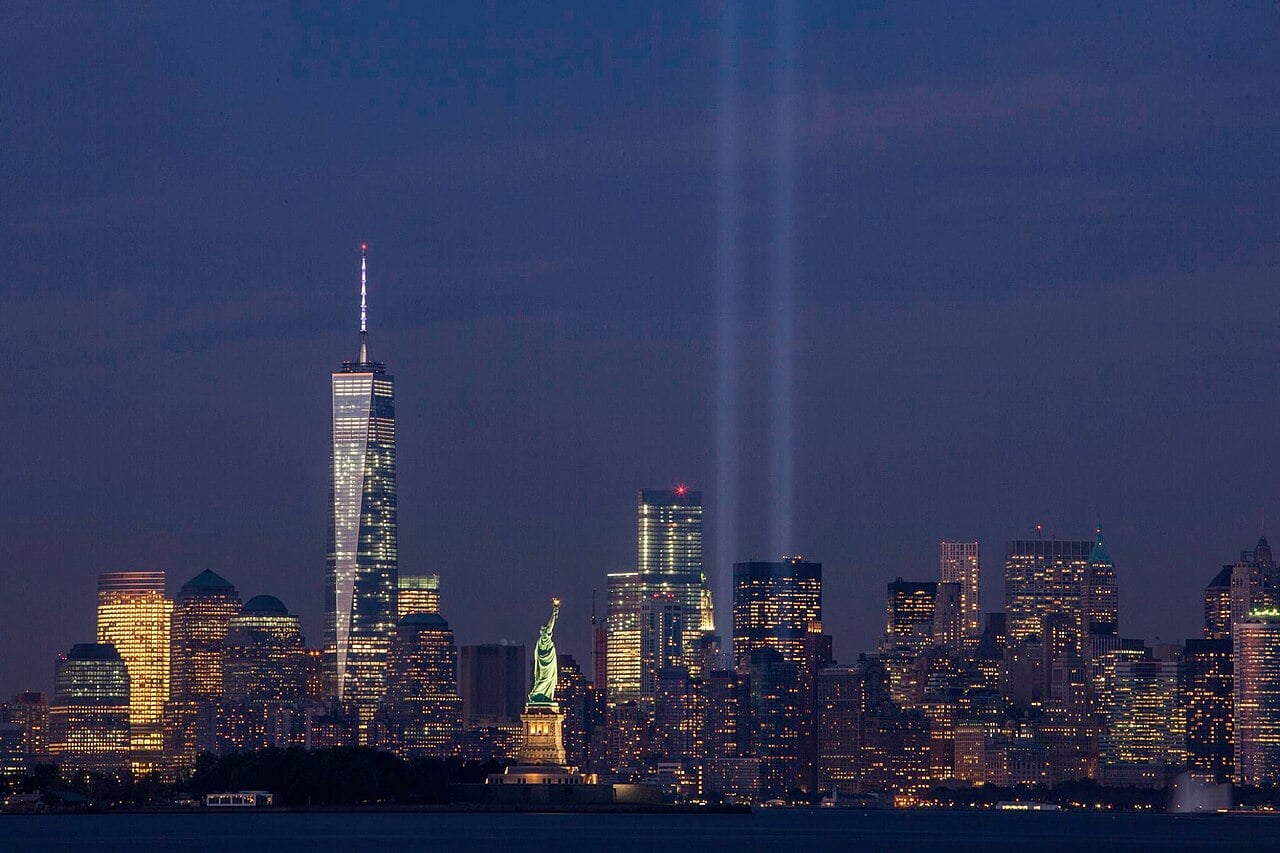
The Tribute in Light rises above Lower Manhattan in remembrance of September 11, with One World Trade Center visible in the skyline. Photo: Anthony Quintano/Wikimedia Commons, CC BY 2.0.
Aired on September 8, 2026
Editor’s Note: This World Footprints special was originally produced to commemorate the 10th anniversary of September 11, 2001. We have since updated the accompanying show page with additional historical context, resources and links while preserving the original interviews and firsthand accounts. These voices offer a lasting record of how survivors, responders, journalists and others experienced the attacks and their aftermath.
Special 25th Anniversary Rebroadcast: World Footprints is rebroadcasting this program on September 11, 2026, to mark 25 years since the attacks.
Remembering September 11 Through the People Who Lived It
September 11, 2001, is remembered through images that became embedded in history. Yet behind those images are individual experiences—people who were at work, on airplanes, reporting the news or simply trying to reach someone they loved when an ordinary Tuesday changed within minutes.
Nineteen al-Qaeda terrorists hijacked four commercial airplanes that morning. Two planes struck the North and South Towers of the World Trade Center in New York. A third hit the Pentagon in Arlington, Virginia. Passengers and crew members aboard United Airlines Flight 93 fought back after learning about the other attacks, and the aircraft crashed near Shanksville, Pennsylvania. The attacks killed 2,977 people.
For readers who want a deeper historical timeline, the National September 11 Memorial & Museum’s 9/11 Primer includes primary sources, first-person video stories, timelines and educational materials.
But a timeline cannot tell us what it felt like to be there.
This World Footprints special preserves 9/11 survivor stories and firsthand accounts from people who experienced September 11 from very different vantage points. Some were inside the World Trade Center or Pentagon. One pilot took to the air as part of the military response. Others were journalists, family members or people who discovered that the attacks had touched their own lives in unexpected ways.
Their accounts take us beyond the events themselves. They speak to evacuation and survival, uncertainty, fear, responsibility and the long process of living with what happened afterward.
Tonya and Ian Fitzpatrick also share their own memories of September 11—something they had not previously discussed publicly when this program was recorded.
9/11 Survivor Stories from the World Trade Center
Nicole B. Simpson — Evacuating the South Tower
Nicole B. Simpson worked on the 73rd floor of Tower II, the South Tower of the World Trade Center. On September 11, she helped evacuate members of her staff. Her experience did not end when she left the building.
In the years that followed, Simpson became an advocate for survivors navigating the emotional and financial effects of the attacks. She also interviewed other survivors for her book, 09/11/01: A Long Road Toward Recovery, creating another record of what happened after people escaped the immediate danger. Her publisher describes the book as an exploration of survivors’ emotional journeys nearly a decade after the attacks.
Readers can learn more about Nicole B. Simpson’s 09/11/01: A Long Road Toward Recovery.
Lauren Manning — Survival and a Long Recovery
Lauren Manning was entering the World Trade Center when a wall of flame engulfed her. Burns covered more than 80 percent of her body.
Survival was only the beginning.
Manning endured a long physical and emotional recovery that she later chronicled in Unmeasured Strength: A Story of Survival and Transformation. Her story offers another way to understand the aftermath of September 11: what happens after the cameras move on and a survivor begins the difficult work of rebuilding a life.
Learn more about Lauren Manning’s Unmeasured Strength from Macmillan.

The rebuilt World Trade Center site in Lower Manhattan, where remembrance and renewal now share the same landscape. Photo: Logan Weaver via Unsplash.
The World Trade Center site carries both remembrance and renewal. The twin reflecting pools preserve the footprints of the original towers, while One World Trade Center rises beside them. The tower stands a symbolic 1,776 feet tall and was designed by David Childs of Skidmore, Owings & Merrill.
Explore the rebuilt World Trade Center campus and One World Trade Center.
Pentagon Survivor Stories and the Military Response
At 9:37 a.m., American Airlines Flight 77 struck the Pentagon in Arlington, Virginia. The attack killed 184 victims—125 people inside the Pentagon and 59 passengers and crew members aboard Flight 77, excluding the hijackers.
The World Footprints interviews preserve several perspectives from the Pentagon and the military response that followed.
William Layer — Inside the Pentagon
William Layer of the U.S. Army National Guard was working in his Pentagon office in the D Ring when Flight 77 struck the building.
Layer assisted with the evacuation and shares what he experienced inside the Pentagon as people tried to understand what had happened and get to safety. His firsthand account adds a perspective easily lost in wider histories of the attacks: September 11 unfolded inside individual offices and corridors, among people who had begun the morning expecting another normal workday. The original World Footprints episode records Layer’s location and role in the evacuation.
Vincent Kam — A Pentagon Survivor
Pentagon survivor Vincent Kam adds another firsthand account of the attack in Arlington.
Taken together, the Pentagon interviews help move the story beyond aerial photographs and television coverage. They return the focus to the people who were physically inside the building when it was attacked.
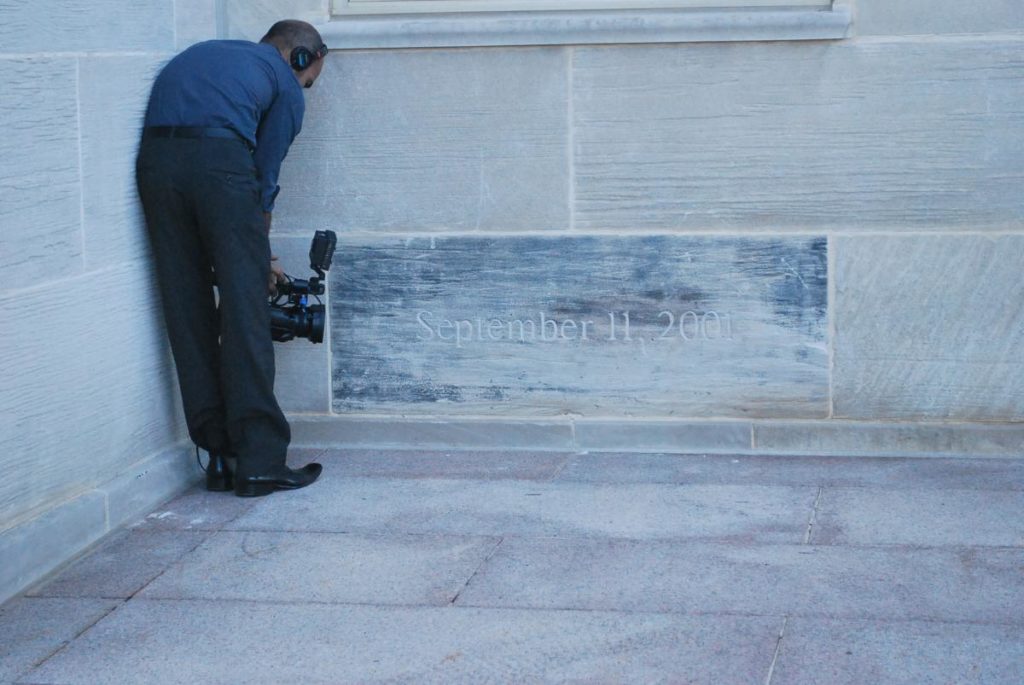
A visitor photographs the area of the Pentagon struck on September 11, 2001. Photo: Tonya Fitzpatrick/World Footprints.
Jeffrey B. Cashman — Responding from the Air
Jeffrey B. Cashman experienced September 11 from another perspective.
Cashman had joined the Vermont Air National Guard in 1999 and was serving as an F-16 pilot and four-ship flight lead. On September 11, 2001, he became one of the first Air Force pilots airborne on an armed domestic combat air patrol in response to the attacks. He later rose to the rank of brigadier general.
His interview captures an important dimension of that morning: while civilians were evacuating buildings and emergency crews were responding on the ground, the United States was also mounting a rapidly evolving defense response in its own airspace.
Read Brigadier General Jeffrey B. Cashman’s official U.S. Air Force biography.
September 11 Beyond Ground Zero
Not everyone whose life intersected with September 11 was physically at an attack site.
For millions of people, the day unfolded in newsrooms, offices, airports and homes. Families tried to reach loved ones. Journalists struggled to report an event that kept changing by the minute. People thousands of miles away discovered deeply personal connections to what they were seeing on television.
Several of the voices in this episode capture that wider experience.
J.C. Hayward — A Journalist’s Connection to Flight 77
Longtime Washington television journalist J.C. Hayward, then an anchor at WUSA 9, was in Santa Monica, California, when the attacks occurred.
Her connection to the story was unusually personal. Two days earlier, Hayward had flown aboard American Airlines Flight 77—the same flight number and aircraft service that would strike the Pentagon on September 11. In the World Footprints interview, she reflects on the day from a journalist’s perspective and on the realization that her own recent travels had placed her so close to a piece of the story.
Don Diamont — Waiting for News from New York
Actor Don Diamont, a native New Yorker who was living in Los Angeles, found himself trying to determine where members of his family were and whether they were safe.
His story represents another part of September 11 that often receives less attention: the hours spent waiting at a distance, making calls and trying to account for people as communication systems became overwhelmed.
World Footprints listeners can also explore our Don Diamont guest profile. Keep that guest profile noindexed if that remains your separate editorial decision; the podcast itself should remain indexed.
Geof Morin and a Different Kind of Response
Geof Morin joined World Footprints to discuss how the American Bible Society responded to the grief and uncertainty that followed September 11.
Within 48 hours of the attacks, the organization repurposed a Scripture resource called God Is Our Shelter and Strength. Staff and volunteers later distributed the booklet and other resources in New York, Washington and Pennsylvania while also assisting with food and water distribution alongside first responders. The American Bible Society reports that it ultimately distributed more than 3.4 million copies.
Read the American Bible Society’s account of its response after September 11.
Remembering 9/11 at the World Trade Center, Pentagon and Flight 93
The geography of September 11 is now preserved through memorials at the three attack sites.
In Lower Manhattan, the National September 11 Memorial occupies the footprints of the former Twin Towers. Its two reflecting pools are surrounded by bronze parapets bearing the names of those killed in the September 11 attacks and the six people killed in the February 26, 1993 bombing of the World Trade Center.
Visit the National September 11 Memorial & Museum.
Each September 11, the site is also associated with Tribute in Light, the twin beams that illuminate the Lower Manhattan sky. The installation first appeared six months after the attacks. Today, 88 xenon lights are arranged in two 48-foot squares that echo the shape and orientation of the Twin Towers.
At the Pentagon, 184 memorial units honor the people killed inside the building and aboard Flight 77. The memorial units are arranged according to the birth years of the victims, creating a chronological passage through the lives lost.
Explore the National 9/11 Pentagon Memorial.
World Footprints also documented another place of remembrance inside the Pentagon. Watch our companion video, Remembering 9/11: Inside the Pentagon Chapel and Memorial. The World Footprints video was originally aired in September 2011.
Near Shanksville, Pennsylvania, Flight 93 National Memorial preserves the crash site and final resting place of the passengers and crew of United Airlines Flight 93. The Memorial Plaza culminates at the Wall of Names, where 40 polished white marble panels carry the names of the passengers and crew members.
Learn more at the National Park Service’s Flight 93 National Memorial.

The Wall of Names at Flight 93 National Memorial commemorates the passengers and crew members of United Airlines Flight 93. Photo: Monumentmike/Wikimedia Commons, CC BY-SA 4.0.
Why Firsthand 9/11 Accounts Still Matter
September 11 now sits at the intersection of lived memory and history.
Many people can still remember where they were when they first heard that a plane had struck the World Trade Center. Others were children that morning. An increasing number were not yet born.
For those generations, September 11 begins with photographs, recordings, museums, classrooms and stories told by people who were there.
That makes firsthand accounts increasingly valuable.
This World Footprints episode does not attempt to tell the complete history of September 11. Instead, it preserves individual experiences: what people saw, how they responded, whom they worried about and what survival required after the immediate crisis ended.
The events belong to history. The voices belong to the people who lived them.
Planning a Visit to the 9/11 Memorial in New York
For travelers planning to visit the National September 11 Memorial & Museum and the surrounding World Trade Center site, staying in Lower Manhattan can make it easier to spend time at the memorial, explore the rebuilt World Trade Center campus and visit nearby historic sites.
Find places to stay near the 9/11 Memorial and Lower Manhattan.
Join the community!
Join our community to receive special updates (we keep your private info locked.)
