

Aruba: One Happy Island

Aruba palapa
Posted August 3, 2026
“Bon bini” was one of the first phrases we heard after arriving in Aruba. The Papiamento greeting means “welcome,” and we felt that welcome throughout the trip.
Like many first-time visitors, we came expecting white sand, warm Caribbean water and reliable sunshine. Aruba delivered all three. Yet the island that captured our attention stretched far beyond the resort beaches. We encountered a dry, cactus-covered interior, a rocky coast pounded by waves, caves marked by early inhabitants and a southern community shaped by oil, migration and war.
Aruba sits about 15 miles north of Venezuela and covers only 69 square miles. Its compact size can be deceiving. The calm western shoreline and rugged eastern coast often feel like two different islands. Aruba’s semi-arid climate supports cacti, aloe and hardy shrubs rather than the dense tropical vegetation found elsewhere in the Caribbean. Trade winds bend the divi-divi and fofoti trees that have become symbols of the island.
At times, the rough northern coastline reminded us more of New England than the Caribbean. That contrast became one of the most memorable parts of our trip.
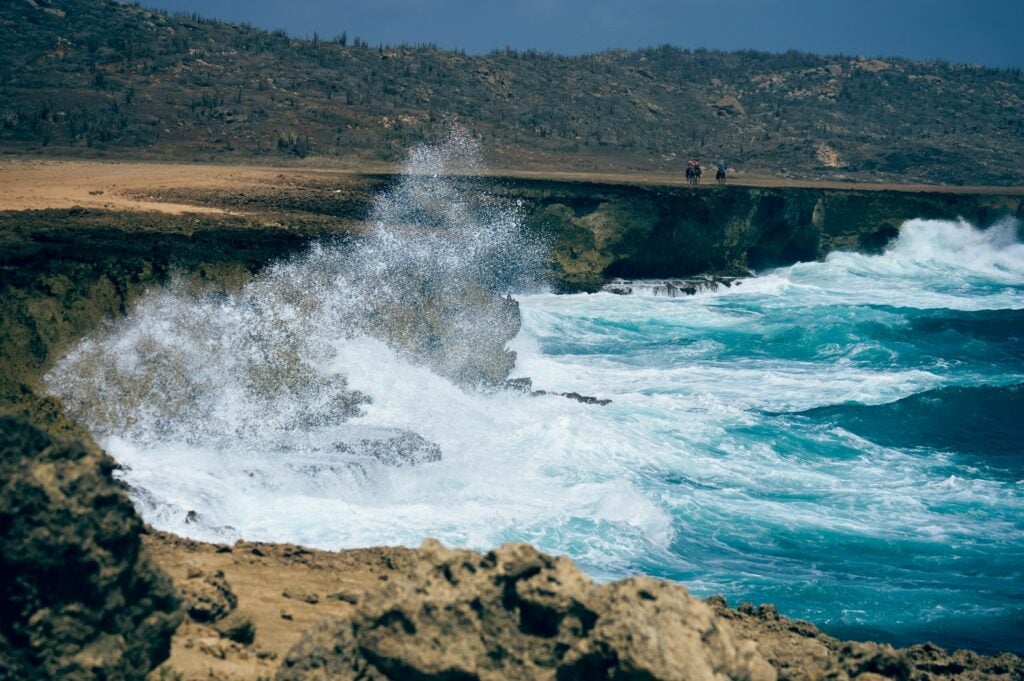
Aruba coastline. Photo by Kalea Morgan.
Aruba’s History Began Long Before the Dutch
Aruba’s history did not begin with European settlement. Archaic communities reached the island from the South American mainland thousands of years ago. Caquetío people later established villages, cultivated crops and left markings in caves and on rock formations.
The history of Aruba reflects its location near Venezuela and its place within the wider Caribbean. Spain claimed the island during the 16th century. The Dutch took control in 1636, briefly lost Aruba to Britain during the Napoleonic Wars and regained it in 1816.
Older travel articles often describe Aruba as part of the Netherlands Antilles. That is no longer accurate. Aruba separated from the Netherlands Antilles in 1986 and became a constituent country within the Kingdom of the Netherlands. Today, the Kingdom consists of Aruba, Curaçao, Sint Maarten and the Netherlands.
Dutch and Papiamento serve as Aruba’s official languages. English and Spanish are also widely spoken. That multilingual character reflects generations of contact among Indigenous, European, African, Latin American and Caribbean communities.
Aloe is also part of that history. Aloe arrived on the island around 1840 and thrived in the climate. At one point, aloe fields covered much of Aruba, and the island became a major exporter. The Aruba Aloe Museum and Factory now preserves that lesser-known chapter of the economy.
Palm Beach Shows Only One Side of Aruba
Palm Beach delivered the classic Aruba many visitors picture before they arrive. The sand was soft, the water inviting and the shoreline lined with hotels, restaurants and casinos. Palapas offered shade during the day, while beachside dining extended the experience into the evening.
Palm Beach made it easy to settle into vacation mode. Water sports, excursions and restaurants sit close to the major resorts. Still, Palm Beach represents only one part of Aruba.
A drive away from the hotel district quickly changes the view. Cacti replace resort landscaping. Pavement gives way to rough tracks. Waves crash against exposed rock instead of gently reaching the sand.
That shift became clear during our safari with ABC Tours Aruba. The company still runs a full-day four-wheel-drive excursion that visits several places we explored, including Arikok National Park, Natural Pool and Baby Beach.
The ride across Aruba’s rugged interior felt like a roller coaster at times. It was dusty, bumpy and far removed from a quiet afternoon beneath a palapa. It also gave us a far better understanding of the island.
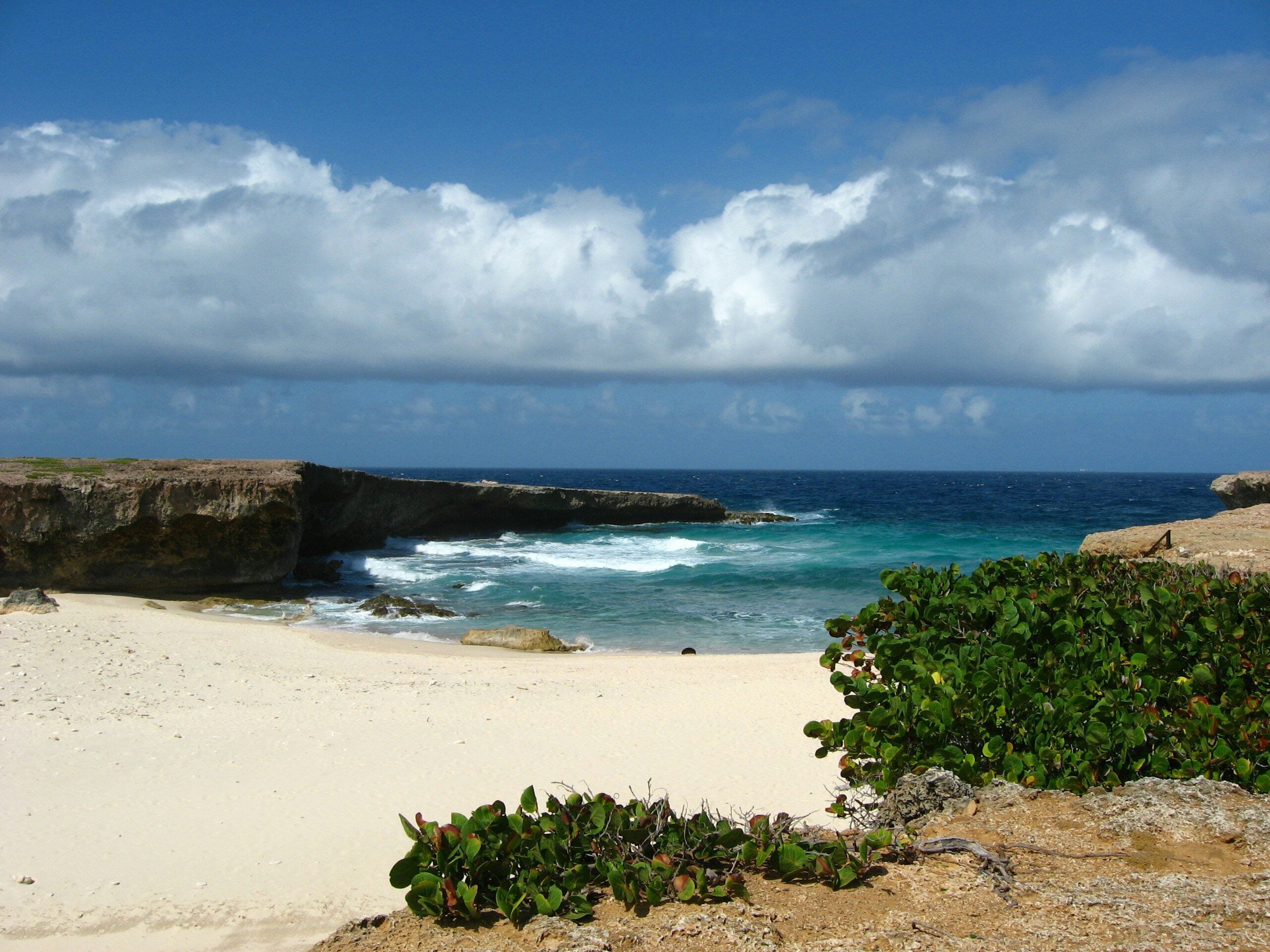
The natural pool in Arikok National Park. Photo by Teresa O.
The Rough Road to Natural Pool
Arikok National Park protects nearly 20 percent of Aruba. The park contains desert terrain, limestone cliffs, volcanic formations, caves, dry riverbeds and secluded beaches.
Fontein Cave contains Indigenous markings, while Quadirikiri Cave has chambers illuminated by openings in the roof. The markings are among the clearest reminders that Aruba had a history long before Spain or the Netherlands claimed the island.
Our most adventurous stop was the Natural Pool, known locally as Conchi. Volcanic rocks surround the pool along Aruba’s windward coast. Reaching it required a rough drive followed by a somewhat challenging walk.
The setting was worth the effort. Waves broke against the rocks while the pool offered a protected place to swim and snorkel. Conditions can change quickly, however. Swimming depends on the sea, and visitors should follow the advice of park staff or experienced guides.
The journey to Natural Pool revealed an Aruba we would never have seen from the hotel district. It felt untamed, even though it lay only a relatively short distance from Palm Beach.
Baby Beach and the Story of San Nicolas
After the rough water and rocky terrain near Natural Pool, Baby Beach felt especially calm. Its shallow lagoon curves around the southeastern end of Aruba near San Nicolas.
Baby Beach earned its name from its sheltered, shallow water. Families and beginning swimmers often gather near the shore. Stronger currents can develop near the opening to the sea, so swimmers should remain within the protected area.
During our visit, the sprawling former refinery created a stark backdrop to the white sand and turquoise water. The refinery looked out of place beside the beach, but it explained much of San Nicolas. In 2025, Aruba and the Netherlands announced plans to dismantle the former refinery and redevelop the site. In July 2026, Aruba signed a formal action plan to evaluate the future uses of the site.
The Lago Oil and Transport Company established operations in San Nicolas in 1924. Refining began later in the decade, transforming the community as workers arrived from across the Caribbean.
During World War II, the refinery produced aviation fuel for the Allies. That made Aruba a German target. On February 16, 1942, the submarine U-156 torpedoed tankers offshore and attempted to shell the refinery. The attack brought the war directly to an island now associated largely with tourism and beaches.
The refinery’s influence extended beyond industry. Trinidadian workers brought steelpan music to San Nicolas during the 1940s. Under musician Leonard Turner, members of the Aruba Invaders fashioned instruments from discarded Lago refinery oil drums.
Today, visitors have another reason to explore the city. Artists have transformed its streets with large-scale works created through the Aruba Art Fair. The San Nicolas murals draw on local history, identity, nature and everyday life.
The Museum of Industry, housed inside the former San Nicolas water tower, tells the story of gold, aloe, phosphate, oil and tourism. The murals and museum give travelers a reason to stop in San Nicolas rather than drive straight through to Baby Beach.
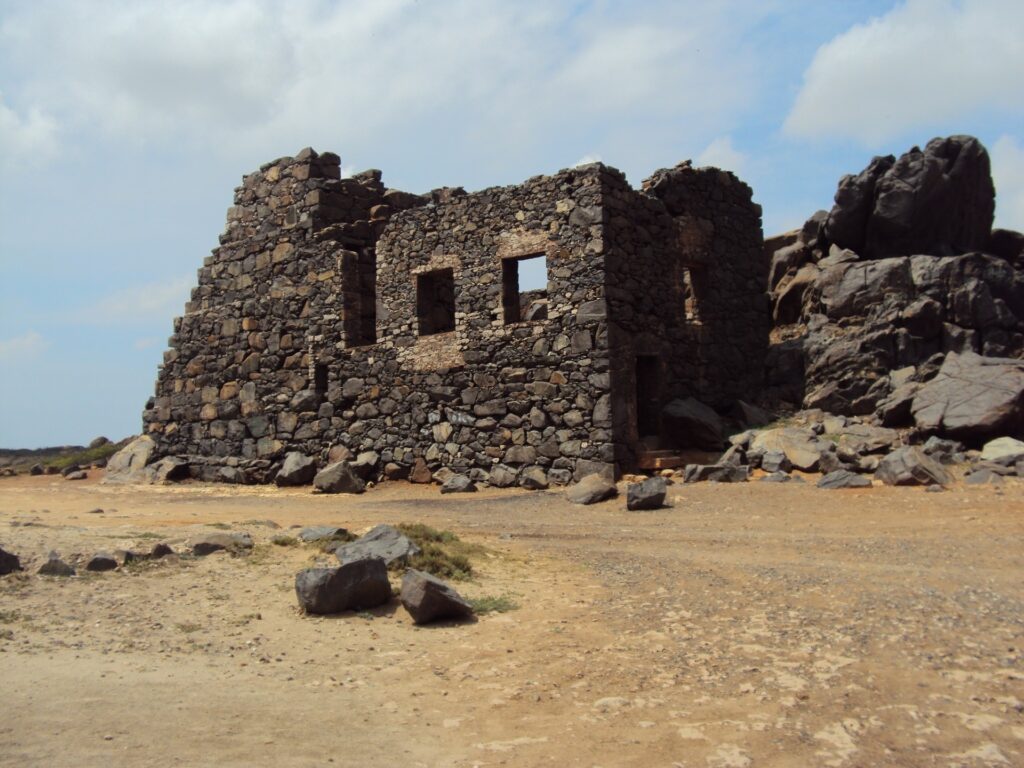
Bushiribana Gold Mill ruins on Aruba’s northern coast. Photo by Tonya Fitzpatrick.atrick.
Gold, Natural Bridges and a Lighthouse
Oil was not Aruba’s first economic boom. The discovery of gold in 1824 drew prospectors and eventually led to mining operations across the island.
The stone walls of the Bushiribana Gold Mill still stand above the rugged northern coast. The ruins have become a popular tour stop, but they also recall a period when Aruba’s future seemed tied to gold rather than aloe, oil or tourism.

Aruba’s Natural Bridge. Photo by Tonya Fitzpatrick.
Farther along the coast, we saw the remains of Aruba’s beloved Natural Bridge. Waves carved the limestone formation over thousands of years. The bridge collapsed on September 2, 2005, but the broken formation still demonstrates the power of the sea. A smaller natural bridge remains nearby.
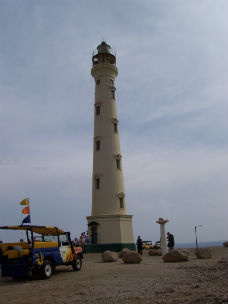
California Lighthouse. Photo by Tonya Fitzpatrick.
The California Lighthouse offers another perspective on the landscape. The white tower rises near Aruba’s northwestern tip, above dunes, cacti and the rocky shoreline. It takes its name from the steamship California, which sank offshore in 1891.
We photographed the lighthouse against Aruba’s dry terrain. Around it were blue water, cacti and dry ground—not the landscape we had expected before arriving in Aruba.
Seeing Aruba From Beneath the Sea
One of our most unusual experiences began in downtown Oranjestad. A high-speed boat carried us from the dock to the launch site of the Atlantis Submarine.
The submarine carried us beneath the Caribbean, revealing marine life, coral formations and shipwrecks without requiring scuba equipment. As a scuba diver, I especially enjoyed the underwater views.
The Atlantis Submarine Expedition still departs from Oranjestad. The current excursion lasts about one hour and 45 minutes and descends approximately 130 feet. Passengers must climb a short ladder into the submarine, so the experience may not suit every traveler.
Oranjestad itself also offers more than shopping. A downtown trolley now connects the cruise terminal with Main Street and several central attractions.
The National Archaeological Museum Aruba occupies the restored Ecury family complex. Its exhibits trace thousands of years of Indigenous life through pottery, tools and other artifacts.
The house also has a powerful World War II connection. Boy Ecury grew up there before moving to Europe. He joined the Dutch resistance during the Nazi occupation and took part in sabotage and efforts to help people in hiding. German forces captured and executed him in 1944, when he was only 22. Aruba continues to honor him as a World War II hero.
That story rarely appears in accounts of an Aruba vacation, yet it belongs to the island as much as its beaches and resorts.
Aruba’s Cultural Mix Reaches the Table
Aruba’s mixed history also shows up in its food. Dutch, Caribbean, Latin American and international influences often share the same menu.
Keshi yena is among the best-known local dishes. Traditionally, cooks fill a hollowed cheese rind with seasoned meat, olives, raisins and other ingredients before baking it. Pan bati, a slightly sweet cornmeal flatbread, often accompanies stews and seafood. Pastechi, a crescent-shaped fried pastry, remains a popular breakfast or snack.
We celebrated my birthday at Papiamento Restaurant, one of our favorite dining experiences on the island. The Ellis family opened it in 1983 and later moved it into a historic cunucu house in Noord. Guests dine in the garden or beside the pool, surrounded by antiques and family history.
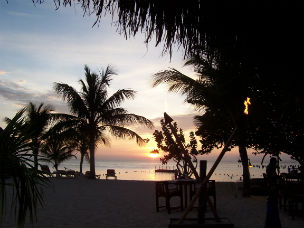
Aruba sunset. Photo by Tonya Fitzpatrick.
Travelers looking for a casual seafood experience can also visit Zeerover in Savaneta. The waterfront restaurant serves the day’s fish and shrimp with simple local sides.
We remember the setting at Papiamento as clearly as the meal. Dinner around the garden and pool made the evening feel special without feeling formal. Aruba gave us candlelit evenings near the sea, long days outdoors and plenty of reasons to slow down.
The island certainly lived up to its beaches. Yet the Aruba we remember also includes the rough ride to Natural Pool, the refinery near Baby Beach, the submarine beneath Oranjestad and the history woven through San Nicolas.
“One Happy Island” may be Aruba’s slogan, but the island becomes more interesting when you look beyond it.
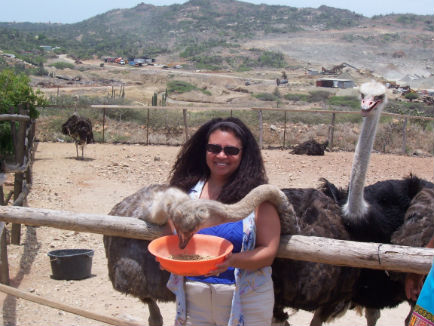
Tonya at the Aruba Ostrich Farm. Photo by Ian Fitzpatrick.
Book Your Stay in Aruba
Use the interactive map to search and compare hotels and vacation rentals from Booking.com, Hotels.com, Expedia, Vrbo and other major booking sites. Move the map to explore accommodations in different parts of Aruba, or use the filters to find nearby points of interest.
Join the community!
Join our community to receive special updates (we keep your private info locked.)