
How Art Helped Transform Gamcheon Culture Village in Busan

Gamcheon Culture Village’s terraced homes rise along a steep hillside in Busan, South Korea.
By Rose Munday
Posted August 24, 2026
Editor’s Note: This article was originally published on August 29, 2023. Tonya Fitzpatrick reviewed and updated it on July 31, 2026, to provide additional historical context and a fuller account of Gamcheon Culture Village’s art-led regeneration. The writer’s original observations and voice have been retained.
On a warm June day, the ocean breeze cools balmy Busan, home to South Korea’s largest port. I stand overlooking Gamcheon Culture Village, which clings to a hillside near the coast. I shiver as I imagine what it once was: an impoverished neighbourhood shaped by war and displacement.
Today, Gamcheon’s rainbow facades could not look more vibrant or inviting. Children clutch ice lollies while young couples take selfies against one of Busan’s most colourful backdrops. It is difficult to imagine this as a place marked by sadness, hunger and fear. Yet there was little to celebrate in Gamcheon for several decades.

Map of South Korea. Credit: OgreBot/Wikimedia Commons, licensed under CC BY-SA 4.0.
The Korean War
Without the Korean War, Gamcheon Culture Village would not exist in its present form.
The war began on June 25, 1950, when North Korean forces invaded South Korea. The Korean Peninsula had been divided after Japanese colonial rule ended in 1945. Separate governments emerged in North and South Korea in 1948.
North Korea sought reunification under communist rule. United Nations forces, led by the United States, supported South Korea. China later entered the war on North Korea’s side.
The conflict killed and wounded millions of soldiers and civilians. Fighting ended when an armistice was signed on July 27, 1953. North and South Korea have never signed a formal peace treaty.
Migration to Busan
Busan remained under South Korean control during the war and became the country’s provisional capital. Its location in the peninsula’s southeast made it a refuge for people fleeing the fighting.
Roughly one million refugees sought safety in Busan during the war. They settled wherever they could find space, including the steep hillsides surrounding the city.
Gamcheon became one of the communities where displaced people began rebuilding their lives.
-

- Gamcheon’s tiered homes follow the steep hills above Busan. Photo: Rose Munday.

-

- Busan became a refuge for people displaced during the Korean War. Photo: Rose Munday.

From Hillside Settlement to Struggling Neighbourhood
Families built modest homes along the slopes, often using whatever materials they could find. Jobs were scarce, and many residents struggled to maintain their homes and support their families.
During the 1950s, followers of Taegeukdo, a Korean religious movement, joined war refugees on the hillside. The settlement became known as Taegeukdo Village.
Its closely packed, terraced houses followed the shape of the mountain. Narrow passageways connected homes built on different levels. That unusual layout remains part of Gamcheon’s identity.
Over time, residents replaced temporary structures with sturdier homes and added second floors. Living conditions improved, but poor infrastructure and limited economic opportunities remained.
The 2009 revival
By the early 2000s, Gamcheon still lagged behind many other Busan neighbourhoods. Its population had declined, and abandoned homes had begun appearing along the hillside.
In 2009, Saha District launched an art-led regeneration project with support from South Korea’s Ministry of Culture, Sports and Tourism. Residents, artists and local officials worked together on the effort.
The approach resembled other art-led neighbourhood projects in South Korea, including Ihwa Mural Village in Seoul.

Ihwa Mural Village is another South Korean neighbourhood known for art-led regeneration.
In 2010, six galleries and nine more artworks were added. Empty or deteriorating houses became small exhibition spaces. Alley paintings and installations encouraged visitors to explore the village on foot.
Later projects added workshops where visitors could try ceramics, painting and natural dyeing. These activities created opportunities for local artists and residents.
Maps and designated walking routes also helped visitors navigate Gamcheon’s maze of alleys. They directed tourists towards galleries, viewpoints and public art without sending them through every residential passage.
Response from locals
Gamcheon’s transformation was not immediately popular with everyone. Some residents worried about crowds, noise and visitors photographing homes without permission.
The village began raising ethical questions that now affect many residential destinations. Where does a public attraction end and a private neighbourhood begin?

A lifelike art installation reflects everyday village life in Gamcheon.
Tourism brought cafés, shops, workshops and new economic activity. The regeneration project also improved public spaces and drew attention to an area once overlooked by visitors.
However, research has also documented negative effects on residents’ community life, sense of safety and psychological wellbeing. Residents’ attitudes often depended on their involvement in tourism and whether they shared in its benefits.
The experience shows why visitor numbers alone cannot measure tourism success. Residents must have a voice in decisions that reshape their neighbourhoods.
Gamcheon Culture Village today
Gamcheon’s original artworks have been joined by dozens of others. Murals, sculptures and lifelike figures appear throughout the village. From a distance, some figures look eerily real.
Many hillside homes are painted in soft shades of blue, pink and yellow. The scenery has earned Gamcheon nicknames including the “Santorini of Busan” and the “Machu Picchu of Korea.”

Jaman Mural Village brings contemporary street art to Jeonju’s historic surroundings. Photo: Rose Munday.
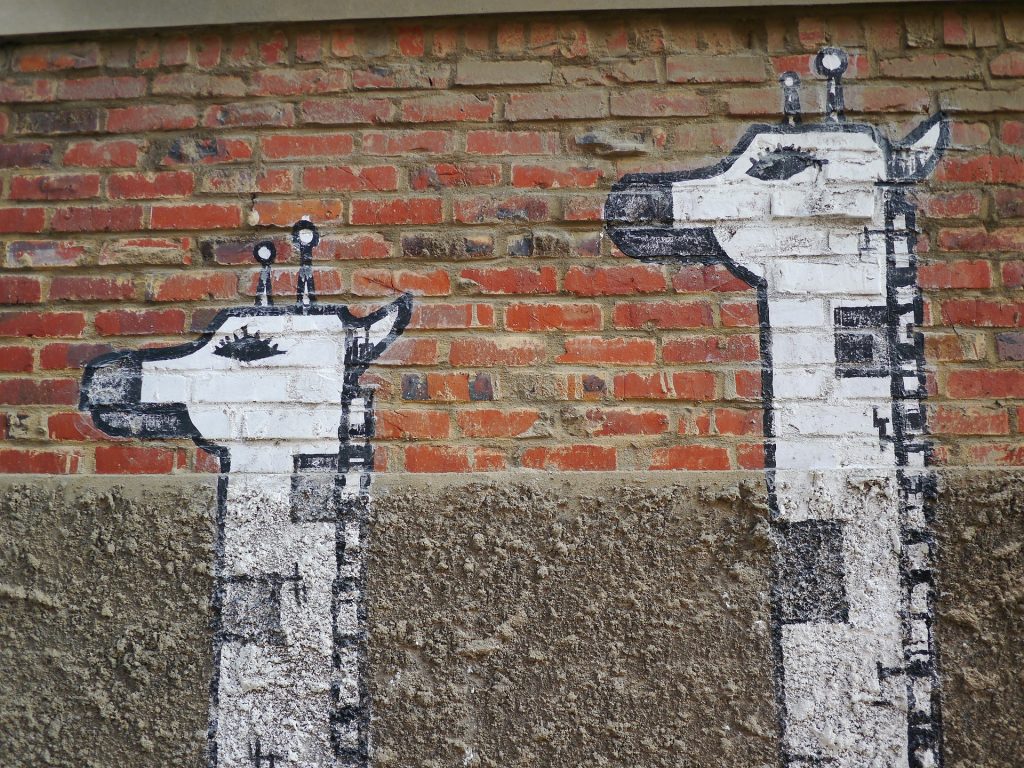
Mural of giraffes. South Korea
Find a Place to Stay Near Gamcheon Culture Village, South Korea
Search the map to compare hotels and prices across Busan. Find the stay that best fits your trip and budget. You can also use the filters to find restaurants, tours, attractions and other points of interest.