
Safer abroad? Black American travelers are glad to be outside the U.S.

For some Black travelers, time abroad offers freedom from certain racial pressures experienced in the United States.
By Tasha Prados
Posted August 9, 2025
Editor’s note: This article reflects interviews and events during the COVID-19 pandemic and the racial justice reckoning that followed the murder of George Floyd. The experiences shared by the travelers remain relevant to broader conversations about race, safety, belonging and representation in travel. The article has been updated for clarity and readability while preserving the original interviews and historical context.
“I hoped things had changed. [George Floyd’s murder] makes me feel like almost nothing has changed. It makes me feel like I wouldn’t mind never going back to America,” said Gene Ellis, a Black American web developer who was living in Mexico when he was interviewed.
A Powerful Travel Market Still Fighting for Recognition
The Black American travel market represents billions of dollars in economic power. Yet Black travelers, travel writers and influencers have often remained underrepresented, undervalued and overlooked by the industry.
The Black Travel Alliance launched its #PullUpForTravel campaign to hold travel companies accountable. The campaign asked brands that had posted black squares for #BlackoutTuesday to disclose information about their diversity, partnerships and commitments to meaningful change.
The campaign reflected a longstanding frustration: Travel brands have eagerly accepted Black consumers’ money without consistently including Black travelers in advertising, media campaigns, leadership positions or paid partnerships.
At the same time, continuing incidents of hate crimes and police violence have caused many Black Americans to question where they can feel physically and emotionally safe.
In 2017, a Black travel writer identified the “Trump Factor” as a reason Black Americans should get a passport, arguing that growing white supremacy and the repeated killings of unarmed Black people made international mobility feel increasingly important.
“Abroad, any racism I’ve faced has come from fear of the unknown. They have little information and it’s inaccurate; they’re generalizing because they don’t know.”
Gabby Beckford
Leaving America—and Looking Toward Africa
For some Black Americans, traveling or living abroad offers more than an escape from daily routines. It can provide distance from the racial pressures they experience at home.
The idea is not new. The Back-to-Africa movement emerged during the 19th century as some Black Americans looked toward the continent as a place of heritage, identity and possibility.
Although the phrase “go back to Africa” has often been used as a racist insult, Black-owned travel companies such as Black & Abroad have worked to reclaim and reframe the idea. In 2019, Ghana’s “Year of Return” invited descendants of Africans forcibly removed through the transatlantic slave trade to visit and reconnect with the country.
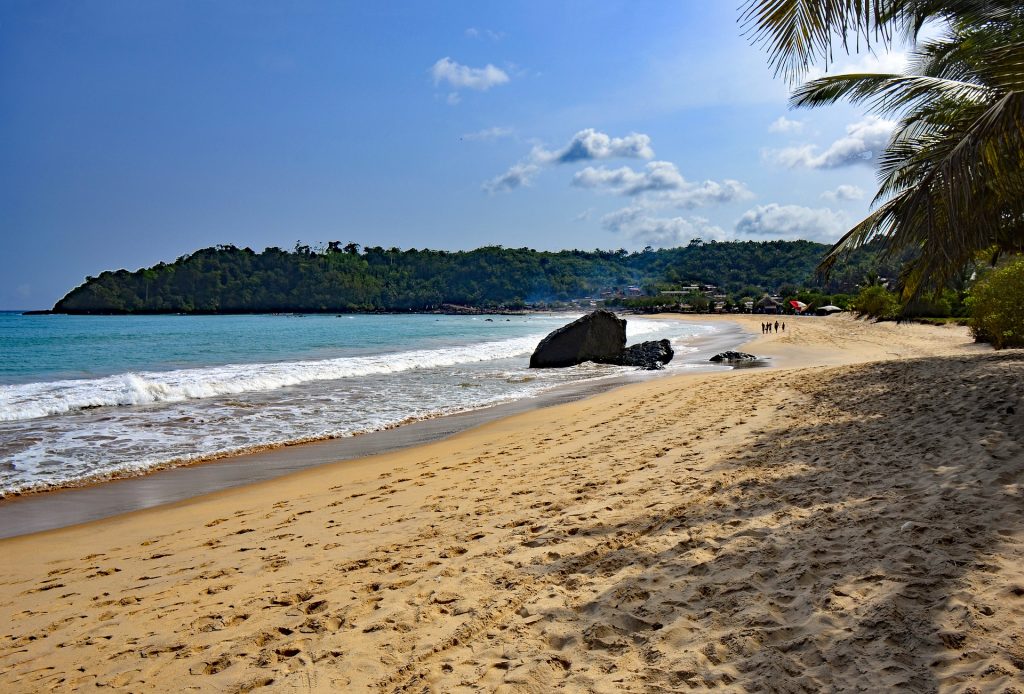
Butre, a village in western Ghana, reflects the country’s appeal to travelers interested in African heritage and connections to the diaspora.
“Many Black people feel as though America is not made for us. We feel discriminated against in so many ways,” said Olumide Gbenro, a Nigerian man raised in the United States.
“And it’s not just the physical abuse necessarily. It’s the mental turmoil of having to prove yourself and overcome stereotypes about intelligence and ability to get the job done.”
Why Some Black Travelers Feel Safer Abroad
Gabby Beckford is a Black and multicultural travel entrepreneur and content creator. As a founding member of the Black Travel Alliance, she noticed growing interest in international travel and relocation among Black Americans.
“For those abroad right now, they’re happy they’re not in the U.S.,” Beckford said at the time. “There’s been a huge push for Black Americans to move, especially to Africa, where we have roots. America is not as it used to be, and there are other countries with other opportunities.”
Several Black digital nomads and travelers told us they felt safer abroad. Some experienced less racism or felt less threatened by it than they had in the United States.
Feeling Less Scrutinized
Latrice Coates was living in Thailand when we interviewed her. She described the emotional burden of monitoring her appearance and behavior in predominantly white settings at home.
“While I am at home, I feel like I constantly have to police myself in order to not be the topic of discussion in a white setting,” she said. “It goes from what I am wearing to what I say and how I speak. My tone, my hair, my attitude.”
Abroad, people openly admired some of the same features that had made her self-conscious in the United States.
“I’ve been told that I am beautiful and that my hair and skin are beautiful,” Coates said. “I get stares abroad as well as I do back at home. However, I feel like the staring is out of curiosity rather than ignorance.”
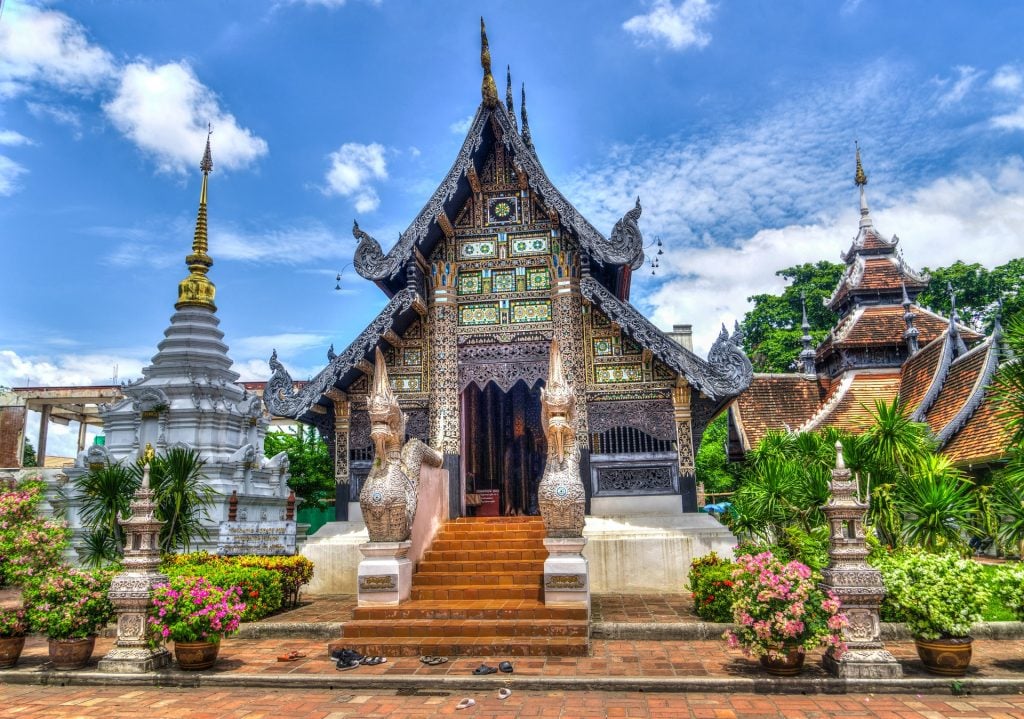
Buddhist temple in Chiang Mai Province, Thailand
The Complicated Privilege of a U.S. Passport
At the time of these interviews, neither Coates nor Ellis had personally faced direct racism abroad. Still, Coates acknowledged that racism existed in other countries. She also noticed that her American identity sometimes changed how people treated her.
“I also believe that my blue passport grants me more grace than anything,” she said. “Once people know that I am an American, the vibe typically switches—a different tone of voice and more willingness to help out.”
Her observation points to a complicated reality. A Black traveler may face racial prejudice while benefiting from the economic or social privilege associated with U.S. citizenship.
Ellis also recognized that racism takes different forms around the world. These include colorism and preferences for lighter skin. However, he distinguished those experiences from the systemic racism he had encountered in the United States.
“In terms of systemic racism, I’ve never felt that anywhere except America,” he said.
While growing up, Ellis endured repeated racism. People called him the N-word and pressured him to end relationships because he was Black. Police stopped him without cause and once surrounded him because he allegedly “fit the description.”
A friend eventually begged him to leave the country.
“I don’t know what I would do if you were killed just for being you,” she told him.
The Vigilance Black Travelers Carry With Them
International travel does not automatically erase the habits Black Americans develop for self-protection.
“I am always conscious of where I go as a Black American,” Coates said. “I am always aware of the spaces that I enter, what I say, where I walk, whom I talk to, what hours of the night I stop for gas and how I speak to the police.”
That awareness follows many Black travelers across borders.
“It is second nature to always look into where I am headed next,” she continued. “It’s embedded in myself and my brothers and sisters to always seek these things while moving abroad and domestically.”
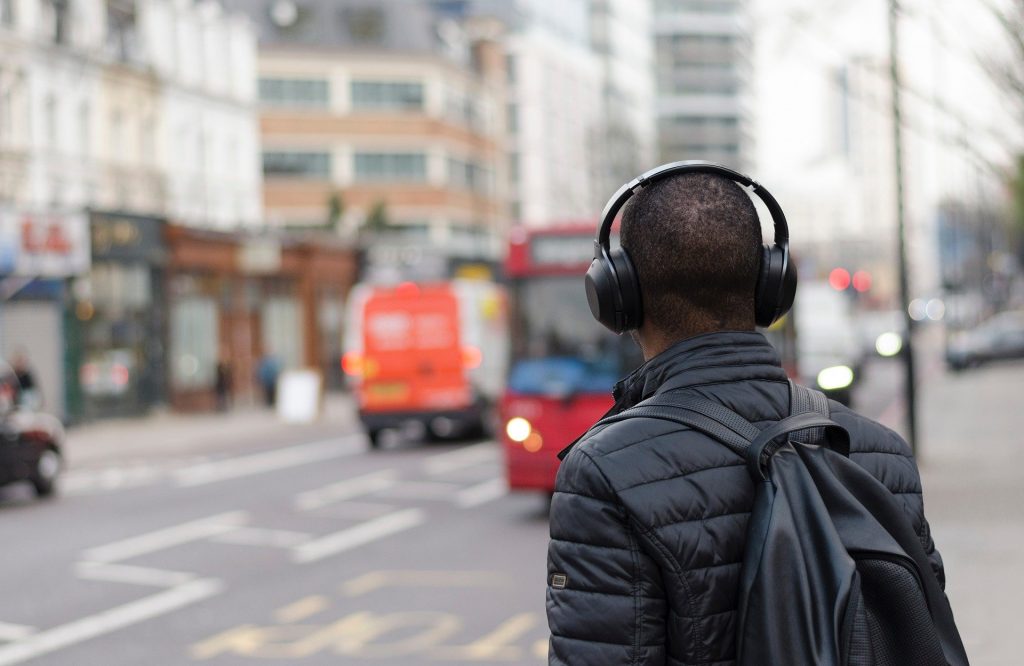
Black travelers interviewed for this story described both greater freedom abroad and a continuing awareness of race and place.
Beckford said the racism she encountered overseas often grew from unfamiliarity and misinformation. In the United States, she faced more deeply rooted structures.
“I have definitely faced more racism in the U.S.,” she said. “Outside the U.S., it’s not as expected or accepted.”
“…While I am abroad and in the countries that I’ve been to, the very things that made me super self-conscious are the things that are praised here…”
Latrice Coates
Racism Does Not Disappear at the Border
Not every Black traveler feels safer outside the United States.
During his first month in Bali, Gbenro said a white foreigner called him the N-word. He described the racism abroad as more direct than the subtler discrimination he had experienced in the United States.
At home, people had followed him through department stores and made jokes about interracial dating.
His experience offers an important reminder: Living abroad does not provide automatic refuge from racism. Prejudice can come from local residents, tourists, expatriates and members of the international nomad community.
Gbenro believes travelers and digital nomads have a responsibility to challenge discrimination.
“I think there’s a danger in thinking because you’ve traveled to 60 countries, you get a pass,” he said.
“I believe travel is the ultimate equalizer because you really see the human condition and how it surpasses what you look like and what skin color you have. I urge remote entrepreneurs who have the influence and impact to use their voice to shine a light on this. Even if it’s not affecting you directly, we need your voice.”
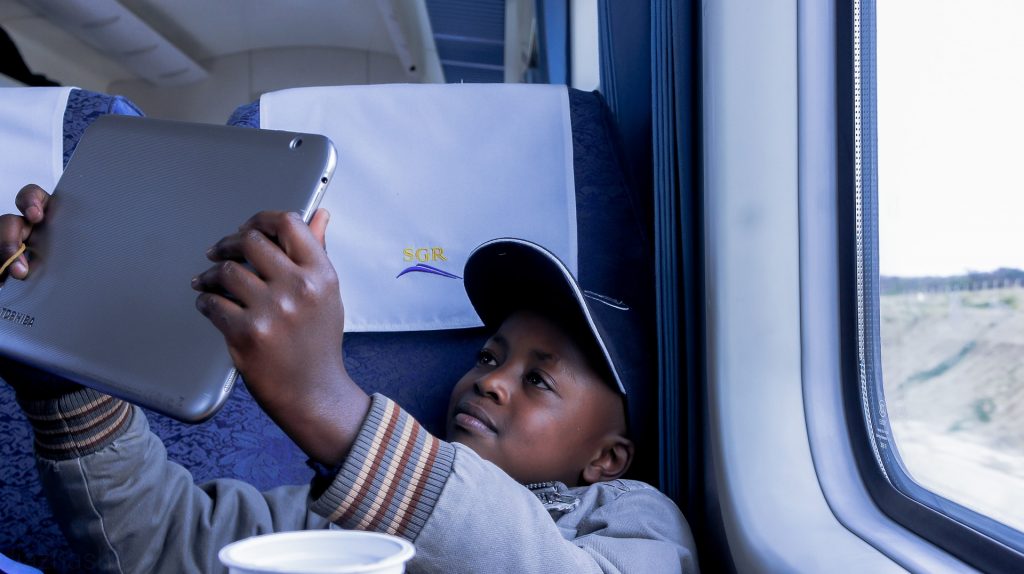
International travel may offer a different sense of belonging, but racism does not disappear when travelers cross borders.
Black Travelers Deserve More Than Tokenism
The racial justice movement forced travel companies to examine how they worked with Black creators.
At the time, Coates helped businesses develop their brands. After Floyd’s murder, several white-owned companies contacted her about collaborations that would diversify their social media feeds.
She declined most of the offers. She said the outreach did not appear genuine and that some companies expected her to work without pay.
Coates accepted one Instagram takeover because it allowed her to control the narrative. She did not want to serve as a face in someone else’s campaign.
Gbenro also considered his responsibilities as a successful Black entrepreneur. Shortly after Floyd’s murder, he organized a Digital Nomad Summit for several hundred people.
“After his death, I thought, ‘Not again. They keep killing us like animals on television screens,’” he said. “I felt disrespected by the nation that I spent much of my life in.”
After reflecting, Gbenro decided to use the event and his influence to encourage other Black entrepreneurs.

Black travelers deserve to be represented enjoying adventure, discovery and everyday moments—not only in stories centered on discrimination.
Why Representation in Travel Matters
Beckford helped establish the Black Travel Alliance to advocate for representation and share the experiences of Black travelers.
People frequently asked why representation mattered in an industry associated with vacations and leisure. Her answer connected travel imagery with the way society understands Black identity.
“It affects systemic racism and mindset in the travel industry and beyond,” she said. “It’s really important to see Black people not just in the context of war, poverty and civil rights actions. We enjoy and deserve luxury.”
Black travelers should not appear only when a story involves struggle, racism or trauma. Images of Black people resting, exploring, celebrating anniversaries and traveling with family also affirm their humanity.
So do images of Black people enjoying luxury, romance and adventure.
“Seeing Black people as humans is just as important as seeing Black people in trauma porn,” Beckford said. “Black people deserve to relax and enjoy our lives.”
We couldn’t agree more.
Read about 20 more Black travel influencers in Essence.
-

- Mombasa, Kenya, represents the destinations and everyday travel experiences that have often been missing from mainstream tourism imagery.

-

- Images of Black travelers experiencing joy, romance and leisure help broaden representation across the travel industry.

Book Accommodations in ANY Destination
Search, compare prices and book your accommodations anywhere in the world.
Join the community!
Join our community to receive special updates (we keep your private info locked.)