

U.S. State Department Travel Advisories: What the Levels and Alerts Mean

U.S. travelers should review current State Department travel advisories and embassy alerts before an international trip.
Posted November 1, 2025
Editor’s Note: This article was updated as of August 2, 2026.
International travel conditions can change quickly. Civil unrest, armed conflict, crime, disease outbreaks and natural disasters may affect a trip before departure or while you are away. For American travelers, one of the first places to check is the U.S. Department of State’s international travel website.
The terminology has changed, however. The department no longer uses “Travel Warnings” and “Travel Alerts” as its two main country categories. In January 2018, it replaced them with a single system of destination-specific Travel Advisories. U.S. embassies and consulates still issue shorter-term alerts and messages about developing events.
What Is a U.S. State Department Travel Advisory?
Every destination receives a Travel Advisory from Level 1 through Level 4. The level reflects the State Department’s assessment of safety and security risks.
Advisories may change when conditions change substantially. This includes situations in which the U.S. government reduces embassy staffing or limits where its employees can travel.
Levels 1 and 2 are reviewed every 12 months. Levels 3 and 4 are reviewed at least every six months. Conditions can change between reviews, so travelers should check the advisory again shortly before departure.
The Four Travel Advisory Levels
Level 1: Exercise normal precautions. This is the lowest level, but it does not mean a destination is risk-free.
Level 2: Exercise increased caution. The destination has increased safety or security risks. Read the full advisory to understand where those risks exist and why.
Level 3: Reconsider travel. The State Department has identified serious risks that should factor heavily into your decision.
Level 4: Do not travel. This is the highest level and signals potentially life-threatening risks. The U.S. government may have limited or no ability to assist during an emergency.
Do not stop at the number. A country may have an overall advisory level but include regions with much higher risks. The page may also describe restrictions placed on U.S. government employees. Those restrictions can offer important clues about where consular help may be difficult to provide.
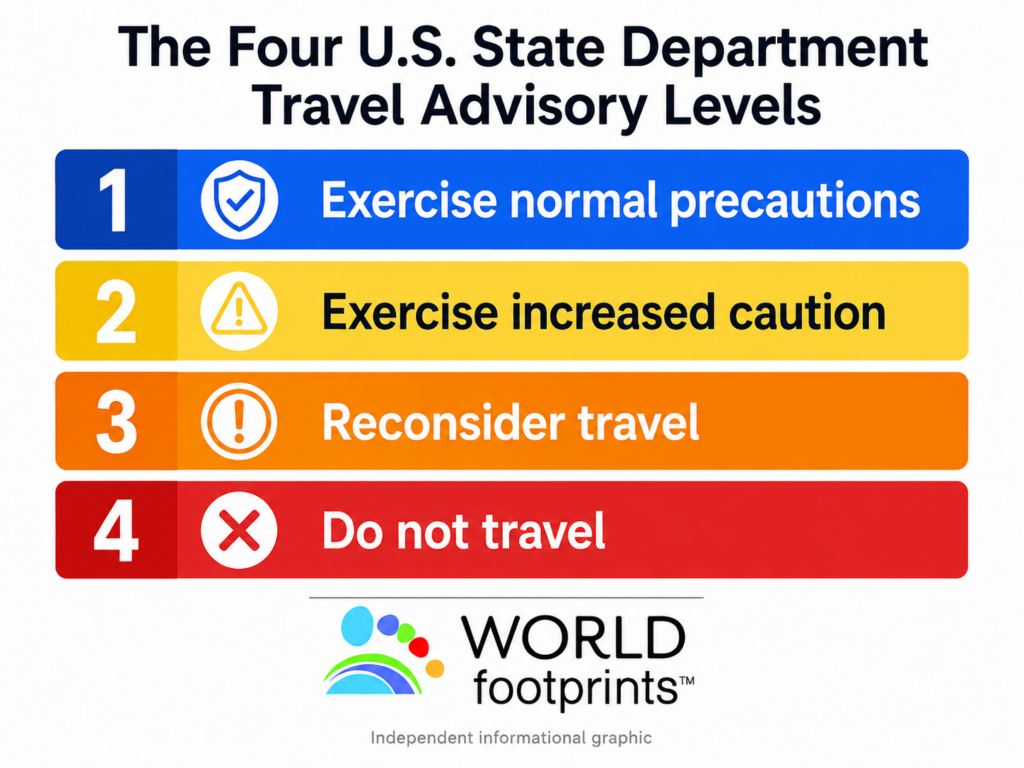
The State Department assigns destinations one of four advisory levels, but travelers should read the full explanation behind each rating.
What Do the Risk Indicators Mean?
Travel Advisories use lettered indicators to explain the concern. The current system has nine:
- Crime
- Terrorism
- Unrest
- Health
- Natural disaster
- Time-limited event
- Kidnapping or hostage-taking
- Wrongful detention
- Other risks
The details matter. Two countries may both be listed at Level 2 for very different reasons. One advisory may focus on crime, while another may identify terrorism, political demonstrations or limited medical care.
How Are Travel Alerts Different?
U.S. embassies and consulates issue alerts about specific or developing conditions. These may include security incidents, demonstrations, health concerns, severe weather, natural disasters or changes in embassy services.
An alert can apply to a city, region or particular event without changing the country’s overall Travel Advisory level. The State Department may also issue a Worldwide Caution or other guidance when a crisis affects several destinations.
Before traveling, review the destination’s full advisory, recent embassy messages and the department’s Global Events Affecting International Travel page.
Enroll in the Smart Traveler Enrollment Program
The Smart Traveler Enrollment Program, better known as STEP, is a free online service for U.S. citizens and nationals traveling or living abroad. It is not an app. Americans considering living overseas should also enroll so they can receive embassy updates and emergency information after they relocate.
After enrolling, travelers receive email alerts and Travel Advisory updates from the U.S. embassy or consulate serving their destination. You can also provide your contact information, itinerary and emergency contact details. This can help an embassy reach you—or your emergency contact—during a crisis.
STEP is an important communication tool, but it is not a substitute for travel insurance or a personal emergency plan. Travelers should know how they would leave a destination if conditions deteriorate. They should not assume that a U.S. government evacuation will be available.
Government advisories provide an important starting point, but they cannot reflect every traveler’s lived experience. Race, gender, disability, sexual orientation and nationality can influence how safe a person feels in a destination. Some Black American travelers say they feel safer abroad than they do in parts of the United States, even when official advisories focus on risks outside the country.
Safety conditions, airspace restrictions and flight schedules can change after a trip has been booked.
A Five-Minute Safety Check Before You Go
Before an international trip:
- Read the entire State Department destination page, not only the advisory number.
- Review recent alerts from the nearest U.S. embassy or consulate.
- Enroll the trip in STEP.
- Confirm what your travel insurance covers, including overseas medical care, evacuation and trip cancellation.
- Share your itinerary and a communication plan with someone you trust.
Americans who need emergency assistance abroad should contact the nearest U.S. embassy or consulate. The State Department can also be reached at 888-407-4747 from the United States and Canada or +1-202-501-4444 from other countries.
A responsible traveler is an informed traveler. Government advisories should not be the only source you consult, but they are an important part of understanding current risks and planning how you will respond if conditions change.
Book Your Travel to ANY Destination
Once you have reviewed current entry, health and safety information, use the interactive map below to search and compare hotels and vacation rentals from several booking platforms. Select your destination from the upper-left corner of the map, then use the filters to narrow your search.
Join the community!

Join our community to receive special updates (we keep your private info locked.)