

The Mangas of Psirri
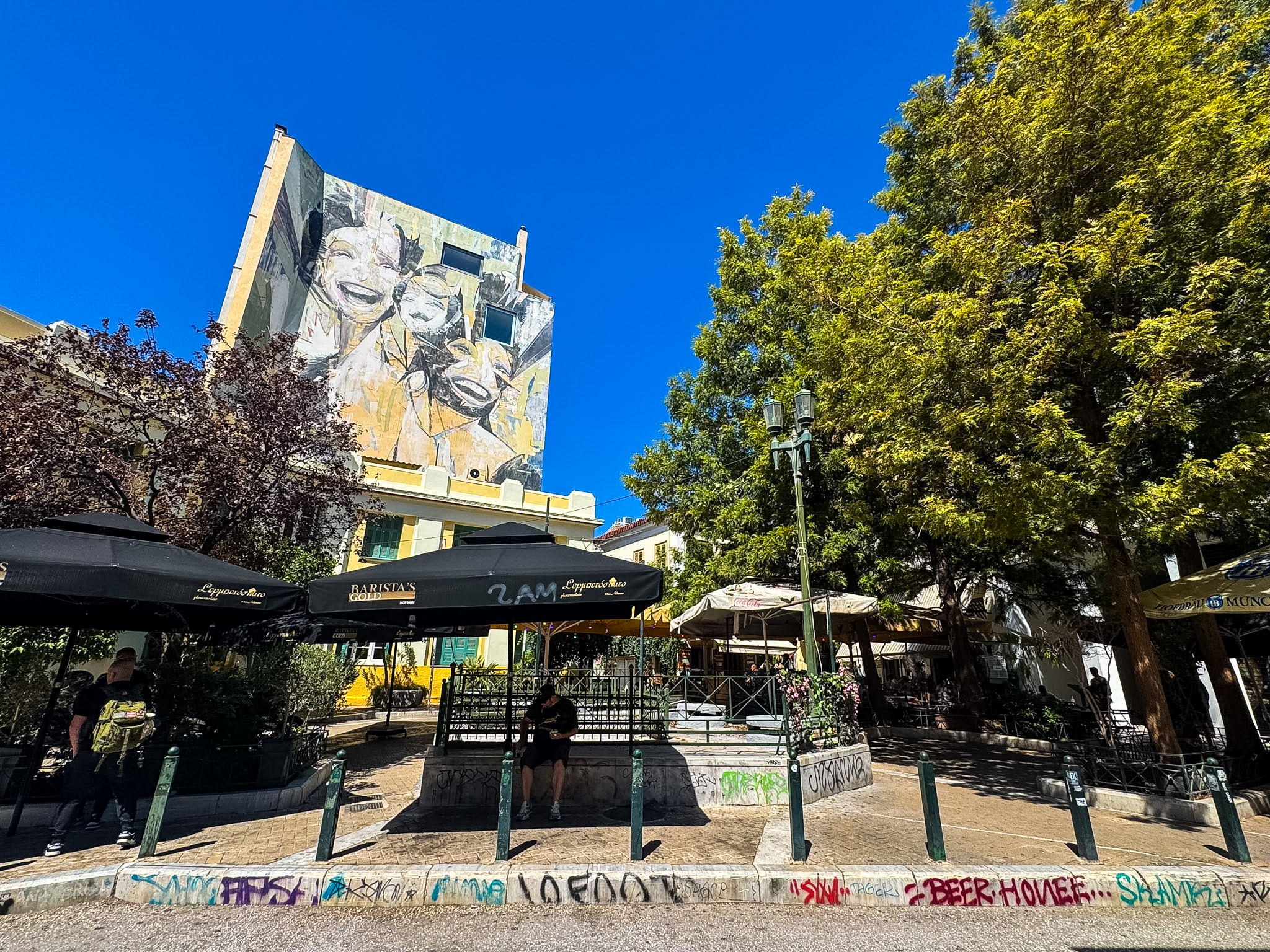
Iroon Square, or Heroes' Square is the vibrant, unofficial center of the historic Psyrri. Photo: Nicholas Kontis
Posted October 8, 2026
If you visit Athens, you’ll more than likely stroll through Psirri, one of the oldest districts of this City of Antiquities. The once-edgy neighborhood took its name from the Psirri family, who purchased many plots of land after moving there during the Turkish occupation from Psara, a small island in the northern Aegean Sea. The historic center, spread around Heroes Square, straddles Monastiraki and Plaka streets.
Lord Byron, the British poet, lived here when he joined other freedom fighters in the 1821 War of Greek Independence against the Ottoman Empire. Alexandros Papadiamantis, considered the “Father of Greek Literature,” shared a spiritual connection with the poor, documenting his experience with Psirri’s working class.
At the boutique Athens Retro Hotel, in the heart of pulsing Monastiraki adjacent to Psirri, I sat down with local chronicler Giorgos Papastefanou to learn more about the historic enclave. The philosophical Papastefanou is an expert on his city’s streets and neighborhoods. He also serves in the presidential guard — the time-honored Evzones.
Famed for their role in the fight for Greek freedom from Ottoman rule two centuries ago, the Evzones still engage in a rigorous nine-month training program, symbolic of that historic struggle. You may see them daily at the changing of the parliamentary guard outside the Presidential Palace in Syntagma Square. “We started with a class of 130, and only 80 passed,” Giorgos recalled. “Of the 80 that survived our unit, only 28 became original Evzones.”
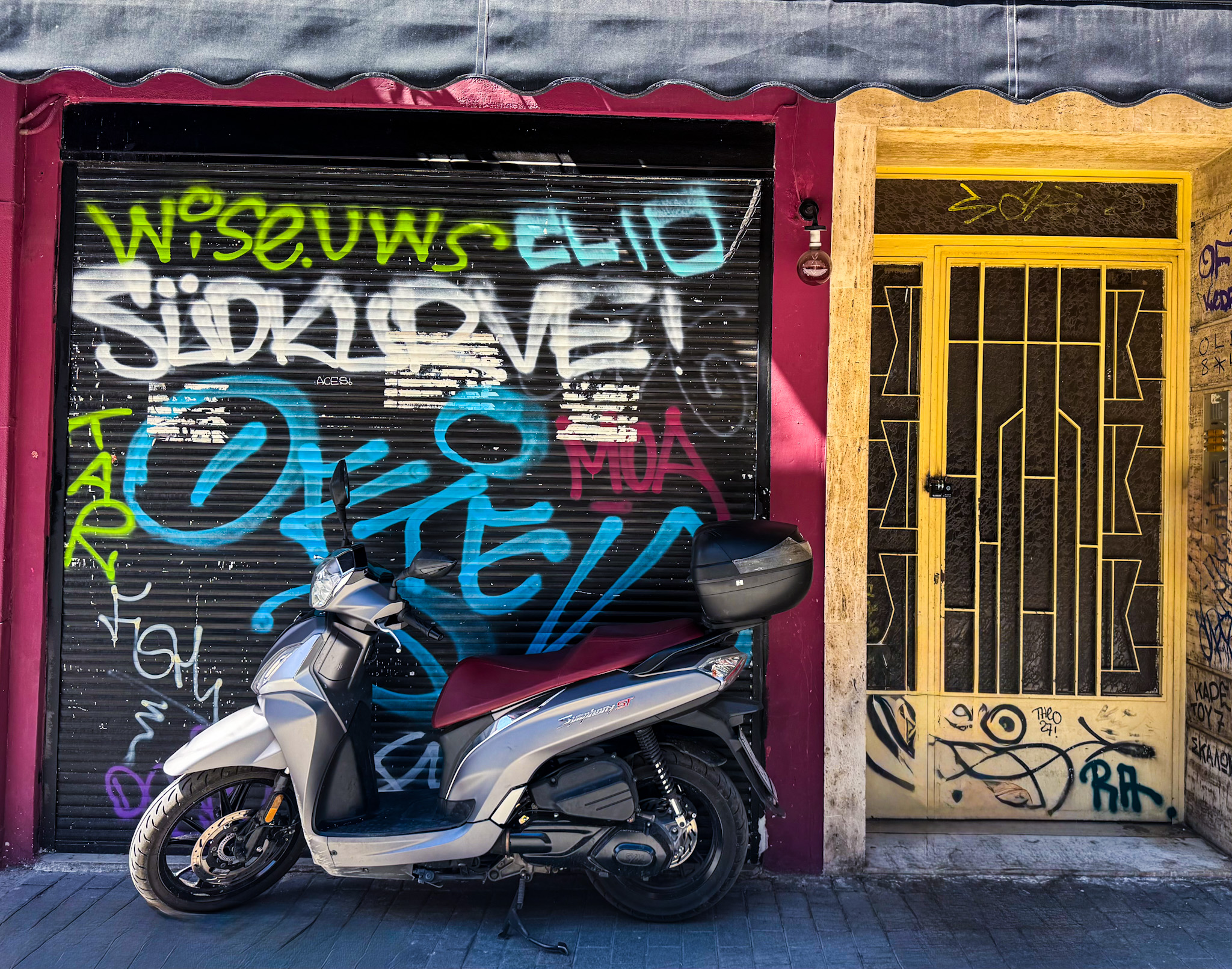
Freedom of expression in the form of raw, expressive murals and graffiti tags that reflect the city’s youth, culture, and socio-political climate. Photo: Nicholas Kontis
The Manga Culture
One night around 11 p.m., when many Americans are getting ready for sleep, I joined Giorgos on a leisurely meander through the streets of Psirri. The restaurants and bars were still lively as we ducked into my companion’s favorite diner, Mavros Gatos (“Black Cat”).
“In the latter half of the 19th century,” Giorgos told me, “Psirri was like a ghetto, with people meeting at the caffenio (coffee shops). The modern restaurants you see today were tavernas and cafes where the Mangas ruled like mafioso. They played bouzouki and other traditional instruments, smoked hashish, drank ouzo, played cards and tavli (Greek backgammon)—and carried knives in their clothes. Whether you liked them or not, you were forced to respect them.”
I learned the word manga during youthful summers in my father’s hometown of Patras, on Greece’s Peloponnese Peninsula. There I often heard the greeting “Ella manga,” which might be translated as “Hey, cool dude!” or “Hey, stud!”
The Former Lifestyle of the Mangas
In the district of Psirri, Mangas are also known as Koutsavakis. They were named for quarrelsome (and colorful) cavalry corporal Dimitrios Koutsavakis, who, Giorgos told me, displayed his street-thug swagger in the post-Ottoman era. The archetypal koutsavak wore a hat with a broad black ribbon symbolizing “sadness” for the murders he may (or may not) have committed. He wore a manica, a jacket with only one sleeve. Its root word — like manga — derives from the same Latin as La Mancha, the English Channel. He wore striped trousers, a double-edged knife (a lazo) through a wide red belt that draped into the street, and a sturdy keraxea, a cherrywood stick useful in beatings.
If an innocent passerby stumbled over the belt, the koutsavakis would punish him — hence the phrase, “He has his belt loosened for a fight.” Another saying, “They took us with lemon cups,” came from the practice of provoking a dispute by tossing a lemon cup at the pedestrian. Picking up the cup accepted the challenge, and a lemon knife would magically appear from the café table.
Wearing a single high-heeled shoe assured that Mangas walked with a distinctive limp that mimicked injured survivors of the revolution of 1821. They dragged their steps and roamed Psirri like tragic caricatures of heroes (thus, Heroes Square). The younger Koutsavak “dudes” imitated the slow, labored walking of the old soldiers as a sign of bravery.
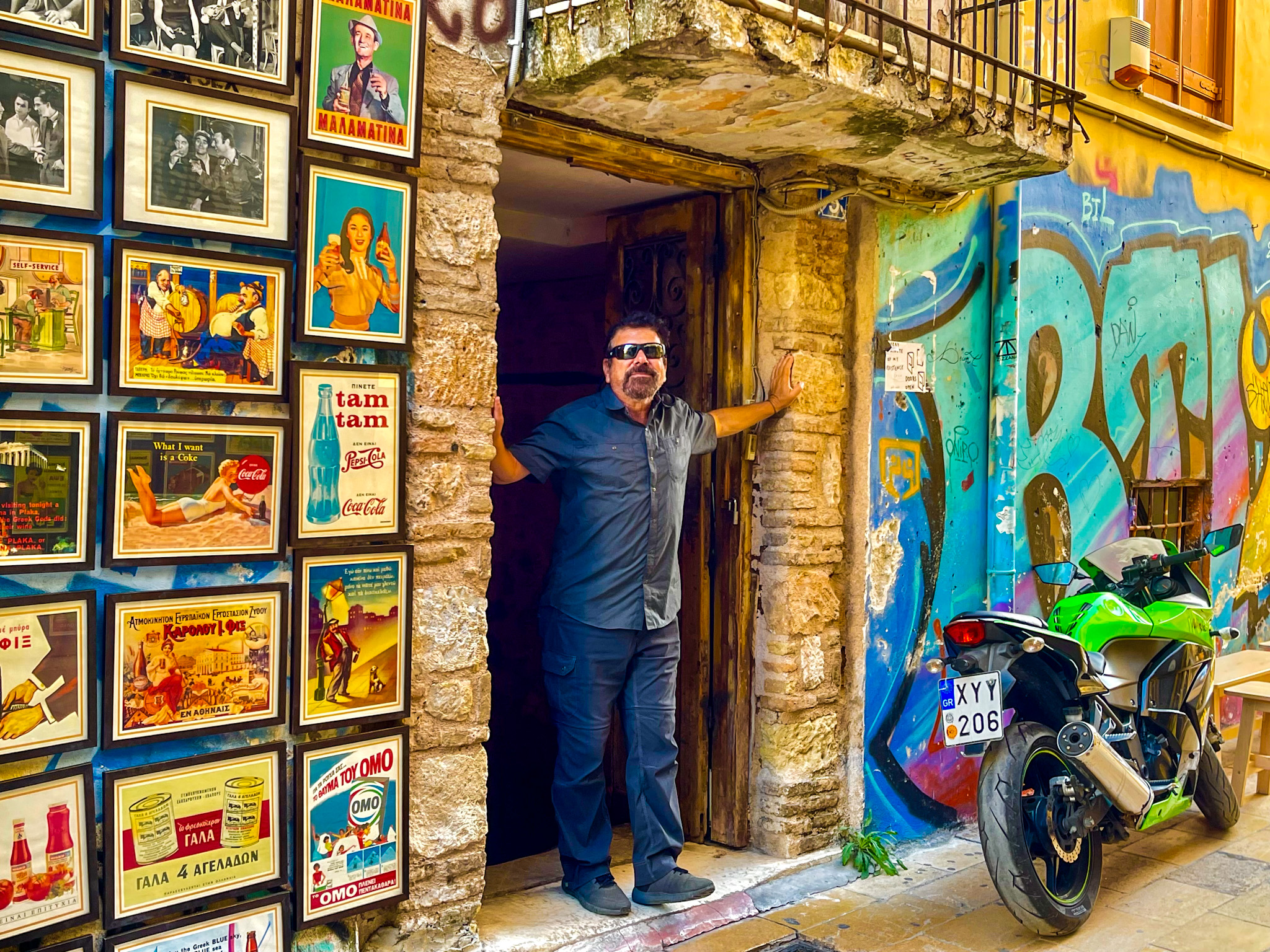
Author standing in a doorway in Bohemian Psyrri. Photo Courtesy of Nicholas Kontis
A Different Era
In a neighborhood of thugs, including ex-convicts, murderers, and drug addicts, unaccompanied women were inevitably perceived to be prostitutes. A woman would never be seen in a tavern without a man or other family members. Even police officers used caution when entering the rough-and-tumble streets. At the time, walking the quarter and crossing paths with the ruling Mangas often led to danger. Today’s beloved bouzouki was decried by the average citizen as a forbidden instrument, its bluesy strains played by the lower classes and a part of the drug counterculture of street gangs.
The Koutsavakia were officially discredited in the late 1890s. Famous Police Director Dimitrios Bayraktaris discredited them. But fully eliminating the subculture took longer, as many Koutsavakia lived into the 20th century.
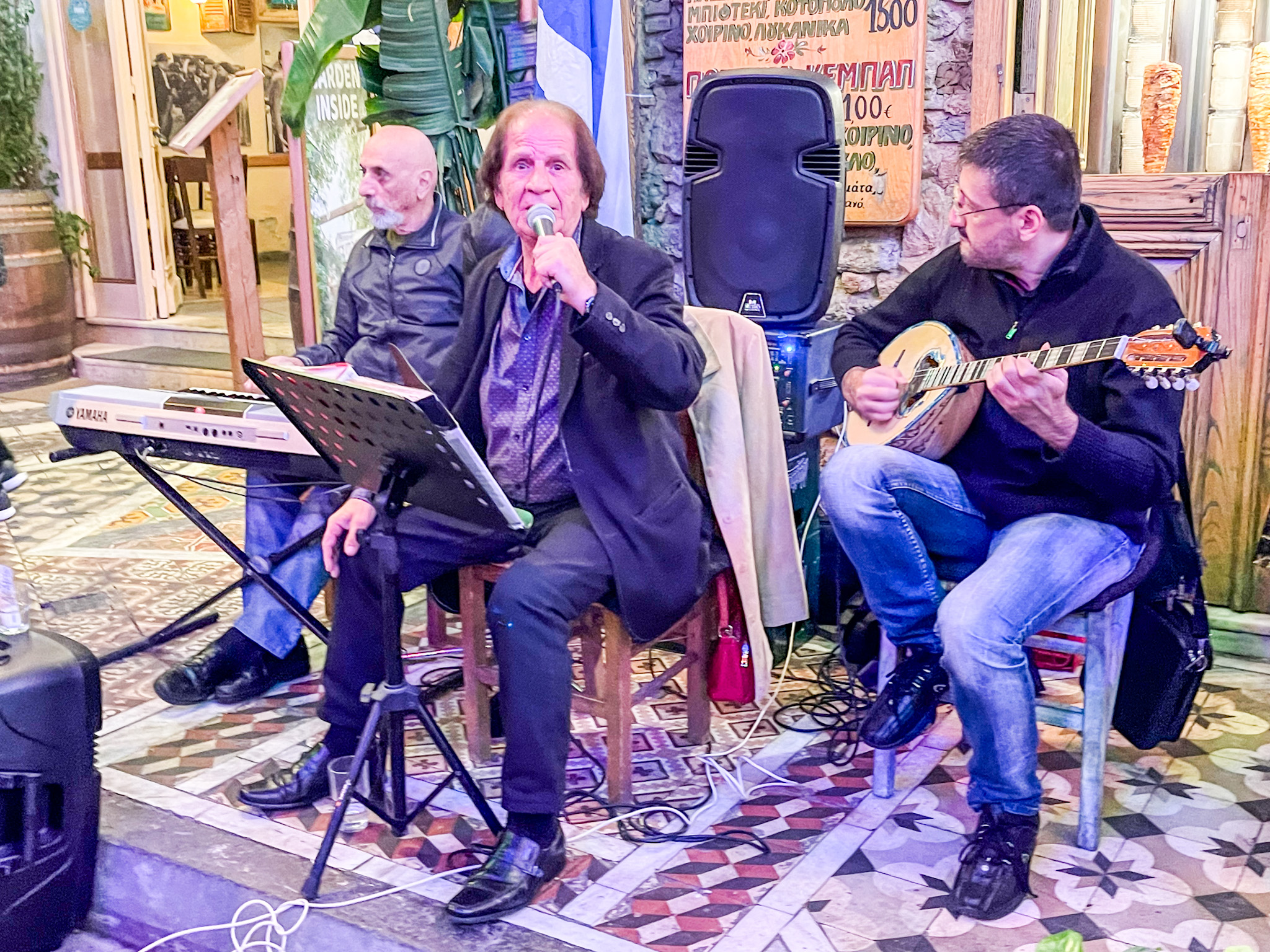
Live music is commonplace in vibrant Psirri. Photo: Nicholas Kontis
Today’s Psirri
Modern Psirri changed significantly in the decades since 2000. Bars began to emerge. Rapid development ensued, encompassing tourism and the arts. While some hooligan teenager gangs attempted to replicate the Manga lifestyle, the ghosts of the Koutsavakis could not withstand modern times and gentrification. Slowly, dilapidated structures converted into boutique hotels and Airbnbs. Now, the raucous early-morning noise from bars, cafes, and restaurants merely serves contemporary tourism.
As Giorgos and I walked back to the Athens Retro Hotel at 2 a.m., my friend left me with this thought: “Imagine, 100 years ago, you could not walk down these streets. What was once one of the world’s most dangerous ghetto neighborhoods is now a tourist attraction and one of the world’s most visited places.”
Click here for discounted accommodations in Psirri
Join the community!

Join our community to receive special updates (we keep your private info locked.)

