

Khao Sok National Park: Ancient Rainforest Older Than the Amazon
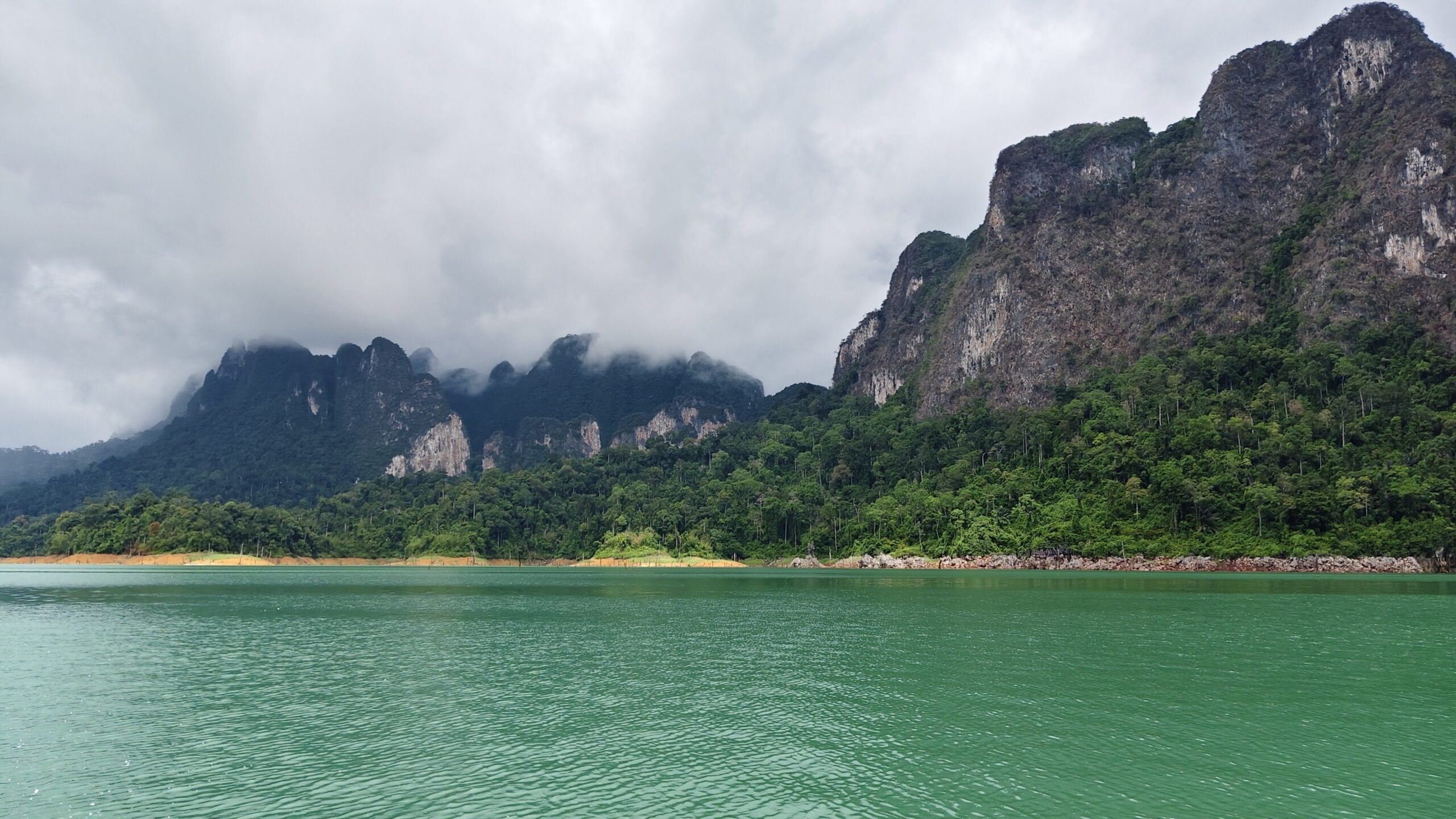
Khao Sok National Park is an ancient rainforest older than the Amazon. Photo: Teh Chin Liang
Posted November 16, 2026
“Going to the Ratchaprapha Dam?” The driver asked with doubt in his voice, as though he might have picked up the wrong passenger.
“It’s Cheow Lan Lake. The lake. A boat tour.” I was pretty sure it was a lake. But the driver’s face made me wonder if I might be on the wrong bus.
As the bus coasted down the mountain road, squeals from the tires broke the forest’s silence whenever the driver slammed on the brakes. At the turn of a corner, the tunnel of green gave way to a sprawling body of water, opening into a sweeping emerald panorama.
At that moment I realized the driver and I had been talking about the same place. Cheow Lan is a man-made reservoir, not a natural lake.
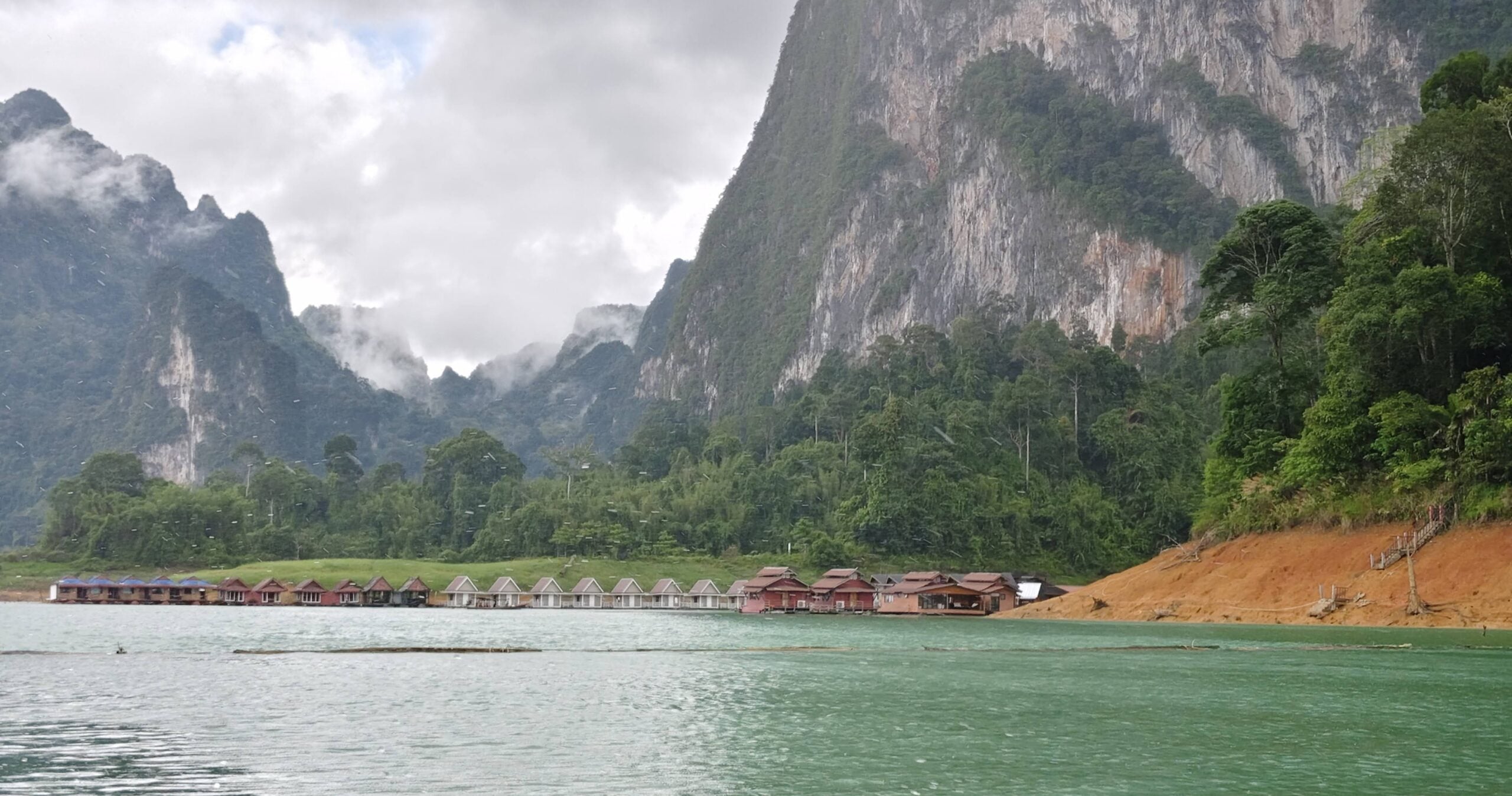
Water bungalows line up across the lake under towering limestone mountains. Photo: Teh Chin Liang
Older Than the Amazon
At 285 square miles, Khao Sok National Park in southern Thailand is a 160-million-year-old rainforest, older than the Amazon.
The wilderness is not completely untouched. In the early 80s, the government built a dam to generate hydroelectric power and to drain the floodwater. Out of it emerged a new landmark: Cheow Lan Lake.
Ancient Rainforest Cruise
You really can’t come to the national park without taking the Cheow Lan Lake boat tour. The tour takes about six hours. Most people stay in the park village to join the tour. Guesthouses and forest lodges provide lodging options. But I decided to skip the village and take the day tour from the nearby city, Surat Thani.
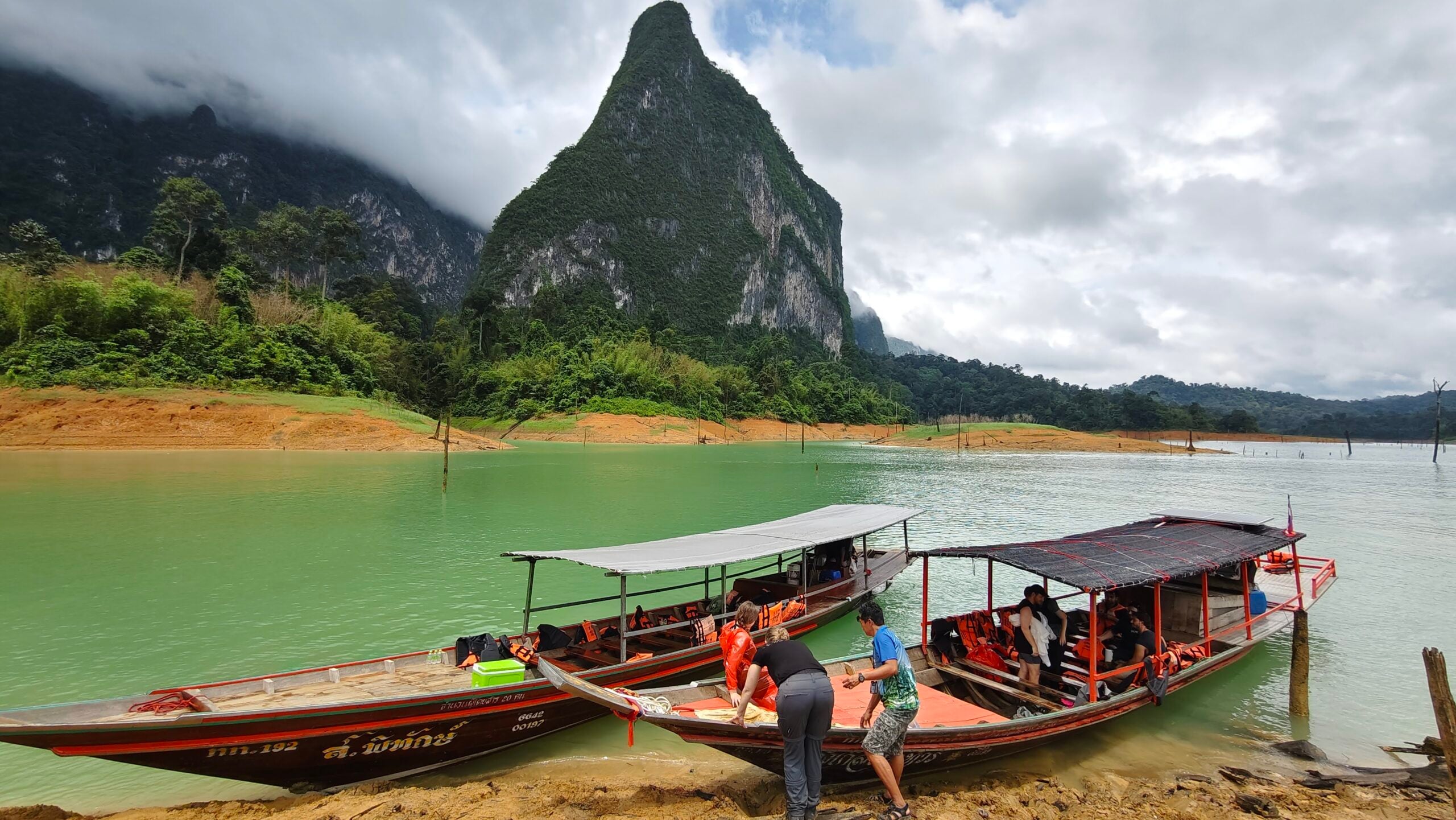
Long‑tail boats pull up to a jungle trailhead. Photo: Teh Chin Liang
Limestone Karsts Dominate the Landscape
The tour started with a long-tail boat ride. The boat zipped past limestone karsts in all their rugged shapes, rising haphazardly out of the emerald‑green water. The distinct emerald color comes from calcium carbonate leaching out of the limestone.
On the precipitous limestone cliffs, vertical walls of trees clung precariously to the rock face, dangling down like a hanging forest, as if nature were pulling off an acrobatic stunt. Fog rolled by and blanketed the peaks, at times dissipating to reveal a peek at the mystic cascading range behind.
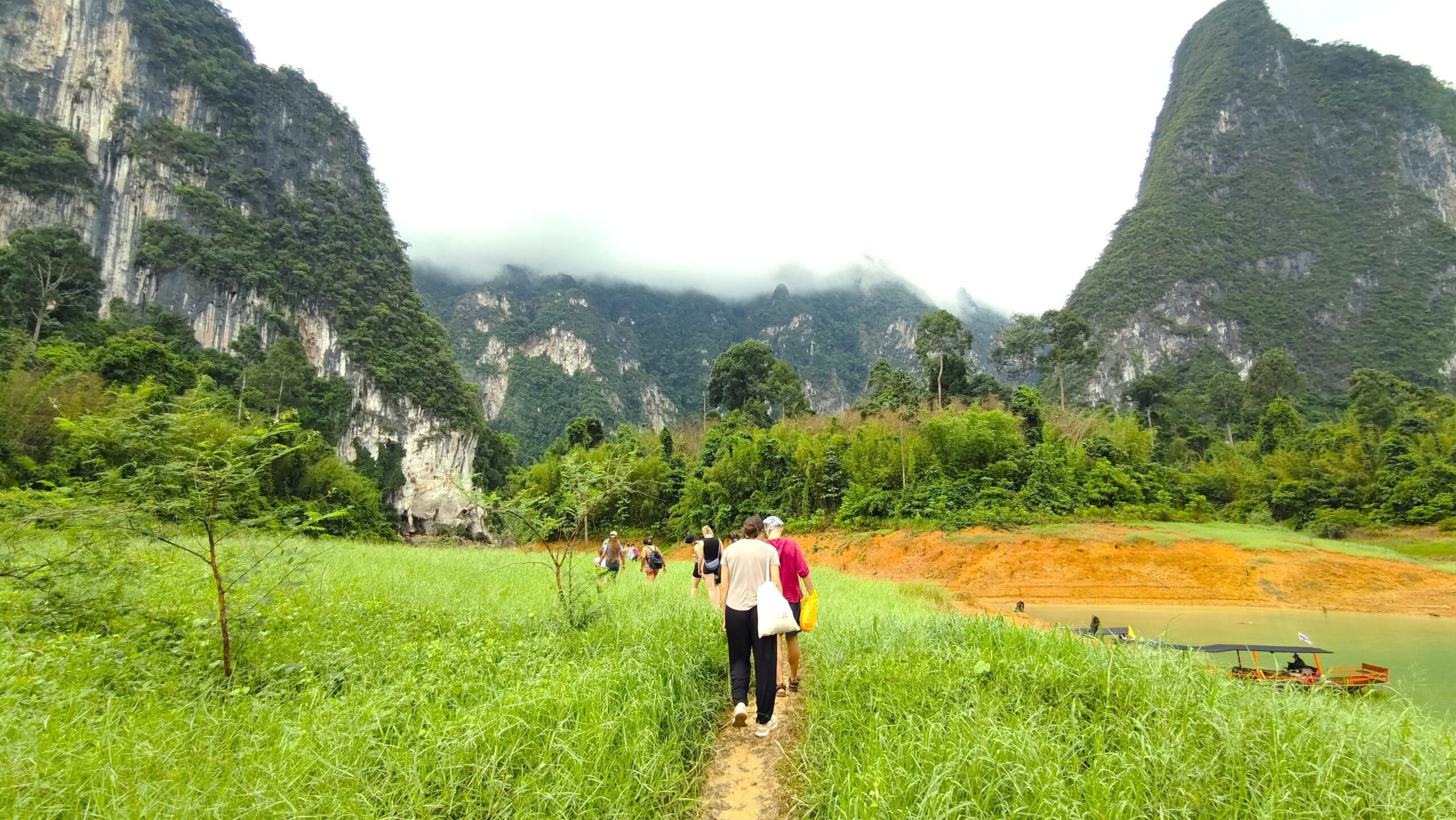
People hike the forest trail to the Diamond Cave. Photo: Teh Chin Liang
Educational Rainforest Trek
The boat pulled up to a trailhead, and from there we started an easy jungle trek. Our first stop was a towering banyan tree; its muscular trunk strangled by twisting roots. The tree looked like giant legs wide splaying on the jungle floor. The fog added a misty fairy-tale mood to the scene.
Calling a banyan “fairy-tale-like” might sound hokey. The tree presents more like a symbol of spiritual significance.
“The banyan tree is highly respected in the Buddhist tradition. It is sacred for monks to meditate under it,” The tour guide said.
The sound of trickling water hinted that a waterfall awaited right ahead. The water gushed over the rocky terrace into a plunge pool. We followed the tour guide’s gaze toward a school of small fish darting beneath the water.
“These are freshwater tiger barbs,” our tour guide noted. “We don’t eat tiger barbs. Too many bones! But if you ever get lost in the jungle, you can eat it to survive!”
We trekked to a bamboo grove. The guide walked up to a bamboo stalk and gave it a shake. The sloshing sound means there is water inside that you can drink in an emergency.
“But watch out if you see a hole in the stalk,” the guide said. “It is a telltale sign that a snake or its eggs are inside.”
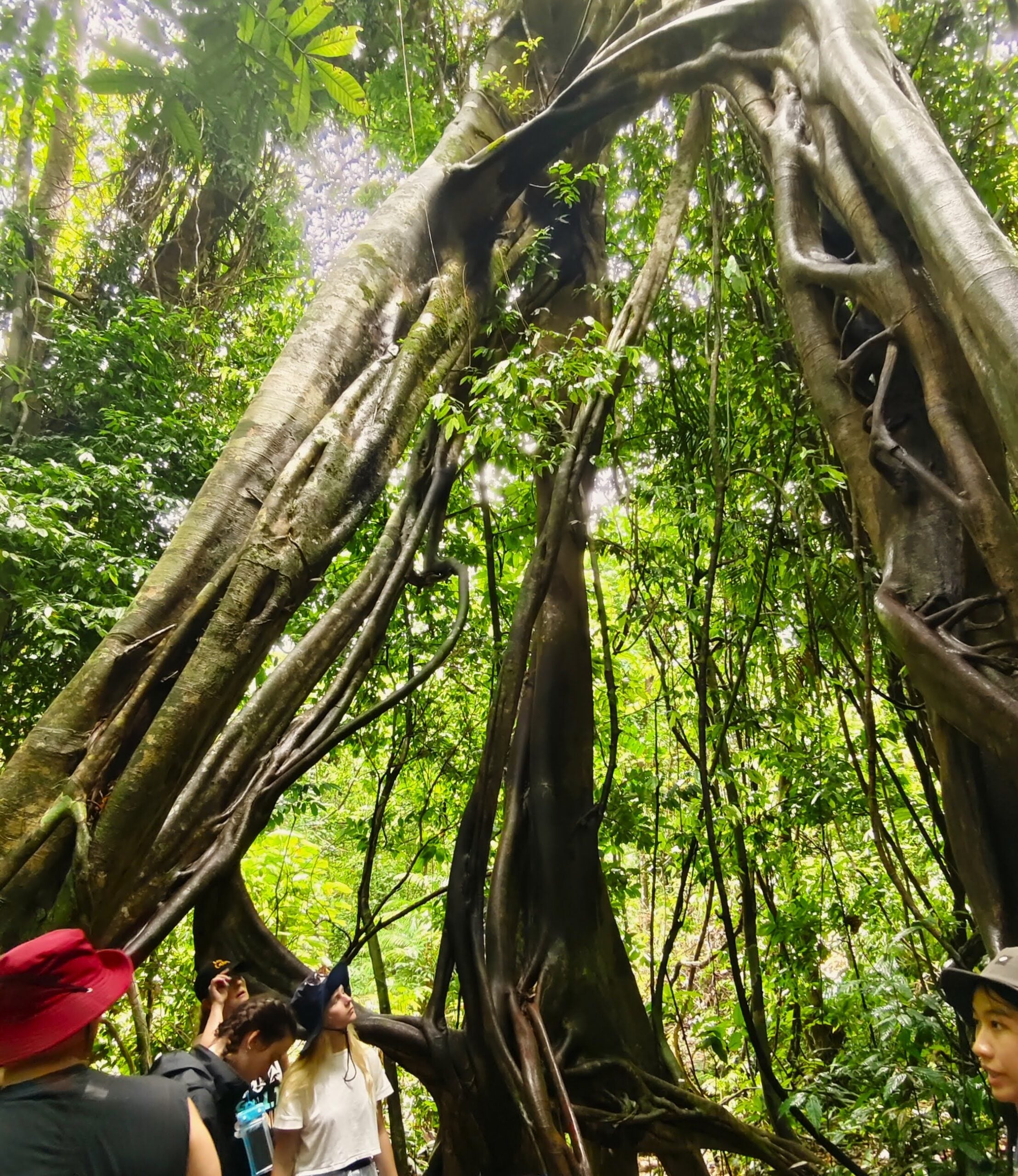
A banyan tree towers above the forest canopy. Photo: Teh Chin Liang
Edible Insects: Thai Snacks
Sometimes, bamboo worms can be found inside the stems. They are edible. At the night markets in Thailand, these small caterpillar‑like worms become deep‑fried crispy snacks.
Cicadas provide another crunchy snack that locals claim to be high in protein. The tour guide picked up a shed of cicada hanging from the tree bark. “Cicadas are “drama insects”,” the tour guide continued, pointing to the translucent exoskeleton. “Why drama? Because they hide underground for up to 10 years, then come out to shed their skins, and not long after that, they die.”
On the way back to the boat, we walked past a nest of termite mounds, standing like randomly sculpted mud cones. “Back in my hometown in Northern Thailand, people eat winged termites,” our tour guide shared. “Termites are drawn to light. Locals put bowls of water under the lights, and the insects drop in. Then they roast or deep‑fry them and sprinkle with salt.”
The Cave Shines Like a Diamond
After the jungle trek, we took the boat to the Diamond Cave. The cave gets its name from the rock formations–stalactites and stalagmites–which catch the light and shine like diamonds.
The cave entrance opens into passages that grotesquely splinter into chambers that would put your tolerance for claustrophobia to the test. We strapped headlamps to our foreheads and threaded our way through the tight chambers. Each chamber showcases unique formations that spark the imagination. In one chamber, a rock looked like a crocodile crawling out of the cave wall.
We edged down over the uneven, rocky slabs. We made certain to keep our hands off the walls as they seemed to close in on us. “Try not to touch the cave walls or the rock face,” our guide warned. “There are bats in here. Some could carry viruses.”
One of the coolest things to see is a stalactite and stalagmite halfway fused into a column. This happens when water, dripping from the top, leaves behind bits of rock that dangle downward. The same drops hit the cave floor, pile up, and grow upward. For both rocks to fuse together, it takes tens of thousands to hundreds of thousands of years!
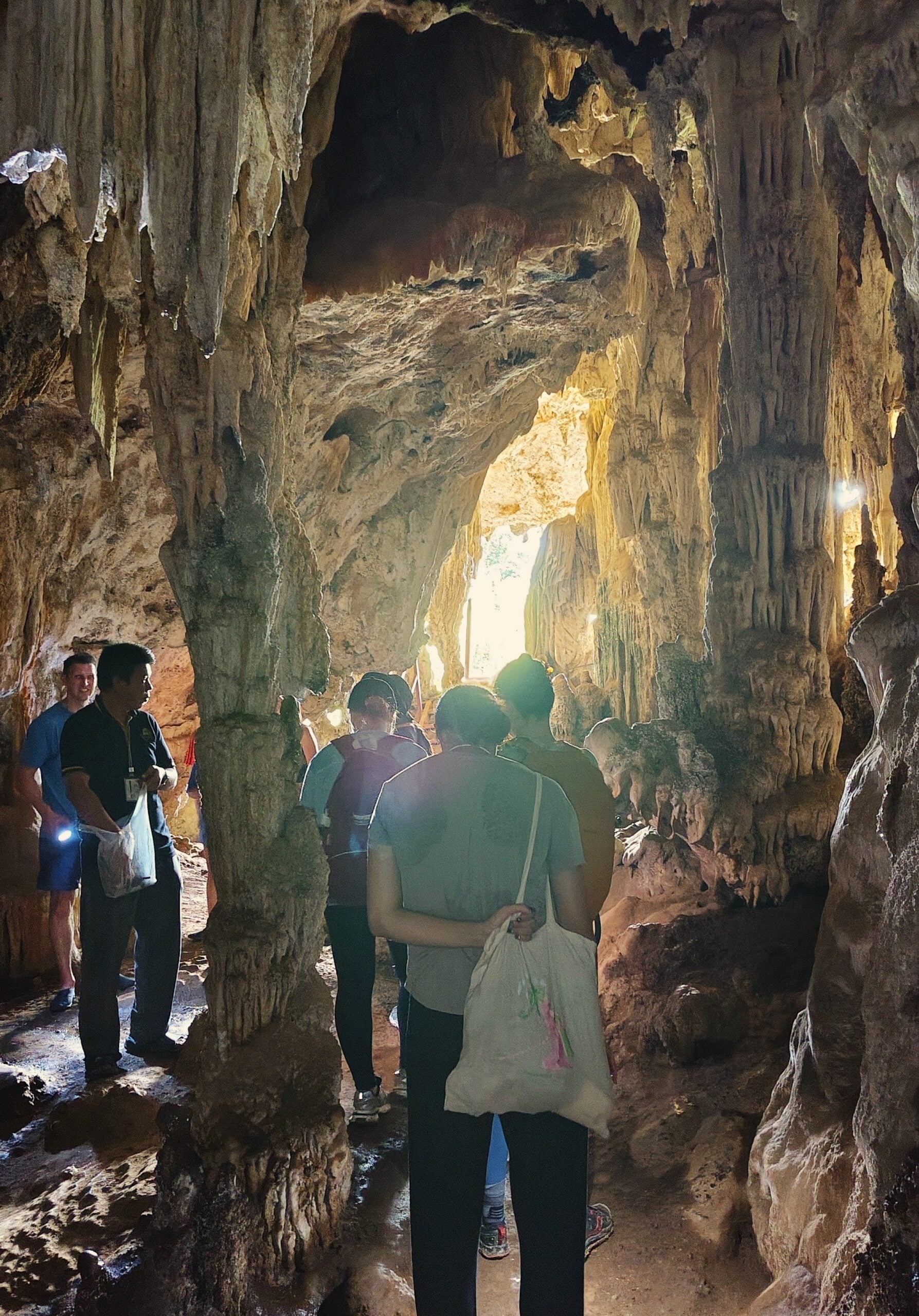
Stalactites and stalagmites in the Diamond cave. Photo: Teh Chin Liang
Floating Wilderness Retreats
A simple Thai lunch was served to the tour group at the floating bungalow after the cave exploration. On the way to the bungalow, the boat pulled in close to the iconic “Three Brothers” rocks. These three limestone pillars, standing in a perfect triangle, are Khao Sok’s signature landmark and can be found on most souvenirs and postcards.
The bungalows were in sight in the distance, but the rain started beating down sideways, pelting us from all directions. The ponchos did nothing to keep us dry. We seemed close to the shelter, yet too far.
“Next time, come during dry season. December to April,” the tour guide suggested, turning to us as we sat there soaking wet.
At the bungalow, the rain reduced to drizzle. Some people took the paddle board out to the water, and some plunged in for a quick dip.
Through the soft patter of the rain, I could still hear the distant hoots of gibbons, the hum of insects and the splash of fish breaking the water. A natural symphony worth losing yourself in. After all, these primal rhythms have echoed the ancient pulse of this rainforest for millions of years.
Click here for discounted accommodations across Southern Thailand
Join the community!
Join our community to receive special updates (we keep your private info locked.)

